
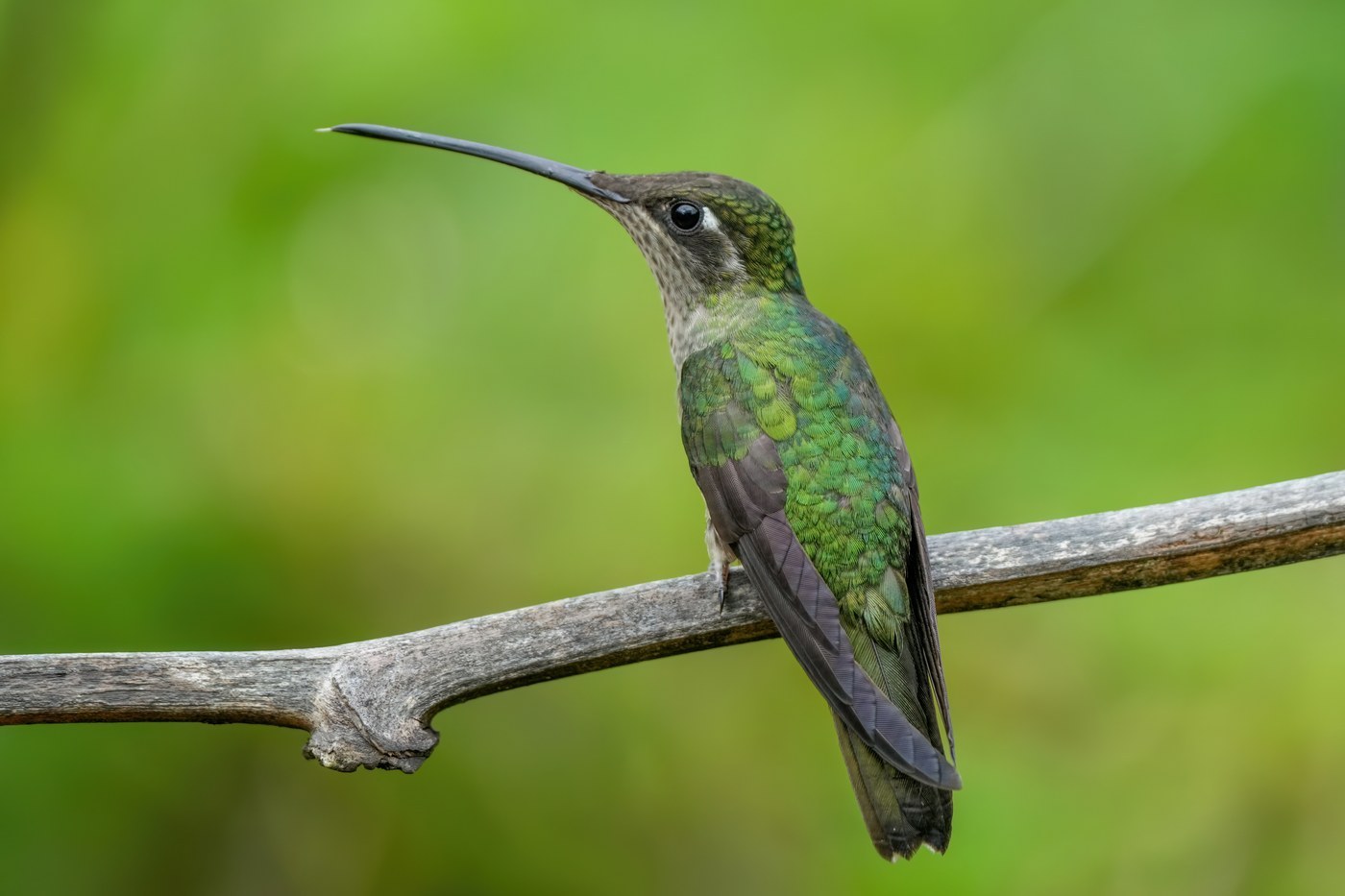
Rivoli's Hummingbird
Eugenes fulgens
One of the largest hummingbirds found in the United States, with a male whose head glitters violet and green against an otherwise dark body.
- Size
- 11-14 cm (4.5-5.5 in) long, 17-18 cm wingspan
- Habitat
- montane pine-oak forest and shaded canyons
- Type
- hummingbird
Spotted a bird like this?
Identify any bird from a photo, free.
Overview
Rivoli's Hummingbird, formerly known in North America as the Magnificent Hummingbird, is a large, robust hummingbird of mountain forests along the U.S.-Mexico border. Adult males appear mostly blackish at a distance, but at close range and in good light reveal a glittering emerald-green throat and a violet-blue crown, set against a dark green body. Females are considerably plainer, with a green back, grayish underparts, and a pale grayish throat lacking iridescence.
Its large size relative to most North American hummingbirds, combined with its preference for shaded mountain canyons, makes it one of the specialty birds sought out in the sky island mountain ranges of the Southwest.
How to identify it
Key Field Marks
- Notably large hummingbird, appearing dark or blackish at a distance
- Male: glittering green throat, violet-blue crown, otherwise dark green body
- Female: green back, gray underparts, plain pale throat
- Slightly decurved, long black bill
Similar Species
- Blue-throated Mountain-gem is similarly large but shows broad white tail corners and bold white facial stripes, which Rivoli's lacks.
- Black-chinned and Broad-billed Hummingbirds are both considerably smaller.
- Female Rivoli's are best identified by large size and plain gray throat in combination with mountain canyon habitat.
Habitat & range
Habitat
This species favors shaded, humid pine-oak and fir forest canyons, often near streams, at moderate to high elevations in its limited U.S. range.
Range
In the United States it is found mainly in the mountains of southeastern Arizona, southwestern New Mexico, and the Chisos Mountains of west Texas, with a much broader range through the highlands of Mexico and Central America south to Nicaragua.
Migration
U.S. populations are largely summer visitors, arriving in spring and departing south into Mexico by autumn, though it is a year-round resident farther south in its range.
Behavior & voice
Behavior
Males defend rich nectar sources in shaded canyons and can be seen chasing off both rival hummingbirds and other species from favored flowering shrubs or feeders.
Voice
Calls include a sharp, high-pitched "chip" or "tsip," often repeated in a rapid series during chases.
Feeding
Rivoli's Hummingbirds feed on nectar from a variety of native mountain flowers and readily visit hummingbird feeders, along with catching small insects on the wing.
Nesting
Females build a large, deep cup nest of moss, bark strips, and spider silk, usually saddled on a sheltered branch in a shaded canyon.
Frequently asked questions
Why was the Magnificent Hummingbird renamed Rivoli's Hummingbird?
Taxonomists split the former Magnificent Hummingbird into two species based on differences in size, voice, and range; the northern population retained the older name Rivoli's Hummingbird.
Where can you see a Rivoli's Hummingbird in the United States?
It is a specialty of shaded mountain canyons in southeastern Arizona, southwestern New Mexico, and the Chisos Mountains of west Texas.
How big is a Rivoli's Hummingbird compared to other hummingbirds?
It is one of the largest hummingbirds found in the U.S., noticeably bulkier and longer-billed than familiar species like the Ruby-throated or Black-chinned Hummingbird.
What does a male Rivoli's Hummingbird's colorful head look like?
In direct light it shows a glittering emerald-green throat and a violet-blue crown, though in shade or at a distance the head can look almost entirely black.
Rivoli's Hummingbird guides
In-depth guides for identifying, finding, and understanding Rivoli's Hummingbird.
Other birds you may enjoy
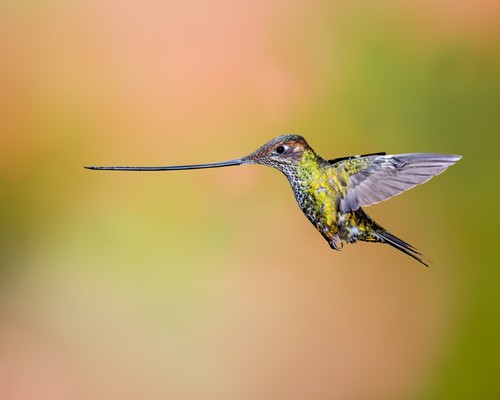
Sword-billed Hummingbird
Body about 13-15 cm (5-6 in) including a bill up to 10 cm long, the longest bill relative to body size of any bird
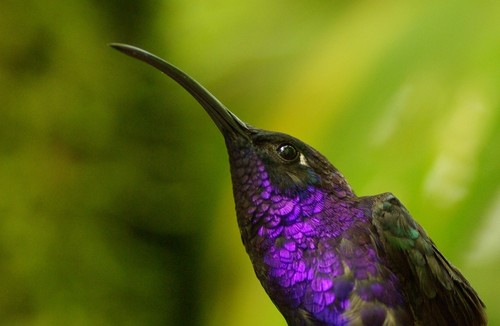
Violet Sabrewing
14-15 cm (5.5-6 in) long
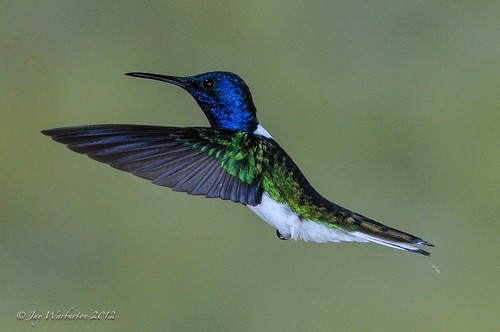
White-necked Jacobin
11-12 cm (4.3-4.7 in) long
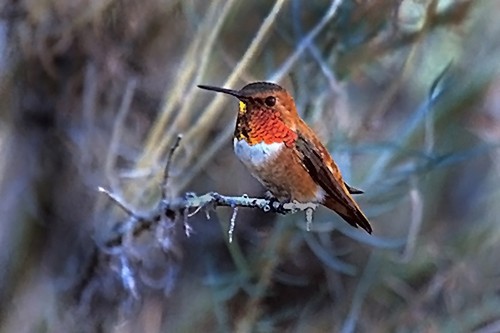
Rufous Hummingbird
8-9 cm (3-3.5 in) long, 11 cm wingspan
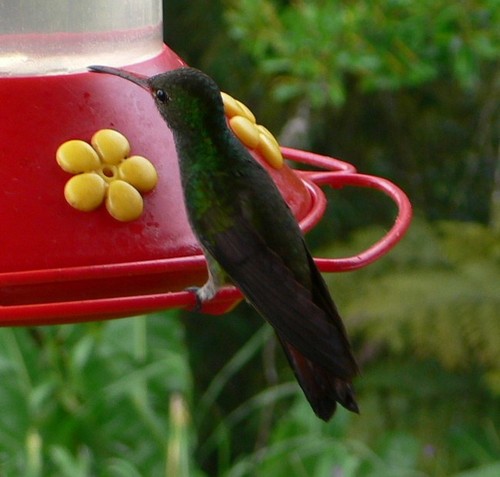
Rufous-tailed Hummingbird
10-11.5 cm (4-4.5 in) long
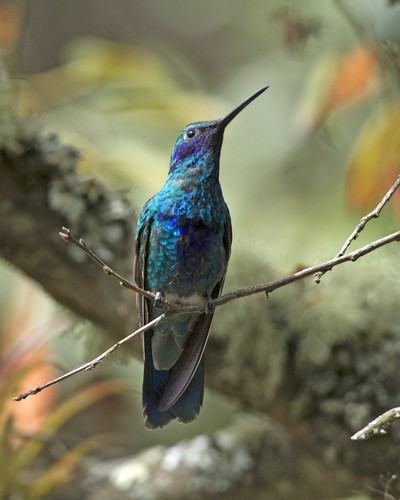
Sparkling Violetear
13-14 cm (5-5.5 in) long including bill
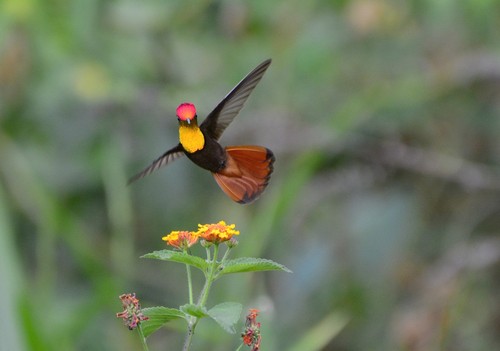
Ruby-topaz Hummingbird
7.5-9 cm (3-3.5 in) long
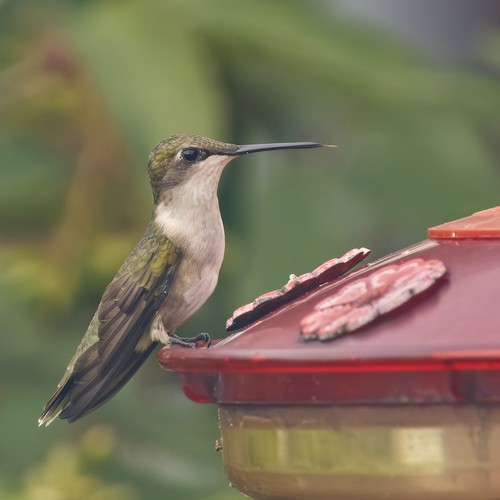
Ruby-throated Hummingbird
7-9 cm (3-3.5 in) long, 8-11 cm wingspan
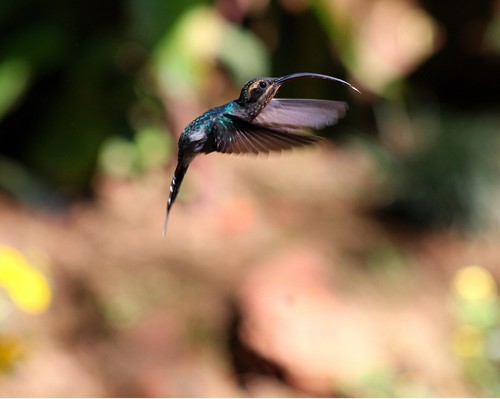
Green Hermit
15-16 cm (6-6.3 in) long including elongated central tail feathers
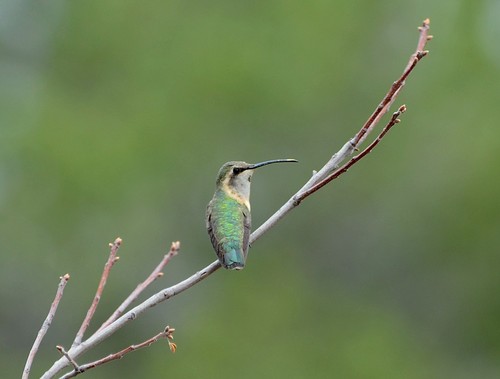
Lucifer Hummingbird
8.5-9.5 cm (3.5 in) long, 11 cm wingspan
Long-tailed Sylph
males 18-19 cm (7-7.5 in) including tail; females 9-10 cm (3.5-4 in)
Giant Hummingbird
20-23 cm (8-9 in) long, largest hummingbird species in the world