
Rivoli's Hummingbird Identification Guide
A large, big-billed hummingbird of southwestern mountain canyons, with males flashing an emerald throat and violet crown in good light.
Read the full Rivoli's Hummingbird encyclopedia entry →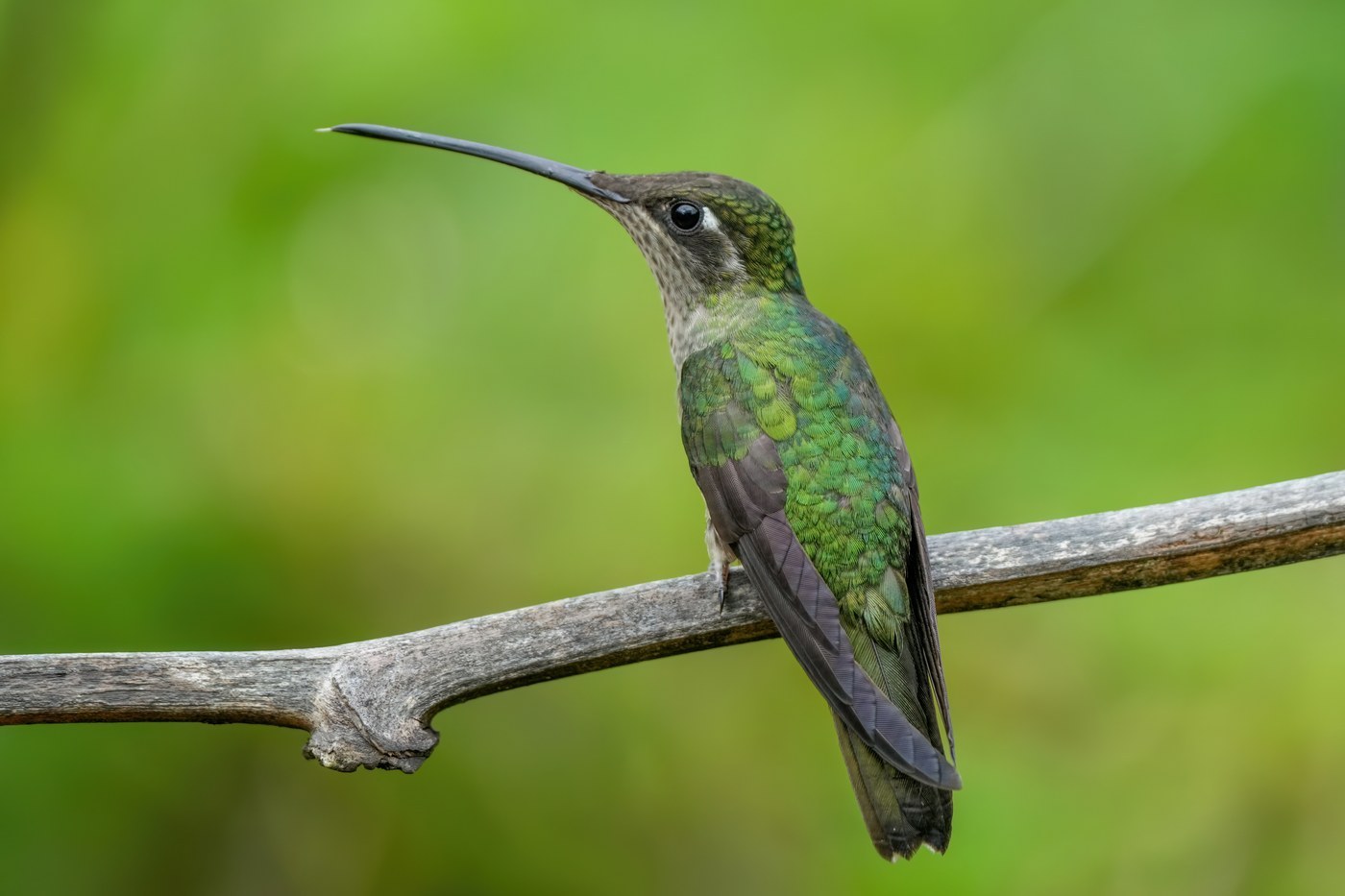
Key Field Marks
- Size & shape: One of the largest hummingbirds regularly seen in the United States, roughly 11–12 cm long with a noticeably long, slightly decurved bill and a bulky, broad-chested build compared to most other hummingbirds sharing its range.
- Plumage (male): Appears blackish at a distance, but in good light shows a glittering emerald-green throat (gorget), a glittering violet-purple crown, and a small black patch on the chest separating the two colors.
- Plumage (female): Dull grayish-green above and pale gray below, with a small white spot behind the eye; lacks any iridescent throat color but is identifiable by sheer size and bill length among the hummingbirds it associates with.
- Behavior: Often perches conspicuously in the open on bare branches between forays to feeders or flowering plants, and is notably aggressive, dominating smaller hummingbird species at feeders.
Separating It From Similar Species
- Blue-throated Mountain-gem: Even larger, with bold white stripes above and below the eye and a blue (not green) throat in males — both species often occur together in the same canyons.
- Broad-billed and Black-chinned Hummingbirds: Both are noticeably smaller and slimmer-billed; size and bulk alone usually separate Rivoli's from these species.
- Talamanca Hummingbird: The southern counterpart species (from Costa Rica/Panama highlands south) split from Rivoli's Hummingbird in 2017; the two are essentially identical in the field and are distinguished mainly by range, as their ranges do not overlap.
Habitat, Range & Season
Rivoli's Hummingbird breeds in humid pine-oak and montane canyon forests of the "sky island" mountains of southeastern Arizona and southwestern New Mexico, south through the highlands of Mexico and Central America. In the U.S. it is present mainly from spring through fall, favoring shaded canyons with sycamores, streams, and flowering understory, and readily visits hummingbird feeders at canyon lodges and campgrounds.
Voice
Gives a sharp, high "chip" or "tsip" call, often repeated. Because of its larger size, its wingbeats produce a lower-pitched, more audible hum than the high whine of smaller hummingbirds.
Frequently asked questions
How can I tell Rivoli's Hummingbird from other Arizona hummingbirds just by size?
It is markedly larger and bulkier than Black-chinned, Broad-billed, or Anna's Hummingbirds, with a longer, heavier bill — size alone is a strong clue even before color is seen.
What was Rivoli's Hummingbird called before 2017?
It was known as the Magnificent Hummingbird until that species was split into Rivoli's Hummingbird (north of the split point) and Talamanca Hummingbird (Costa Rica/Panama).
Where is the best place to see one in the U.S.?
Shaded mountain canyons in southeastern Arizona's sky islands, such as those in the Chiricahua, Huachuca, and Santa Catalina mountains, especially at established feeder sites.
Do female Rivoli's Hummingbirds show any bright colors?
No, females are plain grayish-green and gray with a small white spot behind the eye — they are identified mainly by their large size and long bill rather than color.