
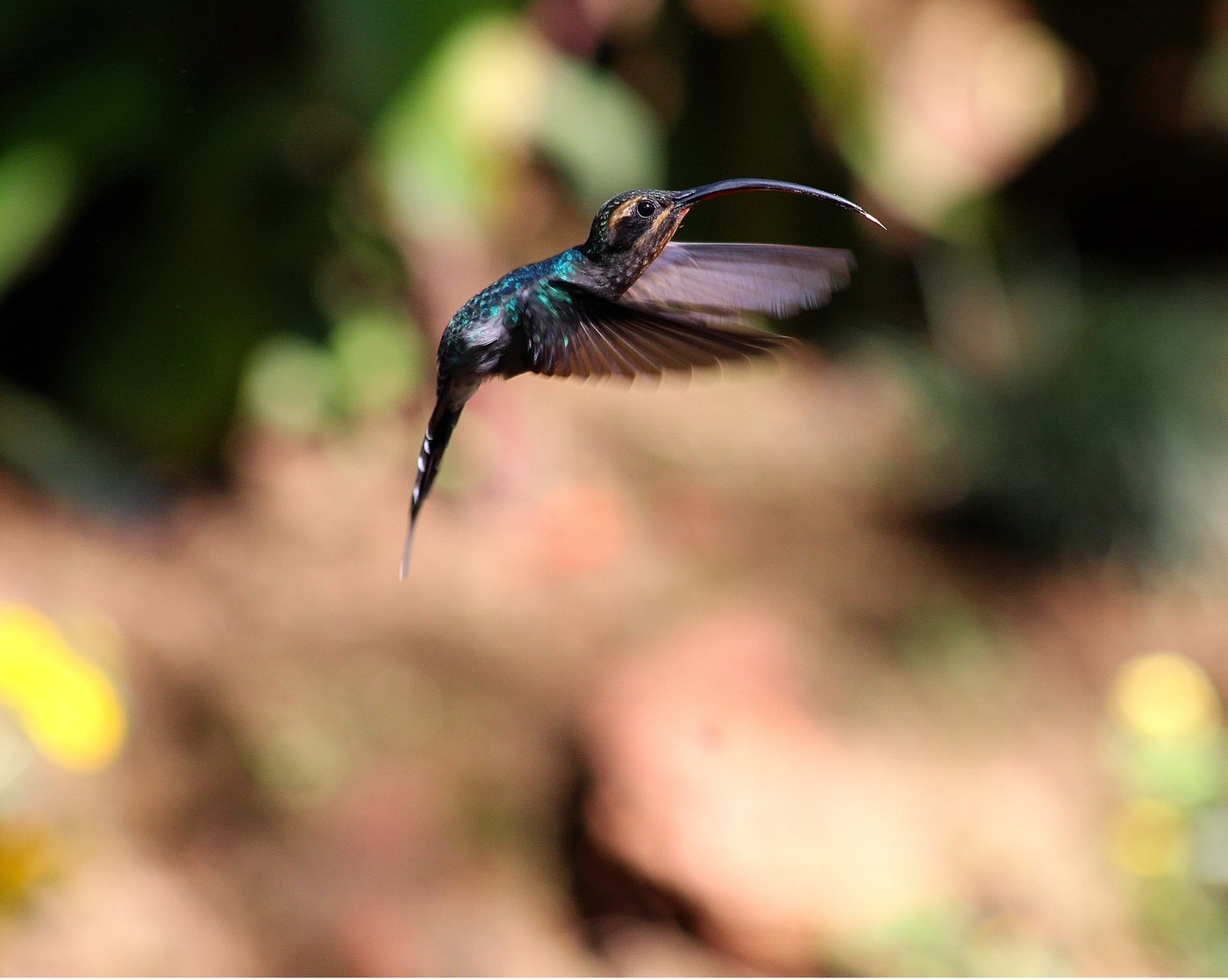
Green Hermit
Phaethornis guy
A large, long-billed hummingbird of the forest understory, dull green above and buffy below, with elongated white-tipped central tail feathers.
- Size
- 15-16 cm (6-6.3 in) long including elongated central tail feathers
- Habitat
- understory of humid forest and forest edge
- Type
- hummingbird
Spotted a bird like this?
Identify any bird from a photo, free.
Overview
The Green Hermit is a large hummingbird typical of the shady understory of humid forest, showing duller, more muted coloring than many of its flashier relatives: greenish upperparts and buffy-cinnamon underparts, without strongly iridescent patches. Its most distinctive features are a long, decurved bill suited to probing deep tubular flowers, and elongated central tail feathers tipped in white that extend well beyond the rest of the tail.
Like other hermits, it is a traplining forager, following a regular circuit of scattered flowering plants through the forest understory rather than defending a fixed territory, and it is often seen investigating patches of heliconia and other tubular flowers along shaded forest trails.
How to identify it
Key field marks
- Greenish, relatively dull upperparts (lacking bright iridescence typical of many hummingbirds)
- Buffy to cinnamon underparts
- Long, strongly decurved bill
- Elongated central tail feathers with white tips, extending beyond the rest of the tail
- Pale buffy stripe behind the eye
Similar species
- Long-billed Hermit is similar in shape but has a longer bill and different tail proportions, with some range overlap.
- Little Hermit and other smaller hermits lack the Green Hermit's larger size and longer tail streamers.
Habitat & range
Habitat
Inhabits the shaded understory of humid lowland and foothill forest, as well as forest edge and adjacent secondary growth.
Range
Found from Central America (Costa Rica, Panama) through the Andes and into parts of the Amazon basin and the Guianas.
Migration
Generally resident, with some local movement tied to flowering patterns.
Behavior & voice
Behavior
A classic "traplining" hummingbird, following a regular route among widely scattered flowering plants rather than defending a single territory; often forages low in the understory.
Voice
A thin, repeated, squeaky "seep" or chattering note, given persistently, especially near display (lek) sites.
Feeding
Feeds mainly on nectar from tubular understory flowers such as heliconias, and catches small insects in flight to supplement its diet.
Nesting
Builds a cone-shaped nest of plant fibers suspended from the underside of a large leaf, often a palm or heliconia leaf; the female incubates and raises the young alone.
Frequently asked questions
What does 'traplining' mean for the Green Hermit?
Traplining is a foraging strategy in which the bird follows a regular circuit among widely scattered flowering plants rather than defending a single feeding territory, a common behavior among hermit hummingbirds.
How do you identify a Green Hermit?
Look for a large, relatively dull green-and-buff hummingbird with a long decurved bill and elongated white-tipped central tail feathers.
What does a Green Hermit eat?
Mainly nectar from tubular understory flowers like heliconias, supplemented with small insects caught in flight.
Where does the Green Hermit live?
In the shaded understory of humid forest from Central America through the Andes and into parts of the Amazon basin.
Green Hermit guides
In-depth guides for identifying, finding, and understanding Green Hermit.
Other birds you may enjoy
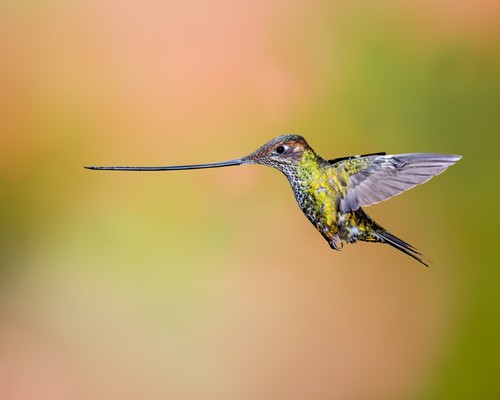
Sword-billed Hummingbird
Body about 13-15 cm (5-6 in) including a bill up to 10 cm long, the longest bill relative to body size of any bird
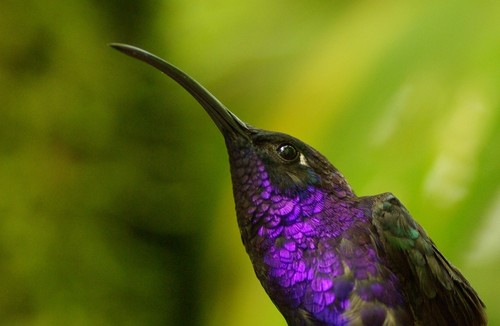
Violet Sabrewing
14-15 cm (5.5-6 in) long
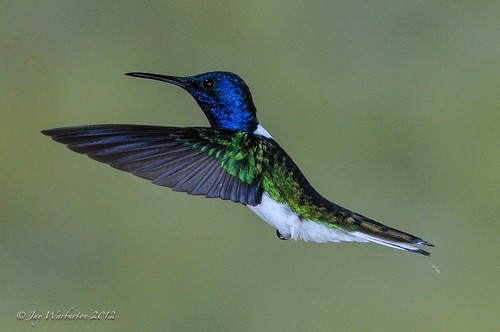
White-necked Jacobin
11-12 cm (4.3-4.7 in) long
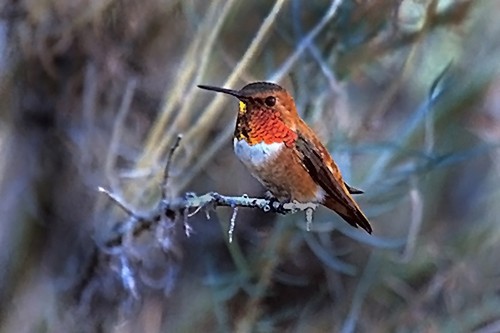
Rufous Hummingbird
8-9 cm (3-3.5 in) long, 11 cm wingspan
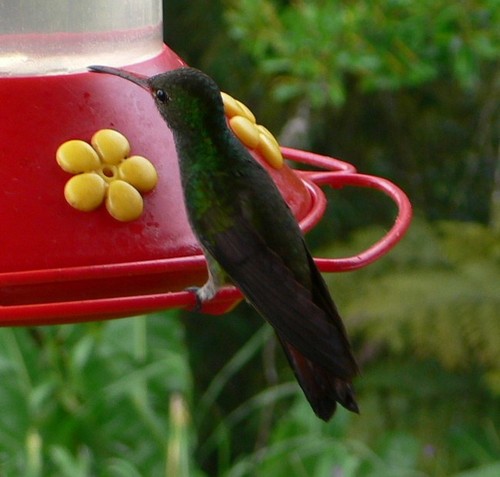
Rufous-tailed Hummingbird
10-11.5 cm (4-4.5 in) long
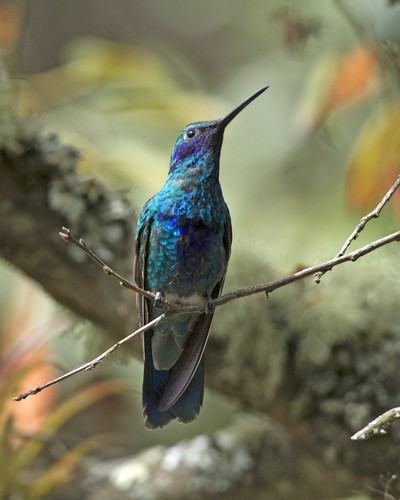
Sparkling Violetear
13-14 cm (5-5.5 in) long including bill
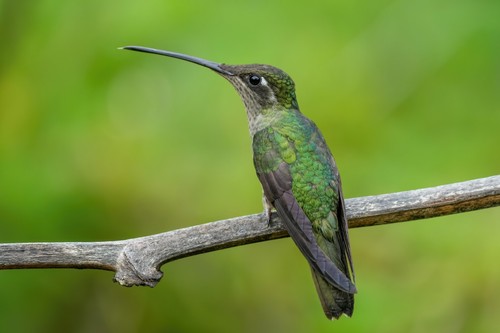
Rivoli's Hummingbird
11-14 cm (4.5-5.5 in) long, 17-18 cm wingspan
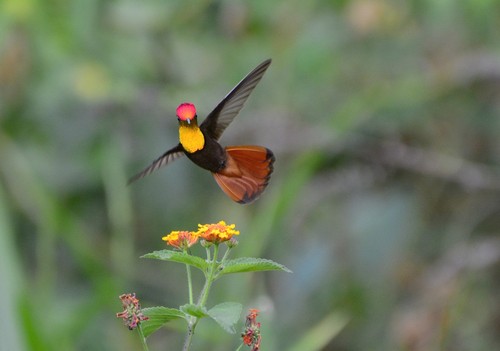
Ruby-topaz Hummingbird
7.5-9 cm (3-3.5 in) long
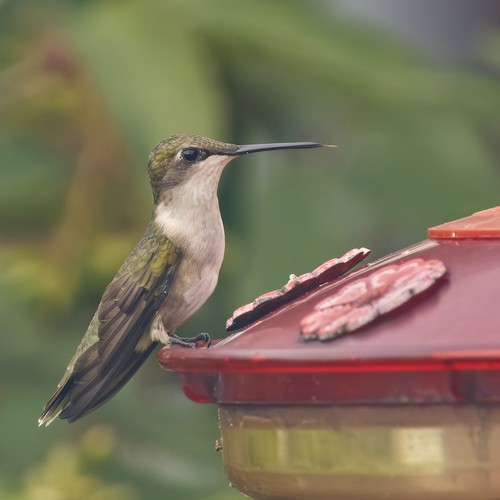
Ruby-throated Hummingbird
7-9 cm (3-3.5 in) long, 8-11 cm wingspan
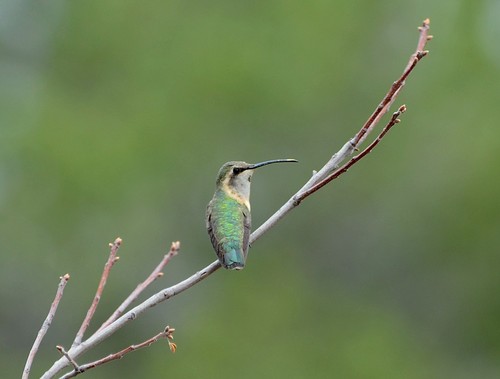
Lucifer Hummingbird
8.5-9.5 cm (3.5 in) long, 11 cm wingspan
Long-tailed Sylph
males 18-19 cm (7-7.5 in) including tail; females 9-10 cm (3.5-4 in)
Giant Hummingbird
20-23 cm (8-9 in) long, largest hummingbird species in the world