
Green Hermit Identification Guide
A large, long-billed hummingbird of Neotropical forest understory, the Green Hermit shows bronzy-green upperparts, a long strongly decurved bill, and elongated white-tipped central tail feathers, and traces regular routes ('traplines') between flowers.
Read the full Green Hermit encyclopedia entry →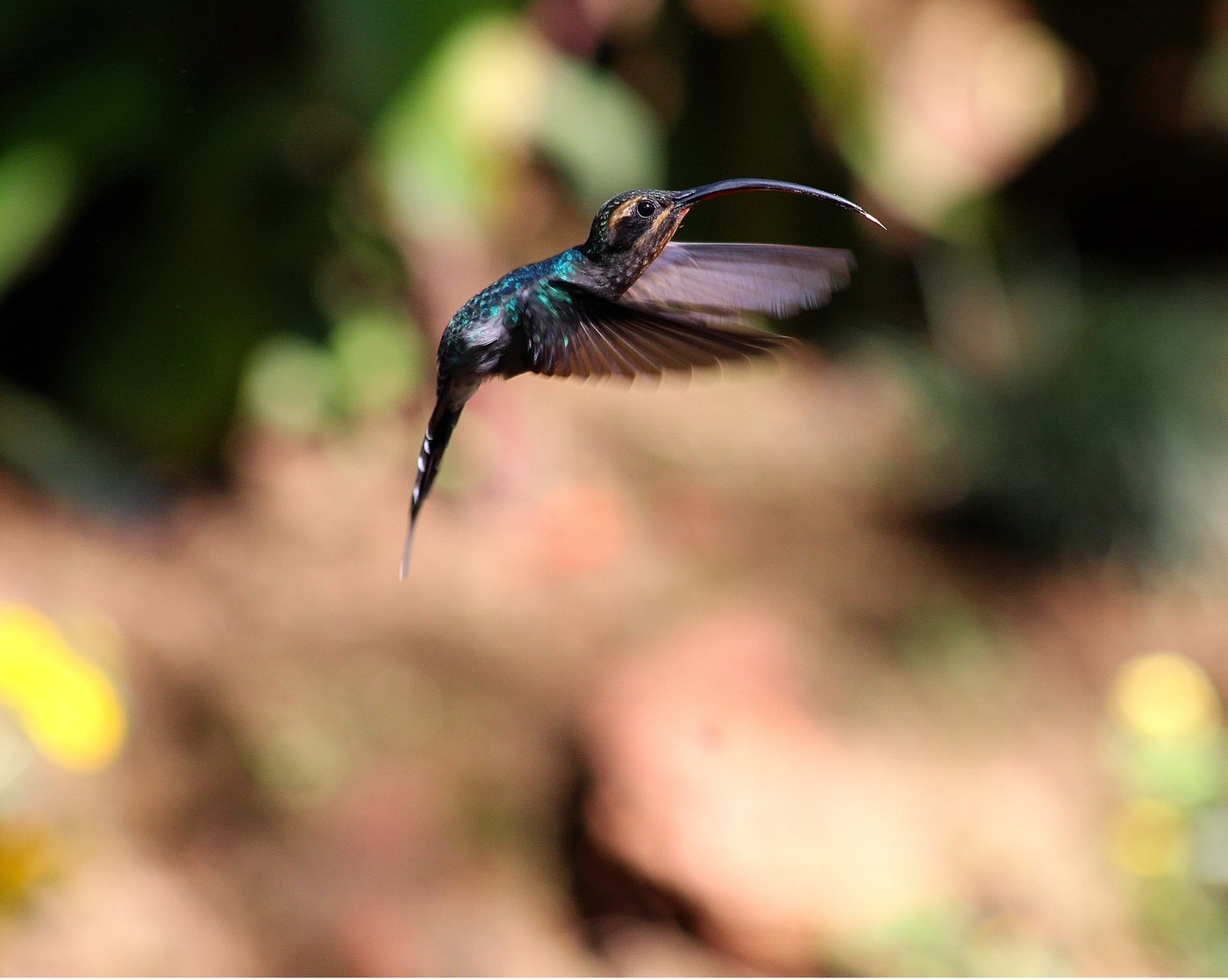
Key Field Marks
- Size & shape: A relatively large hummingbird (about 5.5–6 inches / 14–15 cm including the long tail) with an elongated body and a distinctly long, strongly decurved bill.
- Plumage: Bronzy to dusky green above, somewhat duller and grayer-green below, without the bright gorget colors typical of many other hummingbirds; lacks the strong facial stripes of some other hermit species but shows a buffy or pale stripe behind the eye and a dark stripe through it in many populations.
- Bill: Long, thin, and markedly decurved (curved downward), longer relative to head size than in most non-hermit hummingbirds — an adaptation for probing curved flowers like Heliconia.
- Tail: Long and graduated, with elongated, white-tipped central tail feathers that project beyond the rest of the tail — a key hermit feature, more pronounced in males.
- Behavior: Typically forages low in the forest understory, following a regular circuit of flowering plants (a "traplining" strategy) rather than defending a fixed feeding territory; males gather at communal singing assemblies (leks) in dense understory to sing and attract females.
Separating It From Similar Species
- Other hermit hummingbirds (e.g., Long-billed Hermit, Little Hermit, Pale-bellied Hermit) overlap in range and general shape; Green Hermit is best distinguished by its combination of medium-large size, strongly decurved (but not extremely long) bill, and elongated white-tipped central tail streamers. Long-billed Hermit is larger with an even longer bill; Little Hermit is smaller with a shorter tail and less pronounced streamers.
- Non-hermit hummingbirds sharing green plumage typically have straighter bills, shorter tails without elongated central streamers, and defend fixed flower territories rather than traplining — useful behavioral clues alongside plumage and structure.
- Females and immatures of hermit species are notoriously similar; range, elevation, and voice at leks are often needed for a confident identification.
Where & When to See It
- Habitat: Understory of humid lowland and foothill forest, including secondary growth, forest edge, and dense tangles near streams; favors areas with clumps of Heliconia and related flowers.
- Range: From southern Mexico through Central America and into northern and western South America (Colombia, Ecuador, Venezuela, and parts of the western Amazon basin).
- Season: Resident year-round with little seasonal movement; lekking males can be found displaying and singing at traditional sites throughout much of the year, peaking during local breeding seasons.
Voice
- Males at leks give a persistent, sharp, repeated sweep or tsip note, often continuing for long periods from a low perch in dense understory — the lek chorus is frequently the easiest way to locate the species even when the birds themselves are hard to see.
Frequently asked questions
What is the best way to identify a Green Hermit?
Look for a medium-large hummingbird with a long, strongly decurved bill, bronzy-green plumage without a bright gorget, and long, white-tipped central tail feathers projecting beyond the rest of the tail.
How is the Green Hermit different from other hermit hummingbirds?
Size, bill length, and tail streamer length are the main clues — Green Hermit is smaller and shorter-billed than Long-billed Hermit but larger with longer, more prominent white-tipped tail streamers than Little Hermit.
What does 'traplining' mean for Green Hermits?
Rather than defending a single patch of flowers, Green Hermits follow a regular circuit through the forest understory, visiting a series of flowering plants in sequence — a foraging strategy called traplining.
Where and how can I find a Green Hermit lek?
Listen in dense forest understory for a persistent, sharp, repeated sweep or tsip note; males gather at traditional lek sites low in the vegetation to sing for extended periods, which is often the easiest way to locate the species.