
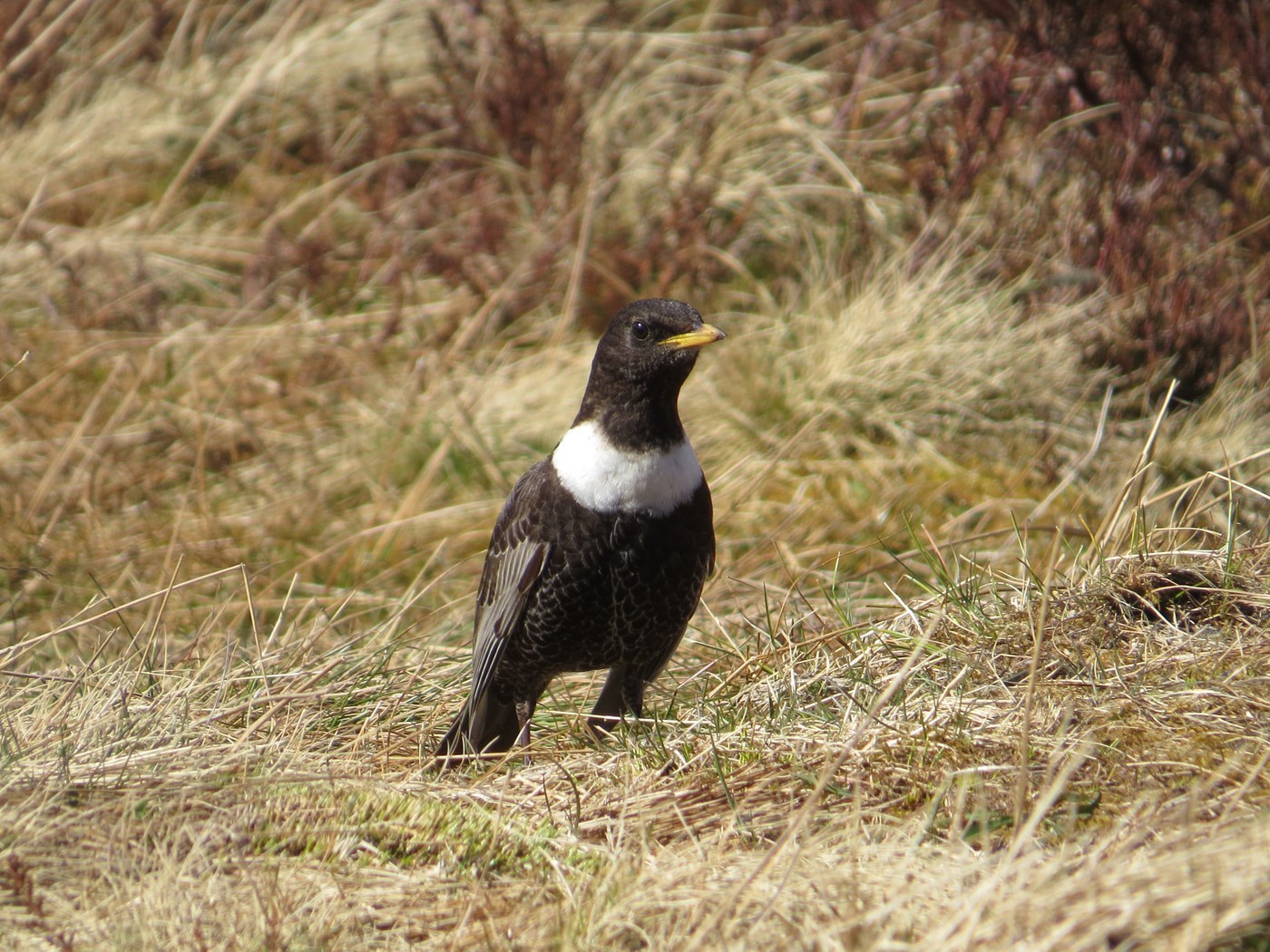
Ring Ouzel
Turdus torquatus
A blackbird of high, wild upland moors and crags, the male distinguished by a striking white crescent across the breast.
- Size
- 23-24 cm (9-9.4 in) long, 38-42 cm wingspan
- Habitat
- upland moorland, mountain crags, and rocky gullies; migratory, breeding in northern and western European uplands
- Type
- songbird
Spotted a bird like this?
Identify any bird from a photo, free.
Overview
The Ring Ouzel, often nicknamed the "mountain blackbird," is a close relative of the familiar Common Blackbird but restricted to wilder, more remote upland habitats, and is a summer visitor to much of its European range rather than a year-round resident.
Appearance
The male is essentially black, like a Blackbird, but with a bold, crescent-shaped white band across the upper breast and pale, scaly fringing to the wing feathers. Females are duller, sooty-brown rather than black, with a less distinct, greyer-white breast crescent.
How to identify it
Key Field Marks
- Male: black plumage with a bold white breast crescent
- Female: duller sooty-brown with a less distinct, greyer crescent
- Pale, scaly fringes to the wing feathers, visible at rest
- Restricted largely to upland/montane habitats during the breeding season
Similar Species
Common Blackbird lacks any white breast crescent and typically occurs in lowland woodland and gardens rather than open moorland and crags. Some female Blackbirds can show a faint pale throat mottling, but never the clean, bold crescent of the Ring Ouzel, and the two species' habitats rarely overlap during the Ring Ouzel's breeding season.
Habitat & range
Habitat
Ring Ouzels breed on open, rocky moorland, upland heath, and mountain slopes with crags, gullies, and scattered low scrub, typically at higher elevations than the Blackbird — a genuinely wild, remote habitat preference.
Range and Migration
The species breeds in upland areas across parts of Britain and Ireland, Scandinavia, and mountain ranges of central and southern Europe including the Alps and Pyrenees. It is a long-distance migrant, wintering mainly around the Mediterranean and in North Africa, including the Atlas Mountains, and its populations in some regions, including upland Britain, have declined markedly.
Behavior & voice
Behavior
Ring Ouzels are typically wary and easily disturbed, often flying off with a loud chattering alarm call at the first sign of disturbance. They forage on the ground for invertebrates in short upland turf and feed heavily on berries, particularly juniper and rowan, before and during migration.
Voice
The song is a rather simple, far-carrying, fluty phrase repeated with pauses, evocative of the wild, open landscapes it inhabits. The alarm and flight call is a harsh, chattering rattle, louder and more strident than the calls of the Common Blackbird.
Nesting and Breeding
The nest, built low in heather, a rock crevice, or a low crag ledge, is a cup of grass, moss, and mud similar in construction to a Blackbird's. The female lays 3-5 eggs and incubates them for about 12-14 days, with pairs typically raising two broods across the short upland breeding season.
Frequently asked questions
How can you tell a Ring Ouzel from a Blackbird?
The male Ring Ouzel has a bold white crescent across the breast, which the all-black Blackbird lacks entirely, and it is generally found in remote upland and mountain habitats rather than lowland gardens and woodland.
Why is the Ring Ouzel called the 'mountain blackbird'?
It occupies wild, high-elevation moorland, crags, and mountain slopes as its breeding habitat, in contrast to the much more widespread, lowland-dwelling Common Blackbird.
Where do Ring Ouzels spend the winter?
They migrate south to winter mainly around the Mediterranean and in North Africa, including mountainous areas such as the Atlas Mountains.
Has the Ring Ouzel declined in Britain?
Yes, upland breeding populations in parts of Britain have fallen significantly in recent decades, prompting conservation concern and monitoring.
Ring Ouzel guides
In-depth guides for identifying, finding, and understanding Ring Ouzel.
Other birds you may enjoy

Black Redstart
13-14.5 cm (5.1-5.7 in) long, 23-26 cm wingspan

Black-throated Sparrow
12-14 cm (4.7-5.5 in) long, about 19-20 cm (7.5-8 in) wingspan

Greater Bird-of-paradise
Body about 43 cm; males with additional flank plumes up to 50 cm and long tail wires

Blue Tit
11-12 cm (4.3-4.7 in) long, 17-20 cm wingspan

Red-billed Quelea
11.5–13 cm long, wingspan about 20–22 cm
White-plumed Antbird
13-14 cm (5-5.5 in) long

Pyrrhuloxia
19-22 cm (7.5-8.7 in) long, 30 cm wingspan

Blue-gray Tanager
16-18 cm (6-7 in) long

Blackburnian Warbler
11-13 cm (4.3-5.1 in) long, 20-22 cm wingspan

Bluethroat
13-14 cm (5.1-5.5 in) long, 20-22 cm wingspan

Eurasian Nuthatch
12-14.5 cm (4.7-5.7 in) long, 22.5-27 cm wingspan

Wood Thrush
19-21 cm (7.5-8.3 in) long, about 33 cm (13 in) wingspan