
Ring Ouzel Identification Guide
A mountain-breeding relative of the Blackbird, told at a glance by the bold white crescent across its breast.
Read the full Ring Ouzel encyclopedia entry →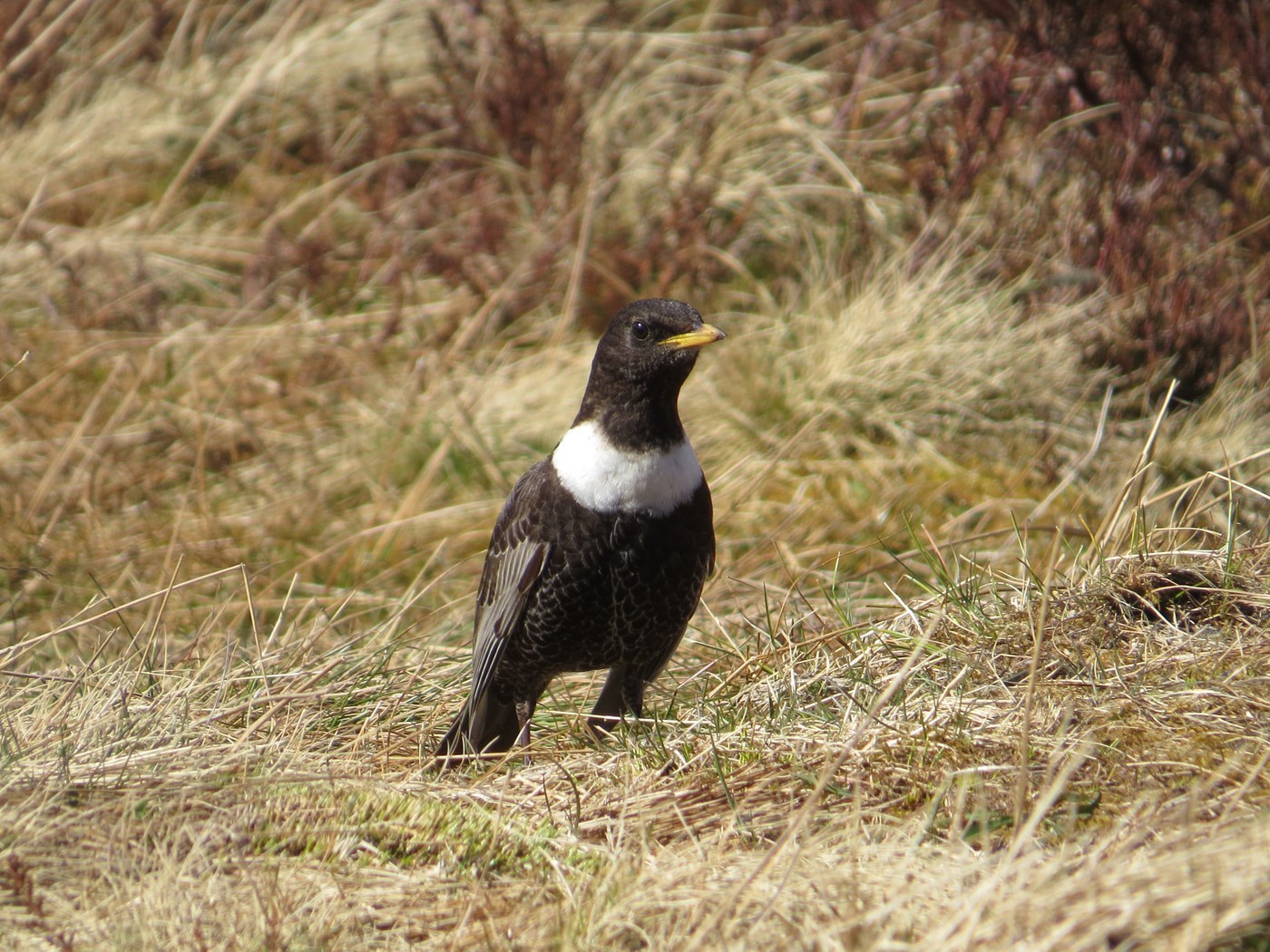
Key Field Marks
- Size & shape: About 23–24 cm, close in size and structure to a Eurasian Blackbird — a stocky, long-tailed thrush with an upright stance.
- Plumage: Sooty-black overall in males, with a broad, crisp white crescent across the upper breast. Females and immatures are browner and sootier with a duller, more mottled, buff-white crescent that can be hard to see at a distance.
- Wings: Pale, silvery-gray fringes to the flight feathers create a distinct pale panel on the closed wing — visible even on birds where the breast band is obscure.
- Bare parts: Bill is dark with a yellow-orange base, brighter and more extensive in adult males; legs and feet are dark brownish-black.
- Behavior: Wary and quick to fly off with a chattering alarm call. Feeds on the ground with hopping, blackbird-like movements, often flicking its wings and cocking its tail.
Separating It From Similar Species
- Eurasian Blackbird: Lacks any white crescent, has uniformly dark wings without a pale panel, and males show a narrow yellow eye-ring the Ring Ouzel lacks. Female/immature Ring Ouzels without an obvious crescent are best told from Blackbirds by the pale wing panel and scaly-looking underparts.
- Female Blackbird vs. female Ring Ouzel: Both are brown, but Ring Ouzel shows pale wing edges and a faint pale breast crescent that female Blackbirds never show.
Habitat, Range & Season
Ring Ouzels breed on open upland moorland, heather-clad hillsides, crags, and rocky gullies across Britain, Scandinavia, and mountain ranges of central and southern Europe. They are summer visitors to these breeding grounds, arriving in April and departing by October. On migration they turn up in lowland habitats they otherwise avoid — hedgerows, coastal headlands, and berry-laden scrub — especially in autumn when they feed heavily on hawthorn and rowan berries before continuing to wintering grounds in the mountains of North Africa and the Mediterranean.
Voice
The song is a simple, far-carrying, piping phrase of two or three repeated notes — "pee-u, pee-u, pee-u" — delivered from a rock or bush and often audible well before the bird is seen. The alarm call is a hard, chattering "tac-tac-tac," harsher and more strident than a Blackbird's scolding.
Frequently asked questions
What is the easiest way to tell a Ring Ouzel from a Blackbird?
Look for the white breast crescent (bold in males, duller in females) and the pale, silvery panel on the closed wing — Blackbirds show neither.
Where would I find a Ring Ouzel in summer?
On open, treeless upland moorland and rocky hillsides, typically above the tree line in Britain, Scandinavia, and the mountains of central/southern Europe.
Do all Ring Ouzels show the white crescent?
No — adult males show it boldly, but females and young birds have a much duller, buffier, less distinct crescent that can be easy to overlook.
When are Ring Ouzels most likely away from mountains?
During spring and especially autumn migration, when they stop over in lowland scrub, hedgerows, and coastal headlands to feed on berries.