
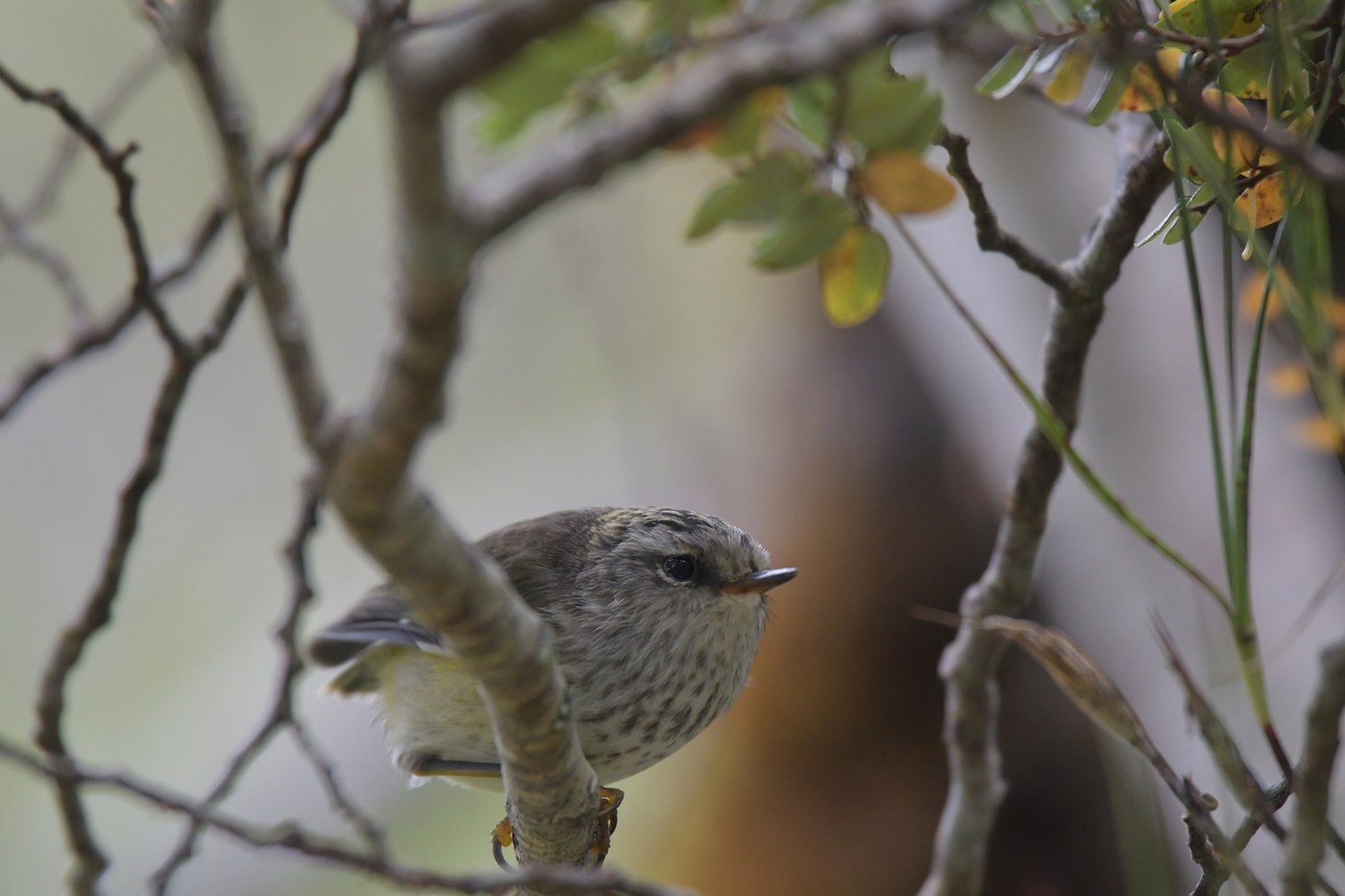
Rifleman
Acanthisitta chloris
New Zealand's smallest bird, a tiny, tail-less-looking green-and-brown forest bird belonging to an ancient lineage found nowhere else on Earth.
- Size
- 8 cm (3 in) long
- Habitat
- native forest throughout New Zealand
- Type
- songbird
Spotted a bird like this?
Identify any bird from a photo, free.
Overview
The Rifleman, known in Maori as titipounamu, is New Zealand's smallest surviving native bird, weighing only a few grams. Males are bright olive-green above with pale underparts, while females are duller, streaky brown, both sexes sharing a very short tail that gives the bird an almost tail-less, rounded silhouette, and a fine, slightly upturned bill.
It belongs to the ancient family Acanthisittidae, the New Zealand wrens, an evolutionary lineage that split from all other songbirds tens of millions of years ago and today survives only as the Rifleman and the rarer Rock Wren, all other members having gone extinct in recent centuries. Constantly active, Riflemen move in short, whirring flights and quick hops as they search tree trunks and branches for tiny insects.
How to identify it
Key field marks
- Tiny size, New Zealand's smallest bird
- Very short tail giving a rounded, almost tail-less silhouette
- Male: bright olive-green upperparts, pale underparts
- Female: streaky brown upperparts, duller than male
- Fine, slightly upturned bill
Similar species
- No other New Zealand bird is as small; the only other surviving member of its ancient family, the Rock Wren, occurs only in alpine South Island habitat and is browner with a longer tail than the male Rifleman's green.
- Silvereyes are similarly small but show a distinct white eye-ring and a proportionally longer tail, unlike the Rifleman's stub tail.
Habitat & range
Range
Found throughout the North and South Islands of New Zealand wherever suitable native forest remains, absent from Stewart Island.
Habitat
Inhabits native forest of many types, from lowland broadleaf forest to beech forest, foraging mainly on tree trunks, branches, and foliage.
Migration
Sedentary, holding small stable territories year-round.
Behavior & voice
Behavior
Constantly active, moving in quick hops up and along branches and trunks, gleaning insects from bark and foliage, with short whirring flights between trees.
Voice
Gives extremely high-pitched, thin, almost insect-like calls, pitched so high that some people cannot hear them at all.
Feeding
Feeds almost entirely on small insects and spiders gleaned from bark crevices, moss, and foliage, working systematically up tree trunks and along branches.
Nesting
Builds an enclosed, domed nest with a side entrance in a tree cavity, crevice, or dense vegetation; both parents, and sometimes additional helpers, share incubation and feeding duties for the four to five eggs and chicks.
Frequently asked questions
Is the Rifleman really New Zealand's smallest bird?
Yes, at only around 8 centimeters long and a few grams in weight, it is the smallest native bird in New Zealand.
Why is the Rifleman considered evolutionarily unusual?
It belongs to the ancient family Acanthisittidae, the New Zealand wrens, a lineage that diverged from all other songbirds tens of millions of years ago and now survives as only two species.
Why is the Rifleman's call hard to hear?
Its calls are extremely high-pitched, near or beyond the upper range of human hearing for many people.
What does a Rifleman eat?
Small insects and spiders, gleaned from bark, moss, and foliage as it forages actively over tree trunks and branches.
Rifleman guides
In-depth guides for identifying, finding, and understanding Rifleman.
Other birds you may enjoy

Black Redstart
13-14.5 cm (5.1-5.7 in) long, 23-26 cm wingspan

Black-throated Sparrow
12-14 cm (4.7-5.5 in) long, about 19-20 cm (7.5-8 in) wingspan

Greater Bird-of-paradise
Body about 43 cm; males with additional flank plumes up to 50 cm and long tail wires

Blue Tit
11-12 cm (4.3-4.7 in) long, 17-20 cm wingspan

Red-billed Quelea
11.5–13 cm long, wingspan about 20–22 cm
White-plumed Antbird
13-14 cm (5-5.5 in) long

Pyrrhuloxia
19-22 cm (7.5-8.7 in) long, 30 cm wingspan

Blue-gray Tanager
16-18 cm (6-7 in) long

Blackburnian Warbler
11-13 cm (4.3-5.1 in) long, 20-22 cm wingspan

Bluethroat
13-14 cm (5.1-5.5 in) long, 20-22 cm wingspan

Eurasian Nuthatch
12-14.5 cm (4.7-5.7 in) long, 22.5-27 cm wingspan

Wood Thrush
19-21 cm (7.5-8.3 in) long, about 33 cm (13 in) wingspan