
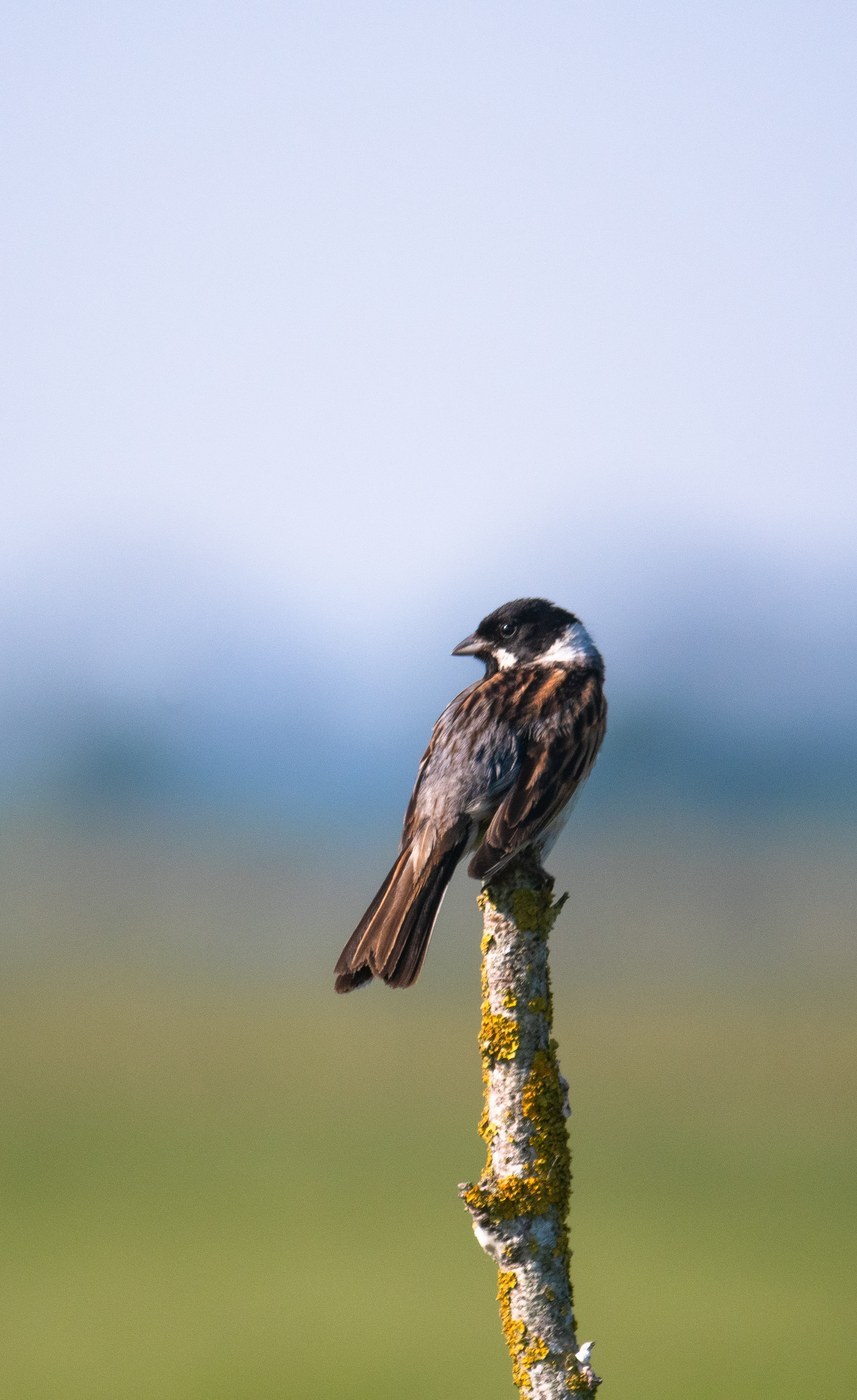
Reed Bunting
Emberiza schoeniclus
A slim bunting of reedbeds and wetlands, with breeding males sporting a bold black head and white collar.
- Size
- 13.5-15.5 cm (5.3-6.1 in) long, 21-28 cm wingspan
- Habitat
- reedbeds, marshes, wet ditches, and increasingly damp farmland and scrub away from water
- Type
- songbird
Spotted a bird like this?
Identify any bird from a photo, free.
Overview
The Reed Bunting is a slender, wetland-loving bunting traditionally tied to reedbeds and marshy vegetation, though in recent decades it has also spread into drier farmland and scrub habitats away from water across much of its European range.
Appearance
Breeding males are boldly patterned, with a jet-black head and throat set off by a crisp white collar and a white moustachial stripe, over a streaked brown back and a greyish, streaked rump. Females and non-breeding males lack the black head, instead showing a warm brown, well-streaked head with a pale supercilium and a dark malar stripe.
How to identify it
Key Field Marks
- Breeding male: black head and throat, white collar and moustachial stripe
- Female/winter male: streaked brown head with pale eyebrow and dark cheek/malar stripe
- Streaked brown back and flanks, white outer tail feathers flashing in flight
- Slim build with a relatively long, notched tail
Similar Species
Female and winter Reed Buntings can resemble female House Sparrow or female Yellowhammer, but the head pattern — pale supercilium bordered by darker crown stripes and a bold dark malar stripe — combined with white outer tail feathers and a habitat closely tied to damp or scrubby vegetation help distinguish it. Little Bunting, a much rarer vagrant in western Europe, is smaller with a chestnut-tinged face and a complete pale eye-ring.
Habitat & range
Habitat
Traditionally a bird of reedbeds, sedge marshes, and wet ditches, the Reed Bunting has adapted in many areas to breed in drier habitats too, including rough grassland, scrubby field margins, and even oilseed rape fields, particularly where wetland habitat has become scarce.
Range and Migration
The species breeds across most of Europe and temperate Asia. Northern populations are migratory, moving south to milder wintering areas, while southern and western populations are largely resident, sometimes joining mixed flocks with finches on farmland in winter.
Behavior & voice
Behavior
Reed Buntings often perch conspicuously on top of a reed stem or low bush to sing, flicking the tail and showing off the white outer tail feathers. In winter they may form small flocks and forage on the ground or low in vegetation, often alongside other seed-eating birds.
Voice
The song is a simple, rather monotonous, unmusical series of short notes: "tsip-tsip-tsip-tsissississ." The call is a thin, descending "tseeu" or a sharp "tsick."
Nesting and Breeding
The nest is built low, often on or near the ground, hidden in a tussock of grass, sedge, or low bush near water. A cup of grass and moss lined with fine grass and hair holds 4-5 eggs, marked with dark scrawling lines similar to those of other buntings; incubation, mainly by the female, lasts about 12-14 days.
Frequently asked questions
Do Reed Buntings only live in reedbeds?
No — while classically associated with reedbeds and marshes, the species has increasingly colonized drier habitats such as farmland, scrub, and rough grassland in many parts of its range.
How can I tell a female Reed Bunting from a female Yellowhammer?
Female Reed Buntings show a more contrasting head pattern with a pale eyebrow and bold dark malar stripe, white outer tail feathers, and lack the warm chestnut rump typical of Yellowhammers.
What does a male Reed Bunting look like in the breeding season?
It has a striking black head and throat contrasted with a crisp white collar and moustachial stripe, over a streaked brown back.
Where do Reed Buntings nest?
Low to the ground, typically hidden in a tussock of grass, sedge, or dense low shrub, often near water but sometimes in drier scrub.
Reed Bunting guides
In-depth guides for identifying, finding, and understanding Reed Bunting.
Other birds you may enjoy

Black Redstart
13-14.5 cm (5.1-5.7 in) long, 23-26 cm wingspan

Black-throated Sparrow
12-14 cm (4.7-5.5 in) long, about 19-20 cm (7.5-8 in) wingspan

Greater Bird-of-paradise
Body about 43 cm; males with additional flank plumes up to 50 cm and long tail wires

Blue Tit
11-12 cm (4.3-4.7 in) long, 17-20 cm wingspan

Red-billed Quelea
11.5–13 cm long, wingspan about 20–22 cm
White-plumed Antbird
13-14 cm (5-5.5 in) long

Pyrrhuloxia
19-22 cm (7.5-8.7 in) long, 30 cm wingspan

Blue-gray Tanager
16-18 cm (6-7 in) long

Blackburnian Warbler
11-13 cm (4.3-5.1 in) long, 20-22 cm wingspan

Bluethroat
13-14 cm (5.1-5.5 in) long, 20-22 cm wingspan

Eurasian Nuthatch
12-14.5 cm (4.7-5.7 in) long, 22.5-27 cm wingspan

Wood Thrush
19-21 cm (7.5-8.3 in) long, about 33 cm (13 in) wingspan