
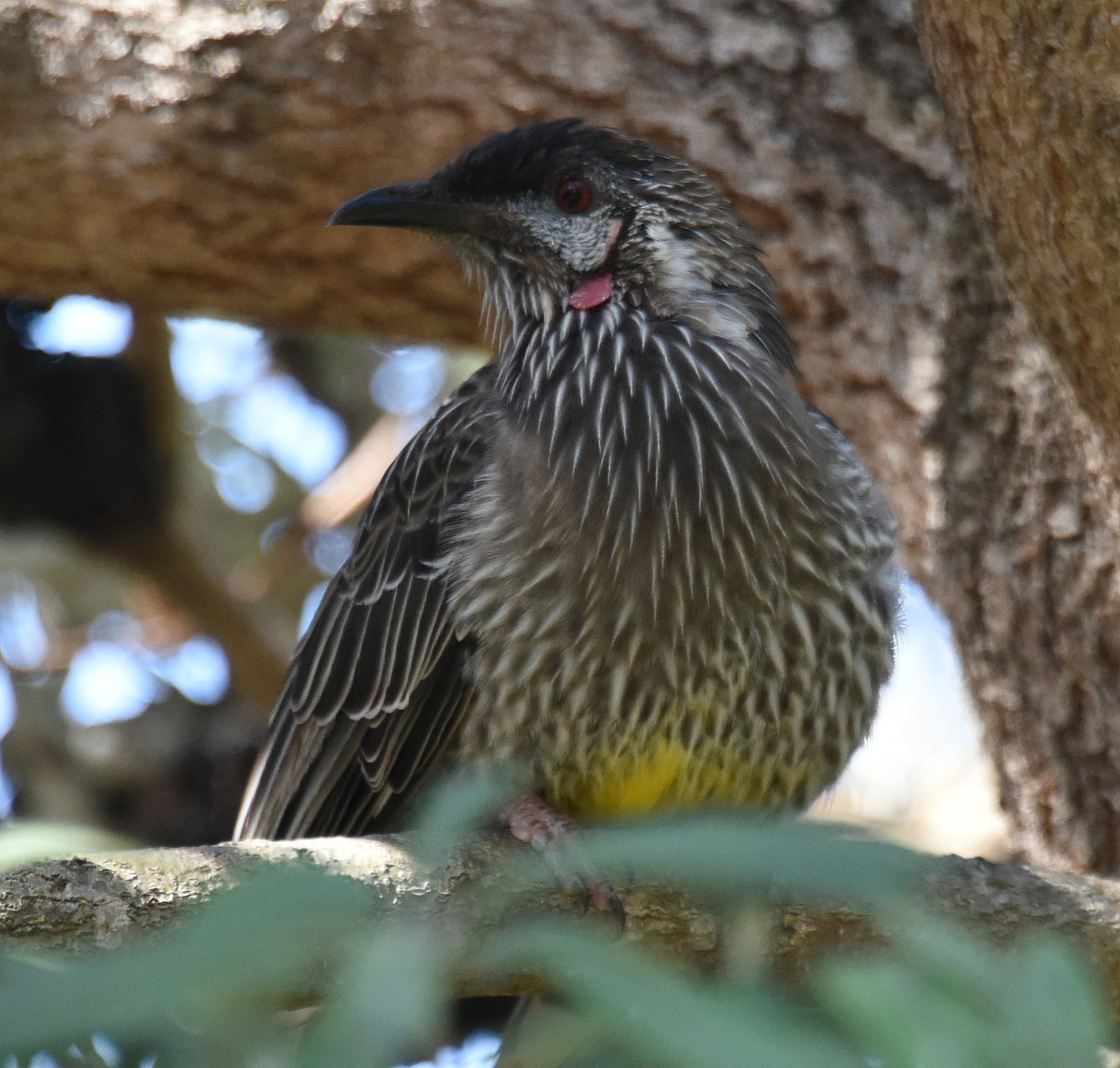
Red Wattlebird
Anthochaera carunculata
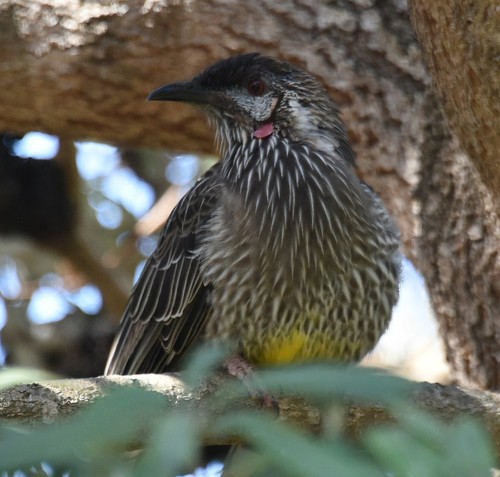
A large, noisy honeyeater with streaky grey-brown plumage, a bright yellow belly patch, and a fleshy pinkish-red wattle hanging below the eye.
- Size
- 33-37 cm (13-14.5 in) long, 40-52 cm wingspan
- Habitat
- eucalypt woodlands, banksia scrub, heathland, and gardens
- Type
- songbird
Spotted a bird like this?
Identify any bird from a photo, free.
Overview
The Red Wattlebird is one of the largest honeyeaters in Australia, a boldly streaked grey-brown bird with a long tail, a red eye, and a distinctive fleshy pink-red wattle drooping from the side of the face below the eye. The underparts are heavily streaked with white and grey before giving way to a bright lemon-yellow belly patch, a useful field mark visible even in flight or at a distance.
A conspicuous and often aggressive presence wherever flowering eucalypts, banksias, or grevilleas are in bloom, it is quick to chase off smaller honeyeaters and other birds from a good nectar source, and its harsh, coughing calls are a familiar sound of woodland and garden alike across southern Australia.
How to identify it
Key field marks
- Large size for a honeyeater, with a long tail and streaky grey-brown plumage
- Fleshy pink-red wattle hanging below the eye
- Bright yellow patch on the lower belly, contrasting with streaked white-grey underparts
- Red eye and a slim, slightly downcurved bill
Similar species
- Little Wattlebird is smaller, lacks the facial wattle entirely, and has a shorter tail.
- Yellow Wattlebird (Tasmania only) is larger still with longer wattles and does not overlap on the mainland.
- Noisy Friarbird lacks streaking and has a bare grey-black head rather than a wattle.
Habitat & range
Habitat
Found in eucalypt woodland, banksia and grevillea heathland, coastal scrub, orchards, parks, and well-vegetated suburban gardens.
Range
Widespread across southern Australia, from southwestern Western Australia across South Australia, Victoria, and New South Wales to southeastern Queensland; absent from the arid interior and the tropical north.
Migration
Partly nomadic, with seasonal movements tracking the flowering of eucalypts and banksias; some populations, especially in the southeast, undertake regular seasonal migrations between breeding and non-breeding areas.
Behavior & voice
Behavior
Bold, assertive, and often dominant at flowering trees, aggressively chasing off other honeyeaters, small birds, and even larger species from favored nectar sources; frequently forages and moves in small noisy groups.
Voice
A loud, harsh, coughing or barking call often likened to a cork being pulled from a bottle, along with a variety of raucous chattering notes.
Feeding
Feeds mainly on nectar from eucalypts, banksias, and grevilleas, supplemented with insects gleaned from foliage and bark, and soft fruit.
Nesting
Builds a bulky, untidy cup nest of twigs, bark, and grass in the outer branches of a tree or shrub; lays 2-3 pale pinkish eggs with reddish-brown spotting.
Frequently asked questions
What is the red wattle on a Red Wattlebird for?
The fleshy pink-red wattle below the eye is a bare skin ornament characteristic of the species and its close relatives; its exact function is not fully understood but it likely plays a role in species recognition and display.
How do you tell a Red Wattlebird from a Little Wattlebird?
The Red Wattlebird is larger, has a bright yellow belly patch, and shows the distinctive facial wattle, while the Little Wattlebird is smaller, lacks any wattle, and has plainer streaked plumage.
What does a Red Wattlebird eat?
Mostly nectar from flowering eucalypts, banksias, and grevilleas, plus insects and soft fruit.
Where do Red Wattlebirds live?
Across southern Australia in woodland, heathland, and gardens, from southwestern Western Australia to southeastern Queensland.
Red Wattlebird guides
In-depth guides for identifying, finding, and understanding Red Wattlebird.
Other birds you may enjoy

Black Redstart
13-14.5 cm (5.1-5.7 in) long, 23-26 cm wingspan

Black-throated Sparrow
12-14 cm (4.7-5.5 in) long, about 19-20 cm (7.5-8 in) wingspan

Greater Bird-of-paradise
Body about 43 cm; males with additional flank plumes up to 50 cm and long tail wires

Blue Tit
11-12 cm (4.3-4.7 in) long, 17-20 cm wingspan

Red-billed Quelea
11.5–13 cm long, wingspan about 20–22 cm
White-plumed Antbird
13-14 cm (5-5.5 in) long

Pyrrhuloxia
19-22 cm (7.5-8.7 in) long, 30 cm wingspan

Blue-gray Tanager
16-18 cm (6-7 in) long

Blackburnian Warbler
11-13 cm (4.3-5.1 in) long, 20-22 cm wingspan

Bluethroat
13-14 cm (5.1-5.5 in) long, 20-22 cm wingspan

Eurasian Nuthatch
12-14.5 cm (4.7-5.7 in) long, 22.5-27 cm wingspan

Wood Thrush
19-21 cm (7.5-8.3 in) long, about 33 cm (13 in) wingspan