
Red Wattlebird Identification Guide
A large, noisy Australian honeyeater identified by the fleshy pinkish-red wattle hanging below its eye and its harsh, coughing calls.
Read the full Red Wattlebird encyclopedia entry →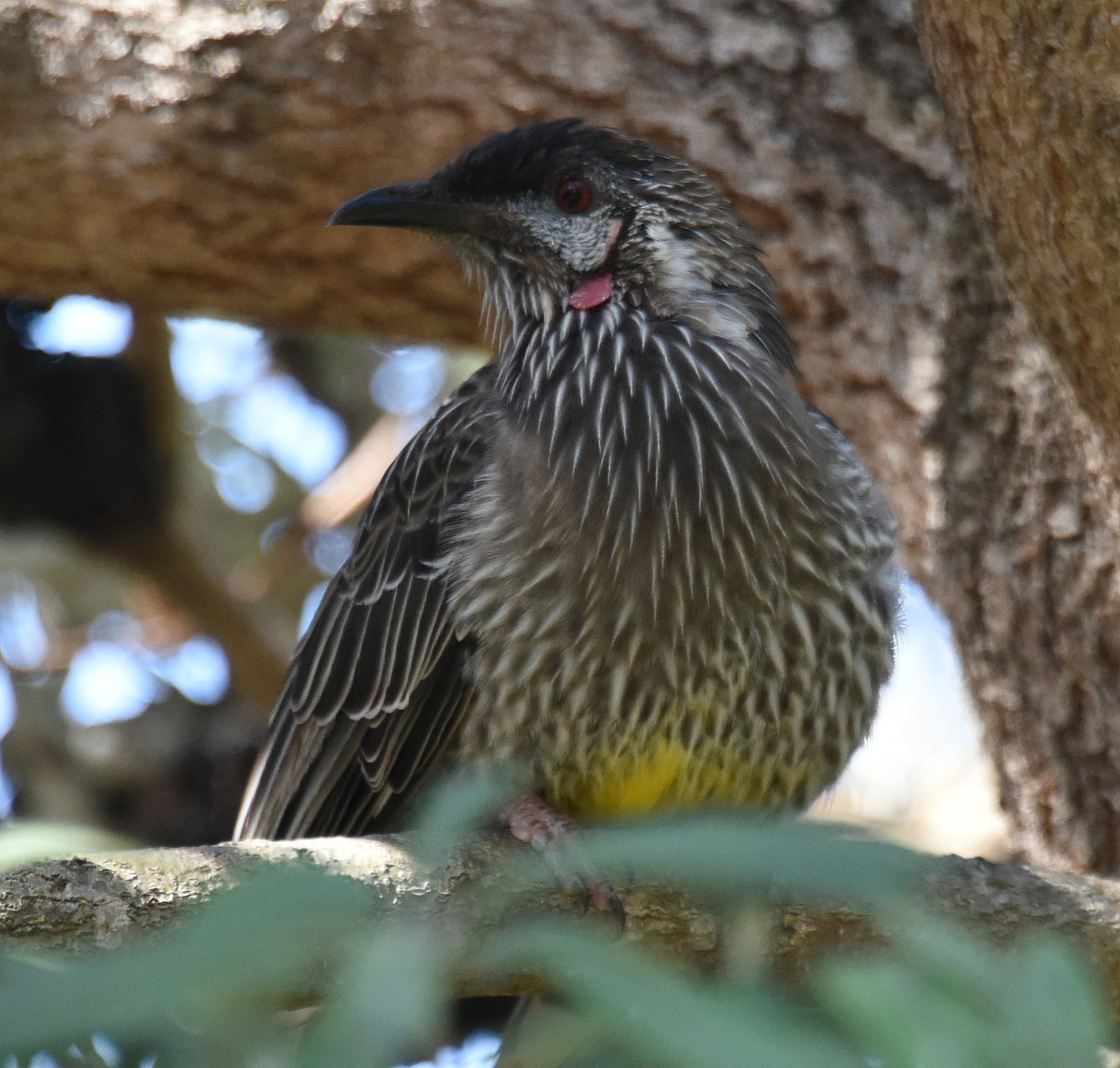
Key Field Marks
- Large honeyeater, 33-37 cm, among the biggest honeyeaters on mainland Australia.
- Streaked gray-brown body overall, with a distinctive pinkish-red fleshy wattle hanging below and behind the eye.
- Pale yellow patch on the lower belly, and a long tail broadly tipped white.
- Slightly downcurved bill typical of honeyeaters, used for probing flowers for nectar as well as taking insects.
- Often seen perched prominently in flowering eucalypts, banksias, or grevilleas, frequently in noisy small groups.
Separating It From Similar Species
- Little Wattlebird: lacks the fleshy red wattle entirely and is noticeably smaller and browner.
- Yellow Wattlebird (Tasmania only): larger still, with a longer wattle and different overall proportions; ranges do not overlap with mainland Red Wattlebird populations.
- The presence of the reddish wattle combined with large size and the yellow belly patch is diagnostic on the Australian mainland.
Habitat, Range & Season
- Common across southern and southeastern Australia, from Queensland through New South Wales, Victoria, South Australia, and southwestern Western Australia.
- Found in eucalypt woodlands, banksia and heath habitats, and increasingly in gardens and urban parks with flowering native plants.
- Largely resident, though some seasonal movements track flowering events and nectar availability.
Voice
- Harsh, coughing, gurgling calls often described as "chok-chok" or a rasping cackle; one of the more raucous-sounding honeyeaters, frequently heard before it is seen.
Frequently asked questions
What does the 'wattle' on a Red Wattlebird look like?
It is a fleshy, pinkish-red skin flap hanging below and slightly behind the eye, which is the bird's key identifying feature.
How do I tell a Red Wattlebird from a Little Wattlebird?
Red Wattlebird is larger and shows the fleshy red wattle, while Little Wattlebird is smaller, browner, and lacks any wattle at all.
What do Red Wattlebirds eat?
They feed mainly on nectar from flowering eucalypts, banksias, and grevilleas, supplemented with insects and occasionally fruit.
Where are Red Wattlebirds commonly found?
They are widespread across southern and southeastern Australia in woodlands, heathland, and increasingly in gardens with flowering native plants.