
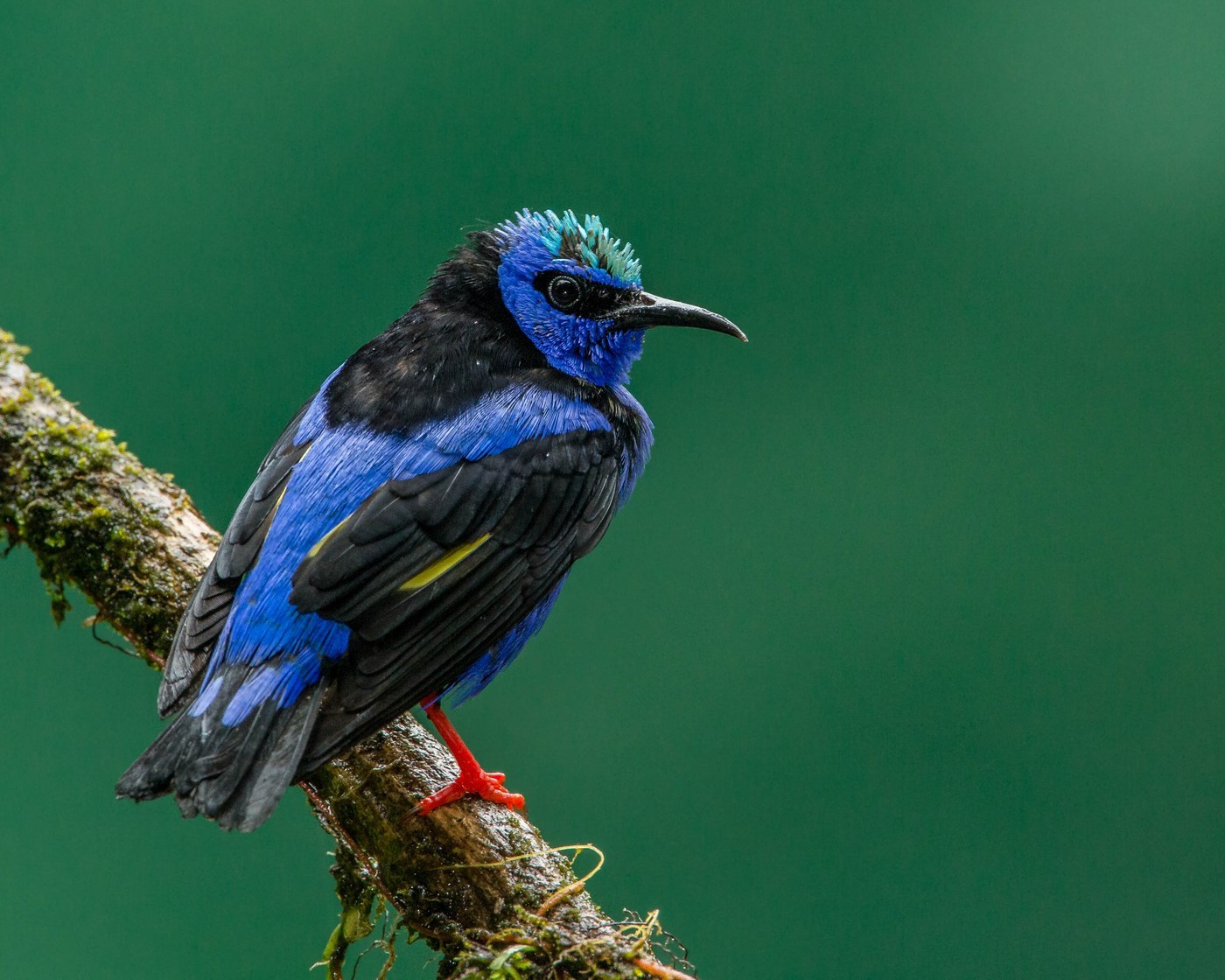
Red-legged Honeycreeper
Cyanerpes cyaneus
A small, vivid violet-blue tanager relative with bright red legs and a slender curved bill, common at flowering and fruiting trees.
- Size
- 12-13 cm (4.7-5 in) long
- Habitat
- forest edge, second growth, plantations, and gardens from Mexico to South America
- Type
- songbird
Spotted a bird like this?
Identify any bird from a photo, free.
Overview
The Red-legged Honeycreeper is a small, brilliantly colored member of the tanager family named for its bright red-orange legs, an unusual feature that stands out against its otherwise blue and black plumage. Breeding males are a rich violet-blue overall, with a contrasting turquoise crown patch and black wings, back, and tail, the legs glowing coral-red.
Females look completely different, being green overall with a faint bluish wash on the head and a pale streaked throat, a pattern that provides better camouflage while nesting. Non-breeding males often show a patchy mix of blue and green as they molt between plumages.
This honeycreeper has a fine, slightly curved bill well suited to probing flowers for nectar, and it is a familiar, active visitor to fruiting and flowering trees across its extensive range.
How to identify it
Key field marks
- Breeding male: violet-blue body, turquoise crown, black wings/back/tail, bright red legs
- Female: green overall with a bluish head wash and pale streaked throat
- Slender, slightly decurved bill
- Bright red-orange legs visible on both sexes, though more vivid on males
Similar species
Purple Honeycreeper male is deep purple rather than violet-blue and has yellow, not red, legs. Female Red-legged Honeycreepers can be confused with other green honeycreepers or female tanagers, but the decurved bill and red-orange legs help confirm identification.
Habitat & range
Habitat
Red-legged Honeycreepers inhabit forest edge, second growth, plantations such as coffee and cacao, gardens, and semi-open woodland, generally avoiding dense unbroken forest interior.
Range
The species ranges from Mexico through Central America and across much of tropical South America, including Colombia, Venezuela, the Guianas, the Amazon basin, and south to Bolivia and southern Brazil, plus Trinidad and Tobago.
Migration
Most populations are resident, though some local or seasonal movements occur in response to flowering and fruiting cycles.
Behavior & voice
Behavior
These honeycreepers are active and often gregarious, sometimes gathering in small groups at flowering or fruiting trees, and frequently joining mixed-species foraging flocks.
Voice
Calls include thin, high-pitched 'tsip' or 'seep' notes given in flight or while foraging, along with a more varied, warbling song from males.
Feeding
It feeds on nectar probed from flowers with its curved bill, as well as small fruits and insects gleaned from foliage, making it an important pollinator for some flowering trees.
Nesting and breeding
The female builds a small, neat cup nest in a tree or shrub and generally incubates alone, though the species can be seasonally polygynous in some populations, with males contributing little to nesting duties.
Frequently asked questions
Why are the legs red on a Red-legged Honeycreeper?
Bright coral-red legs are a distinctive feature of this species, most vivid in breeding males, and help distinguish it from similar blue or violet honeycreepers and tanagers.
How do male and female Red-legged Honeycreepers differ?
Breeding males are violet-blue with a turquoise crown and black wings, while females are green overall with a bluish head wash, a very different appearance.
What does the Red-legged Honeycreeper eat?
It feeds on nectar, small fruits, and insects.
Where is the Red-legged Honeycreeper found?
It ranges from Mexico through Central America and across much of tropical South America.
Red-legged Honeycreeper guides
In-depth guides for identifying, finding, and understanding Red-legged Honeycreeper.
Other birds you may enjoy

Black Redstart
13-14.5 cm (5.1-5.7 in) long, 23-26 cm wingspan

Black-throated Sparrow
12-14 cm (4.7-5.5 in) long, about 19-20 cm (7.5-8 in) wingspan

Greater Bird-of-paradise
Body about 43 cm; males with additional flank plumes up to 50 cm and long tail wires

Blue Tit
11-12 cm (4.3-4.7 in) long, 17-20 cm wingspan

Red-billed Quelea
11.5–13 cm long, wingspan about 20–22 cm
White-plumed Antbird
13-14 cm (5-5.5 in) long

Pyrrhuloxia
19-22 cm (7.5-8.7 in) long, 30 cm wingspan

Blue-gray Tanager
16-18 cm (6-7 in) long

Blackburnian Warbler
11-13 cm (4.3-5.1 in) long, 20-22 cm wingspan

Bluethroat
13-14 cm (5.1-5.5 in) long, 20-22 cm wingspan

Eurasian Nuthatch
12-14.5 cm (4.7-5.7 in) long, 22.5-27 cm wingspan

Wood Thrush
19-21 cm (7.5-8.3 in) long, about 33 cm (13 in) wingspan