
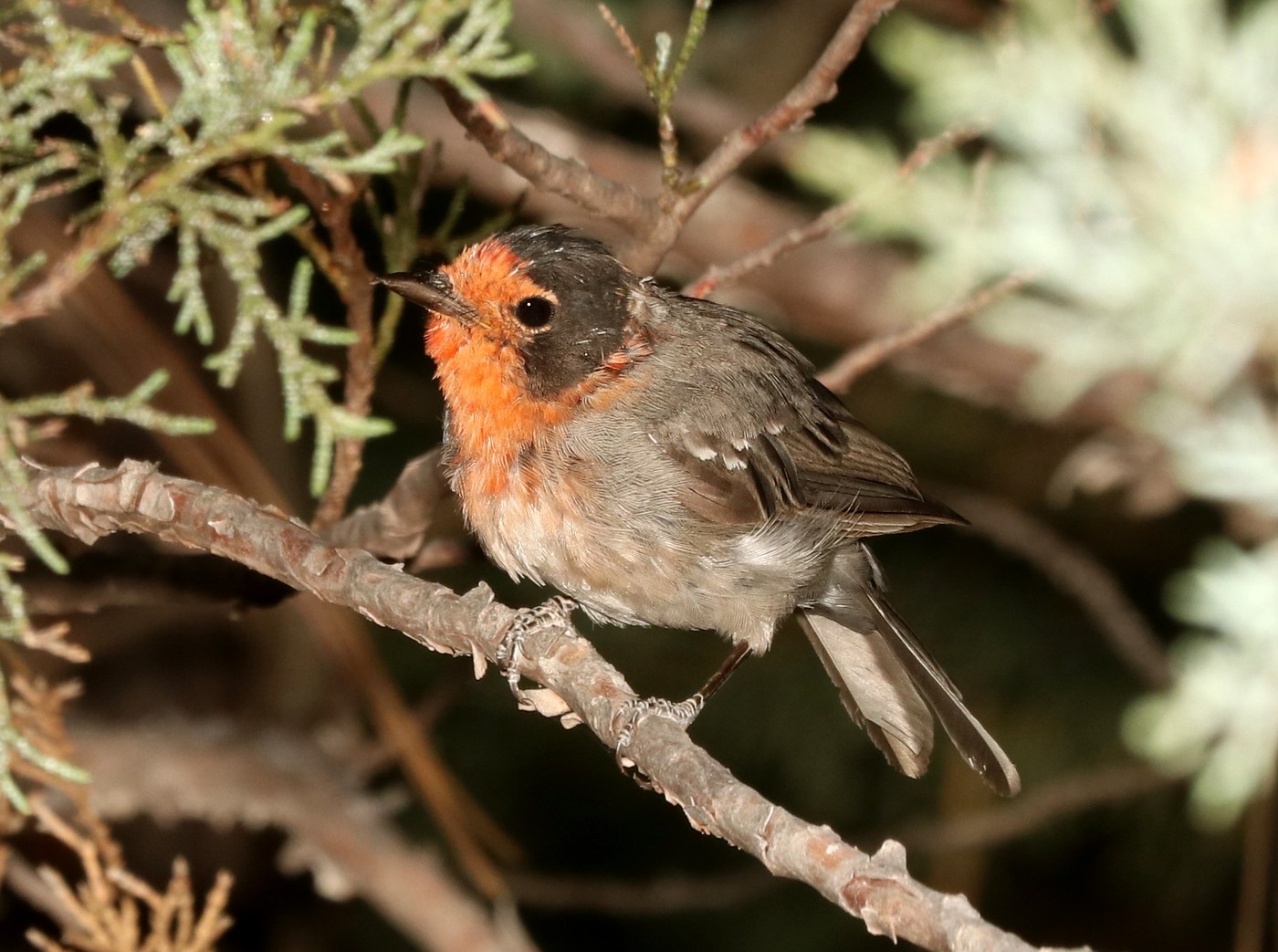
Red-faced Warbler
Cardellina rubrifrons
An unmistakable warbler with a brilliant red face and throat set against a gray body, found in high mountain forests of the Southwest.
- Size
- 13 cm (5 in) long
- Habitat
- high-elevation mixed conifer and pine-oak forests in mountains
- Type
- songbird
Spotted a bird like this?
Identify any bird from a photo, free.
Overview
The Red-faced Warbler is one of North America's most striking wood-warblers, instantly recognizable thanks to its vivid red face and throat, a pattern shared by no other US bird. It breeds in cool, high-elevation forests of southeastern Arizona and southwestern New Mexico, extending south through the mountains of Mexico.
The body is otherwise soft gray above and pale gray-white below, with a black cap and ear patch framing the red face, and a conspicuous white patch on the nape and rump. The overall effect is a bird that looks almost painted, and it is a major draw for birders visiting the sky-island mountain ranges of the Southwest.
How to identify it
Key field marks
- Bright red face and throat
- Black crown and cheek patch surrounding the red
- Clean gray back and wings, whitish underparts
- White patch on the nape and rump, visible especially in flight
- No wing bars
Similar species
The Red-faced Warbler is essentially unmistakable; no other regularly occurring North American warbler combines a red face with a black cap and gray body. Painted Redstart, which shares its range, has a red breast rather than a red face and a black body with white wing patches instead of gray.
Habitat & range
Habitat
This species favors cool, moist mixed conifer forest and pine-oak woodland at elevations generally above 2,100 m (7,000 ft), often along shaded canyon slopes with Douglas-fir, white fir, and aspen mixed with pines.
Range
In the US, Red-faced Warblers breed locally in the mountains of southeastern Arizona (Chiricahua, Santa Catalina, Pinaleno ranges, among others) and southwestern New Mexico. The species breeds more broadly south through the Sierra Madre Occidental and Sierra Madre Oriental of Mexico into Guatemala and Honduras.
Migration
Red-faced Warblers are medium-distance migrants that winter mainly in Mexico and northern Central America, arriving on breeding grounds in late April and departing by September.
Behavior & voice
Behavior
Red-faced Warblers forage actively in the mid and upper canopy, gleaning insects from foliage and frequently sallying out to catch prey in flight, flycatcher-style. They often flick their tails and wings while foraging, adding to their lively, energetic presence.
Voice
The song is a bright, warbling series of clear whistled notes, often described as sweet and musical, given from a perch in the canopy. The call note is a sharp, distinctive chip.
Nesting
Nests are built on the ground, typically tucked into a depression at the base of a tree, log, or rock on a forest slope, and are well hidden by surrounding vegetation and leaf litter. Females lay 3-4 eggs, and both parents help feed the young after hatching.
Frequently asked questions
What does a Red-faced Warbler look like?
It has a bright red face and throat, a black cap and cheek patch, gray upperparts, and pale gray-white underparts with no wing bars.
Where do Red-faced Warblers live?
They breed in high-elevation conifer and pine-oak forests of the mountains of southeastern Arizona and southwestern New Mexico, and more widely in the mountains of Mexico and northern Central America.
Are Red-faced Warblers rare?
They are uncommon and localized in the US but can be reliably found in the right high-elevation habitat in the sky-island mountains of southeastern Arizona during the breeding season.
Do Red-faced Warblers nest in trees?
No, they nest on the ground, usually in a well-hidden depression at the base of a tree or rock on a forested slope.
Red-faced Warbler guides
In-depth guides for identifying, finding, and understanding Red-faced Warbler.
Other birds you may enjoy

Black Redstart
13-14.5 cm (5.1-5.7 in) long, 23-26 cm wingspan

Black-throated Sparrow
12-14 cm (4.7-5.5 in) long, about 19-20 cm (7.5-8 in) wingspan

Greater Bird-of-paradise
Body about 43 cm; males with additional flank plumes up to 50 cm and long tail wires

Blue Tit
11-12 cm (4.3-4.7 in) long, 17-20 cm wingspan

Red-billed Quelea
11.5–13 cm long, wingspan about 20–22 cm
White-plumed Antbird
13-14 cm (5-5.5 in) long

Pyrrhuloxia
19-22 cm (7.5-8.7 in) long, 30 cm wingspan

Blue-gray Tanager
16-18 cm (6-7 in) long

Blackburnian Warbler
11-13 cm (4.3-5.1 in) long, 20-22 cm wingspan

Bluethroat
13-14 cm (5.1-5.5 in) long, 20-22 cm wingspan

Eurasian Nuthatch
12-14.5 cm (4.7-5.7 in) long, 22.5-27 cm wingspan

Wood Thrush
19-21 cm (7.5-8.3 in) long, about 33 cm (13 in) wingspan