
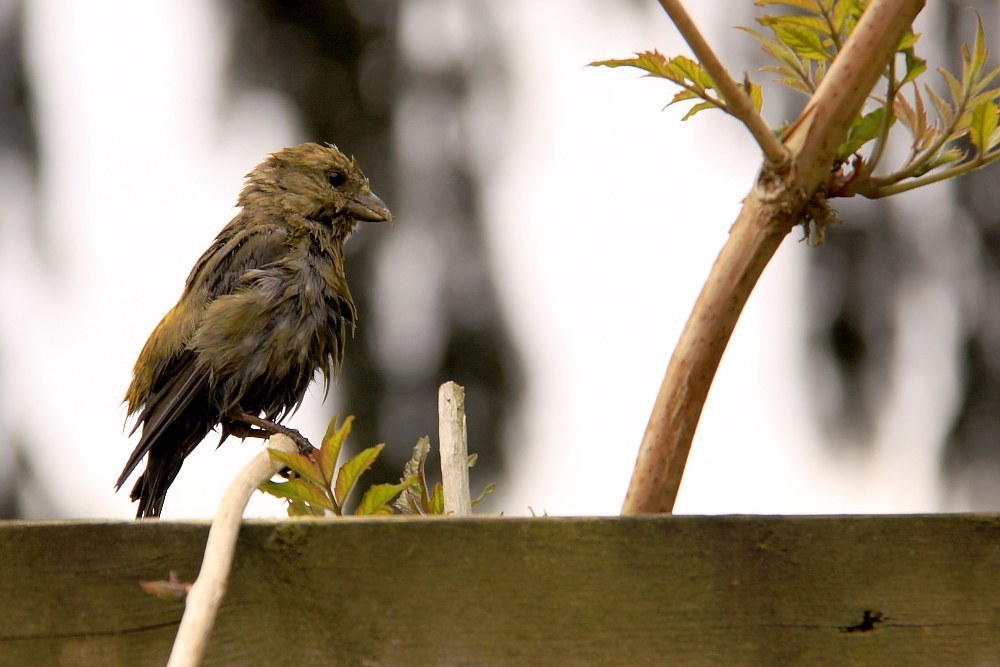
Red Crossbill
Loxia curvirostra
A stocky finch with uniquely crossed mandibles specially adapted to pry seeds from conifer cones.
- Size
- 14-20 cm (5.5-8 in) long, 27-29 cm wingspan
- Habitat
- coniferous forests worldwide
- Type
- songbird
Spotted a bird like this?
Identify any bird from a photo, free.
Overview
The Red Crossbill is instantly recognizable for its odd, crossed bill tips, an adaptation for extracting seeds from between the scales of conifer cones. Adult males are brick-red to orange-red overall with darker wings and tail, while females are dull olive-yellow to gray-green. Juveniles are heavily streaked brownish. The species is notoriously variable, with numerous distinct "call types" across North America that differ subtly in bill size, flight calls, and preferred conifer species, some of which may eventually be recognized as separate species.
Red Crossbills are nomadic wanderers, following unpredictable cone crops rather than holding fixed territories or migrating on a set schedule, and can breed at almost any time of year when a good cone crop is found.
How to identify it
Key Field Marks
- Distinctive crossed bill tip, visible at close range or with binoculars
- Males: brick-red to orange-red body, darker unmarked wings and tail
- Females: olive-yellow to grayish-olive with a yellowish rump
- No wing bars (key difference from White-winged Crossbill)
- Stocky build, short notched tail
Similar Species
- White-winged Crossbill: shows two bold white wing bars, which Red Crossbill lacks; White-winged males tend to be more pink than orange-red.
- Pine Grosbeak: much larger, with a straight (uncrossed) bill and white wing bars.
- House Finch/Purple Finch: lack the crossed bill and are more streaked, especially on the flanks.
Habitat & range
Habitat
Red Crossbills inhabit coniferous forests of pine, spruce, fir, hemlock, and larch, tracking cone crops that vary year to year and region to region.
Range
This is one of the most widely distributed finches, found across boreal and montane conifer forests of North America, Europe, Asia, and parts of Central America and the Caribbean pine forests.
Migration
Rather than following a predictable migratory pattern, Red Crossbills are irruptive and nomadic, moving unpredictably in search of abundant cone crops and sometimes breeding far outside their typical range or season when food is plentiful.
Behavior & voice
Behavior
Flocks move erratically through conifer stands, often heard before seen as they call in flight. Their specialized bill lets them wedge cone scales apart and use the tongue to extract seeds efficiently.
Voice
Flight calls are sharp "kip-kip" or "jip-jip" notes, varying subtly among the different call types; the song is a varied series of warbles, trills, and chips given from a treetop perch.
Feeding
Conifer seeds make up the vast majority of the diet, supplemented occasionally with other seeds, buds, and small amounts of insects; crossbills are also known to visit mineral licks and roadside grit or salt.
Nesting
Breeding can occur nearly any month of the year when cone crops are abundant, even in the dead of winter. Nests are well-insulated cups of twigs, bark strips, and grass placed on a conifer branch, typically holding 3-4 eggs incubated by the female.
Frequently asked questions
Why does the Red Crossbill have a crossed bill?
The crossed mandible tips let the bird pry apart the scales of conifer cones and use its tongue to extract the seed inside, an adaptation unique among North American finches.
Can Red Crossbills breed in winter?
Yes, because their food supply depends on cone crops rather than the calendar, Red Crossbills can nest at almost any time of year, including midwinter, when cones are abundant.
How do I tell a Red Crossbill from a White-winged Crossbill?
Red Crossbills lack wing bars and are usually brick-red (males) or olive (females), while White-winged Crossbills show two bold white wing bars and tend to be pinker.
Why are there different 'types' of Red Crossbill?
Populations have evolved subtly different bill sizes and flight calls adapted to particular conifer species, leading researchers to recognize multiple distinct call types that may represent cryptic species.
What do Red Crossbills eat?
Primarily the seeds of conifer cones such as pine, spruce, fir, and hemlock, extracted using their specialized crossed bill.
Red Crossbill guides
In-depth guides for identifying, finding, and understanding Red Crossbill.
Other birds you may enjoy

Black Redstart
13-14.5 cm (5.1-5.7 in) long, 23-26 cm wingspan

Black-throated Sparrow
12-14 cm (4.7-5.5 in) long, about 19-20 cm (7.5-8 in) wingspan

Greater Bird-of-paradise
Body about 43 cm; males with additional flank plumes up to 50 cm and long tail wires

Blue Tit
11-12 cm (4.3-4.7 in) long, 17-20 cm wingspan

Red-billed Quelea
11.5–13 cm long, wingspan about 20–22 cm
White-plumed Antbird
13-14 cm (5-5.5 in) long

Pyrrhuloxia
19-22 cm (7.5-8.7 in) long, 30 cm wingspan

Blue-gray Tanager
16-18 cm (6-7 in) long

Blackburnian Warbler
11-13 cm (4.3-5.1 in) long, 20-22 cm wingspan

Bluethroat
13-14 cm (5.1-5.5 in) long, 20-22 cm wingspan

Eurasian Nuthatch
12-14.5 cm (4.7-5.7 in) long, 22.5-27 cm wingspan

Wood Thrush
19-21 cm (7.5-8.3 in) long, about 33 cm (13 in) wingspan