
Red Crossbill Identification Guide
The Red Crossbill is a stocky, nomadic finch of conifer forests whose uniquely crossed bill tips let it pry open cone scales to extract seeds.
Read the full Red Crossbill encyclopedia entry →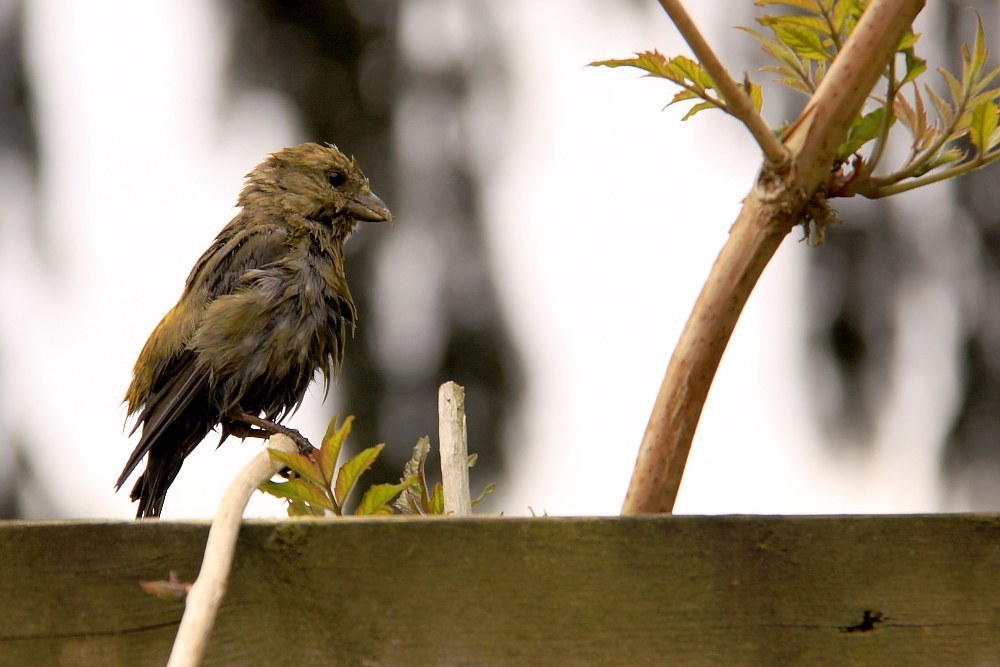
Key Field Marks
- Size & shape: Medium-sized, stocky finch (14–20 cm depending on population) with a large head, short notched tail, and short legs — a chunky, parrot-like silhouette when clambering over cones.
- Bill: The defining feature — a stout, strongly curved bill with the upper and lower mandible tips crossing rather than meeting, an adaptation for prying apart conifer cone scales to extract seeds. The cross direction (upper mandible tip left or right of lower) varies individually and has no field significance.
- Male plumage: Brick-red to orange-red overall, brightest on the rump, with darker brownish wings and tail (no wing bars in most populations).
- Female plumage: Olive-yellow to grayish-green overall with a brighter yellowish rump, dusky wings and tail.
- Immatures: Heavily streaked brown, more sparrow-like, before molting into adult-type plumage.
- Behavior: Forages acrobatically, often hanging upside-down or parrot-like while extracting seeds from conifer cones; highly nomadic and often encountered in flocks moving unpredictably in search of good cone crops; frequently seen at grit sources (roadsides, mineral licks) and occasionally drinking at puddles.
Separating It From Similar Species
- Vs. White-winged Crossbill: White-winged Crossbill shows two bold white wing bars and a black-and-white patterned wing, quite different from the plain dark wings of most Red Crossbill types; White-winged is also slightly smaller-billed on average and specializes more on spruce.
- Vs. Cassin's Finch or House Finch: Neither shows a crossed bill tip; this feature, visible with a good look or photo, is diagnostic and separates crossbills from all other finches immediately.
- "Call types": Red Crossbill is now understood to comprise multiple vocally and morphologically distinct "call types" (some proposed as separate species) tied to different conifer specializations (e.g., ponderosa pine, ancient forest wet cones, hemlock); serious identification to type generally requires flight call recordings analyzed by ear or sonogram, beyond typical visual field marks.
Where & When To See It
Found across coniferous forests of North America, Eurasia, and parts of montane Central America and North Africa, wherever cone-bearing conifers (pine, spruce, hemlock, Douglas-fir) occur. Highly irruptive and nomadic — flocks move erratically in response to cone crop abundance, sometimes remaining in one forest for years and sometimes irrupting far south of typical range in poor-cone-crop years. Breeding can occur at almost any time of year when cone crops are abundant, unusual among songbirds.
Voice & Song Cues
Flight call is a sharp, hard "kip-kip" or "jip-jip," given in flight and while perched; call structure varies subtly among the different "call types" and is the primary tool researchers use to distinguish them. Song is a varied warbling series mixed with call-like notes, often given from a high conifer perch.
Frequently asked questions
What is the most distinctive feature of a Red Crossbill?
The crossed bill tips — the upper and lower mandible cross past each other rather than meeting evenly, an adaptation for prying open conifer cone scales to extract seeds. No other North American finch shows this.
How do I tell a Red Crossbill from a White-winged Crossbill?
Check the wings: White-winged Crossbill has two bold white wing bars on blackish wings, while Red Crossbill typically has plain dark wings without wing bars.
Why are Red Crossbills so hard to predict where to find?
They are highly nomadic, following conifer cone crop abundance rather than fixed migration routes, so flocks can be abundant in a forest one year and absent the next.
Are there different types of Red Crossbill?
Yes, researchers recognize multiple vocally distinct 'call types' within Red Crossbill, each associated with different conifer species and bill-size adaptations; some may eventually be split into separate species, but distinguishing them typically requires analyzing flight-call recordings.