
Red-cockaded Woodpecker
Dryobates borealis
A rare cooperative-breeding woodpecker of the southeastern pine forests that excavates its nest exclusively in living, old-growth pines.
- Size
- 20-23 cm (8-9 in) long, 35-38 cm wingspan
- Habitat
- mature open longleaf and other southern pine forests with minimal understory
- Type
- woodpecker
Spotted a bird like this?
Identify any bird from a photo, free.
Overview
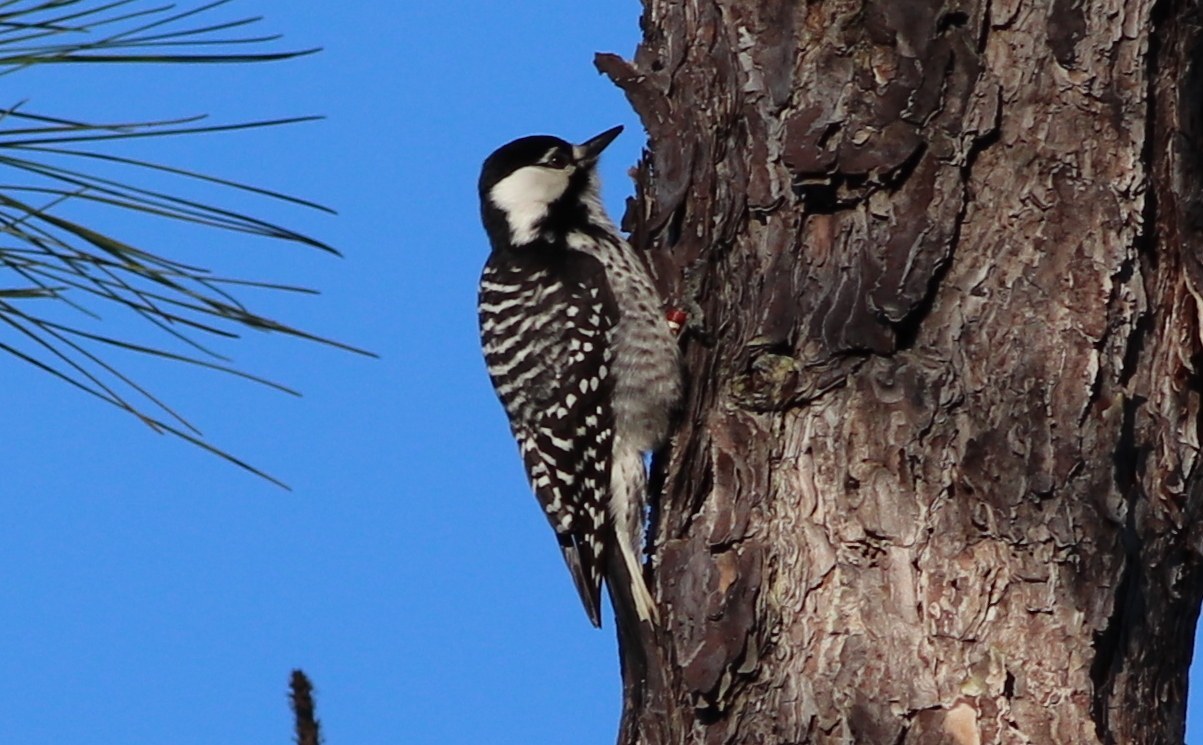
The Red-cockaded Woodpecker is a small, black-and-white barred woodpecker of the southeastern United States, with a bold black cap and nape, white cheek patches, and finely barred black-and-white back. The tiny red 'cockade' feathers on the male's head, for which the species is named, are rarely visible in the field.
This species is famous among ornithologists both for its dependence on mature, living pine trees for nesting and for its cooperative breeding system, in which offspring from previous years, usually male, remain with their parents as helpers to raise subsequent broods.
How to identify it
Key Field Marks
- Black cap and nape contrasting with large white cheek patches
- Finely barred black-and-white back, giving a 'ladder-backed' look
- White underparts with black spotting along the flanks
- Tiny red cockade feathers on the male's head, usually concealed and rarely seen
Similar Species
- Hairy and Downy Woodpeckers show a solid white back stripe rather than fine barring, and lack the bold white cheek patch bordered by black.
- Ladder-backed Woodpecker has a streaked, spotted breast and different range, mostly not overlapping.
Habitat & range
Habitat
Red-cockaded Woodpeckers require mature, open pine forest, historically longleaf pine savanna, with widely spaced older trees, sparse midstory, and a grassy understory maintained by frequent fire.
Range
The species is found in fragmented populations across the southeastern United States, from Texas and Oklahoma east to Florida and North Carolina, in remaining stands of managed pine forest and a few protected preserves.
Migration
This species is entirely non-migratory and highly sedentary, with family groups remaining on the same territory year-round for generations.
Behavior & voice
Behavior
Red-cockaded Woodpeckers live in small family groups called clusters, centered on multiple active nest and roost cavities excavated in living pines. Cooperative breeding is common, with helper birds, typically male offspring from prior years, assisting in raising the current brood.
Voice
Calls include a distinctive raspy, high-pitched sklit note and various chattering calls used to maintain contact within the group.
Feeding
Diet consists mainly of insects such as beetles, ants, and their larvae gleaned from pine bark, along with some seeds and fruit.
Nesting
Uniquely among North American woodpeckers, cavities are excavated in living pine trees, usually those infected with red heart fungus that softens the heartwood; the process can take over a year. Birds drill small holes around the cavity entrance that cause sap to flow, creating a sticky barrier that deters climbing predators such as snakes.
Frequently asked questions
Why is the Red-cockaded Woodpecker considered special?
It is one of the few woodpeckers that excavates its nest cavity in a living tree rather than a dead one, and it lives in cooperative family groups with helper birds assisting in raising young.
Is the Red-cockaded Woodpecker endangered?
It was long listed as endangered and has been reclassified as Near Threatened following decades of habitat management and recovery efforts, though it remains dependent on active conservation of mature pine forest.
Where does the Red-cockaded Woodpecker live?
It lives in mature, open longleaf and other southern pine forests across scattered locations in the southeastern United States.
Why do the birds drill small holes around their nest cavity?
The holes cause sticky pine sap to flow down the trunk, creating a barrier that helps deter climbing predators such as rat snakes.
Red-cockaded Woodpecker guides
In-depth guides for identifying, finding, and understanding Red-cockaded Woodpecker.
Other birds you may enjoy
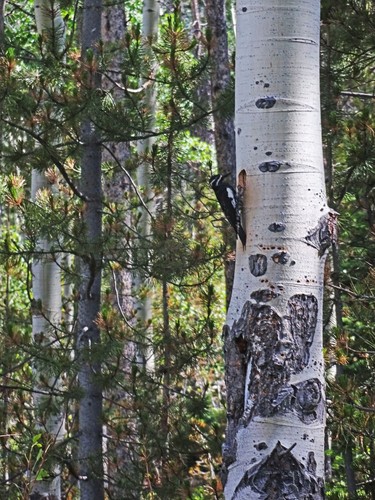
Williamson's Sapsucker
21-25 cm (8-10 in) long, 40-42 cm wingspan
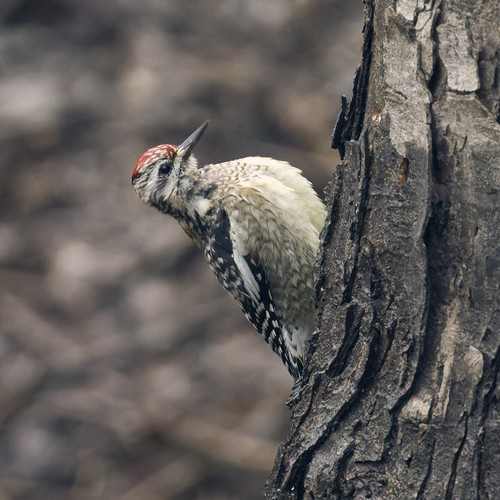
Yellow-bellied Sapsucker
18-21 cm (7-8.3 in) long, 34-40 cm wingspan
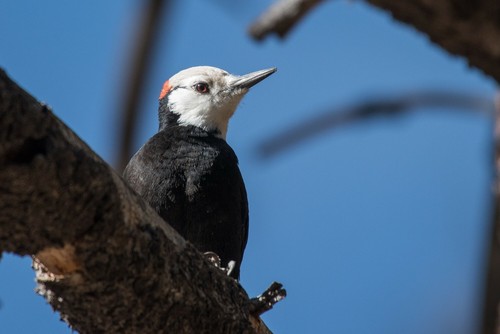
White-headed Woodpecker
20-23 cm (8-9 in) long, 38-41 cm wingspan
Red-headed Woodpecker
19-23 cm (7.5-9 in) long, 42-46 cm wingspan
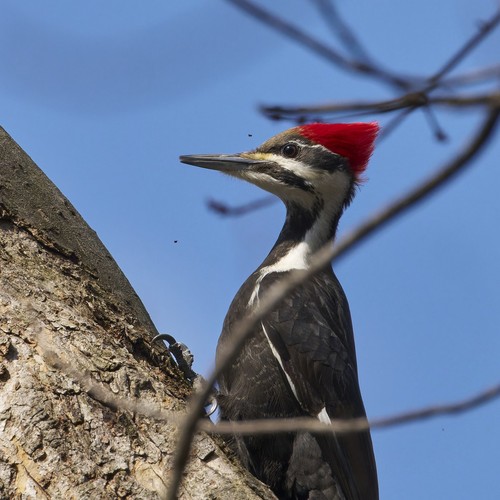
Pileated Woodpecker
40-49 cm (16-19 in) long, 66-75 cm wingspan
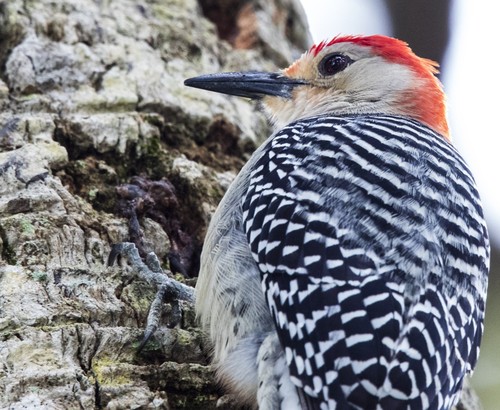
Red-bellied Woodpecker
22-27 cm (9-10.5 in) long, 38-46 cm wingspan
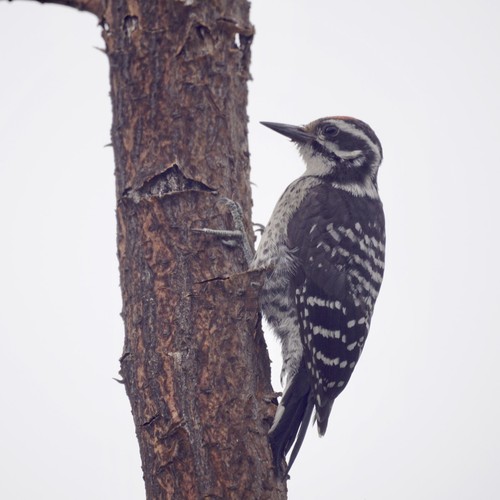
Nuttall's Woodpecker
18-20 cm (7-8 in) long, 34-38 cm wingspan
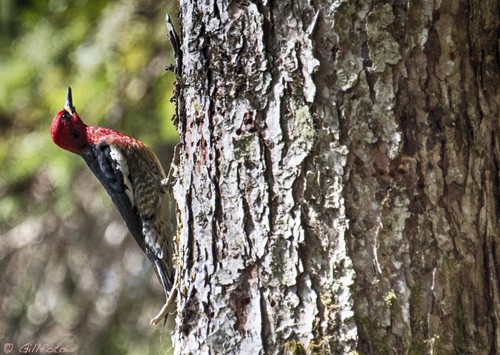
Red-breasted Sapsucker
20-23 cm (8-9 in) long, 34-40 cm wingspan
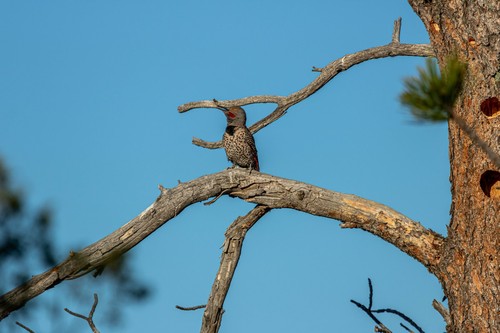
Northern Flicker
28-36 cm (11-14 in) long, 42-51 cm wingspan
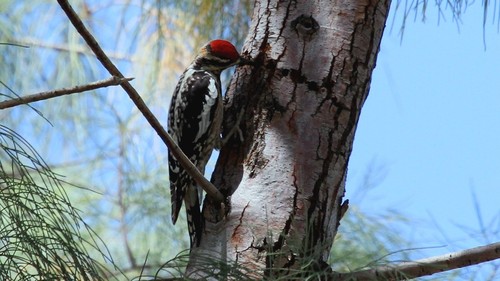
Red-naped Sapsucker
19-21 cm (7.5-8.3 in) long, 34-40 cm wingspan
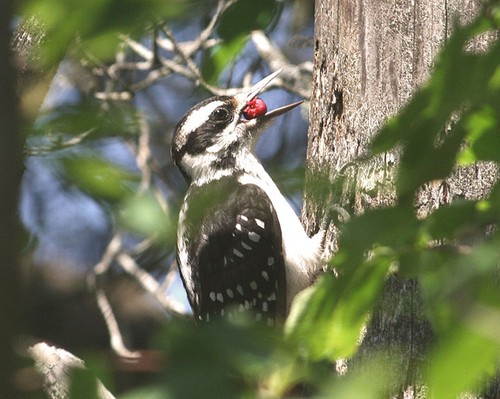
Hairy Woodpecker
23-26 cm (9-10 in) long, 33-41 cm wingspan
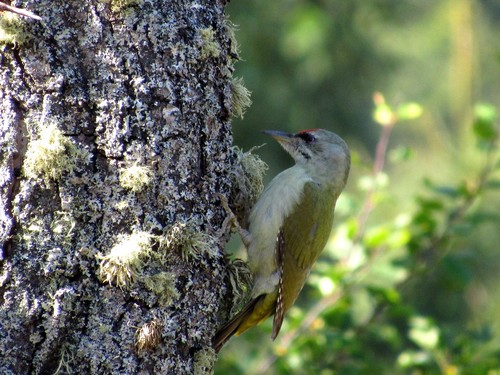
Grey-headed Woodpecker
25-33 cm (10-13 in) long, 38-40 cm wingspan