
Red-cockaded Woodpecker Identification Guide
The Red-cockaded Woodpecker is a small, endangered black-and-white woodpecker restricted to mature open pine forests of the southeastern United States.
Read the full Red-cockaded Woodpecker encyclopedia entry →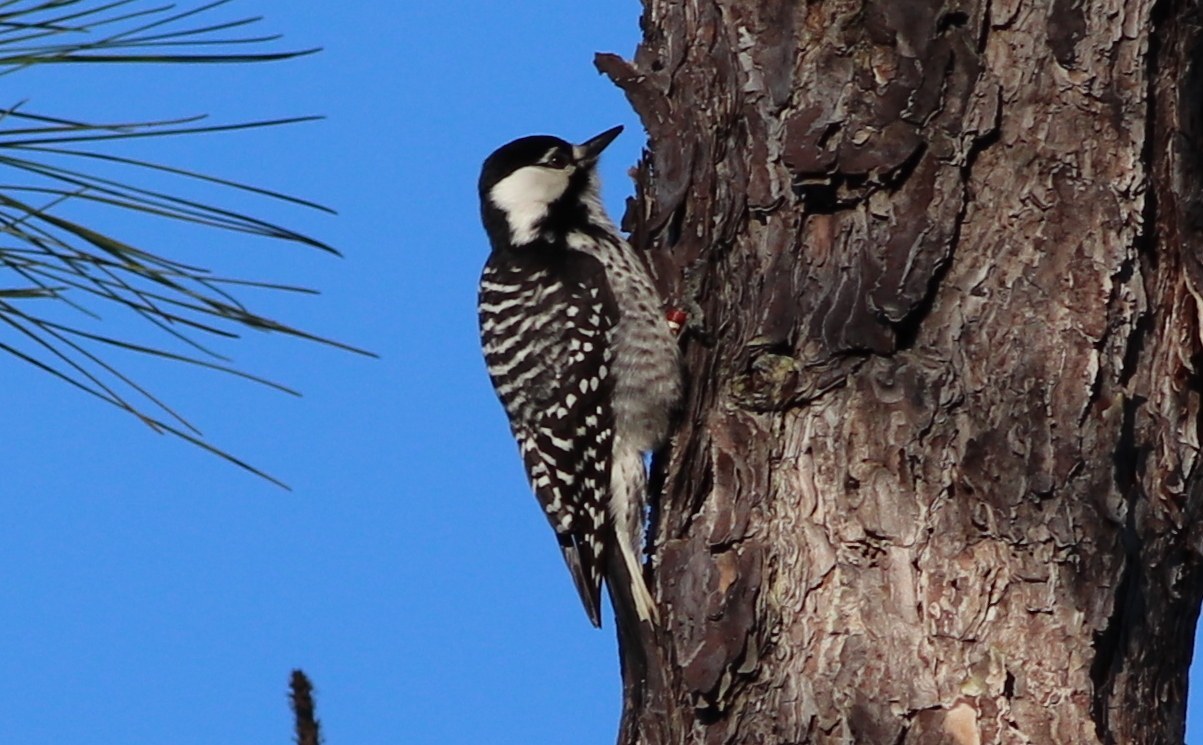
Key Field Marks
- Size & shape: Small woodpecker (20–23 cm), similar in size to a Downy or Hairy Woodpecker but with a proportionately larger, blockier head and stiff, pointed tail used for bracing against tree trunks.
- Plumage: Black-and-white barred (ladder-backed) pattern on the back and wings; large white cheek patch bordered above by a black cap and nape stripe that meets at the back of the neck; underparts whitish with scattered black spotting/streaking on the flanks.
- The "cockade": Adult males show a tiny, usually concealed red streak (the namesake "cockade") on each side of the black cap, visible only at very close range or when the bird is agitated and raises its head feathers — rarely a practical field mark.
- Bill: Straight, chisel-shaped, blackish, typical woodpecker bill.
- Behavior: Highly social for a woodpecker, living in small family groups/cooperative breeding clans; excavates and roosts in cavities drilled into living mature pine trees (not dead snags), and drills small resin wells around the cavity entrance so sticky pine sap runs down the trunk — a deterrent against snakes and other predators, and a signature clue to an active cavity tree.
Separating It From Similar Species
- Vs. Downy/Hairy Woodpecker: Both lack the Red-cockaded's large solid white cheek patch bordered by black above and below; Downy/Hairy have a white back stripe (not a barred black-and-white back) and males show a red patch on the nape/head, not a barely visible tiny red streak on the cheek/cap side.
- Vs. Ladder-backed Woodpecker: Range does not overlap in the pine belt where Red-cockaded occurs (Ladder-backed is a southwestern species), and Ladder-backed has a more solidly black-and-white barred face pattern without the large clean white cheek patch.
- Key confirming clue: Look for the sap-streaked "candle" resin flow around active cavity holes on living pine trunks — a behavior unique to this species among North American woodpeckers, and a reliable way to locate colonies even without seeing the bird.
Where & When To See It
Restricted to mature, open, fire-maintained pine forests (historically longleaf pine, also loblolly and other southern pines) of the southeastern United States, from Texas and Oklahoma east to Florida and north to Virginia, in scattered, actively managed populations, many on protected lands (national forests, military bases, wildlife refuges). Non-migratory, resident year-round in cooperative breeding groups defending a shared territory of cavity trees. Federally listed as endangered in the U.S., with populations dependent on active habitat management including prescribed burning to maintain open pine understory.
Voice & Song Cues
Gives a distinctive raspy, sharp "sklit" or "shreep" call, often repeated, plus rattling chatter among group members at cavity trees, especially around dawn as birds leave their roost holes together.
Frequently asked questions
How is a Red-cockaded Woodpecker different from a Downy or Hairy Woodpecker?
Look for the large solid white cheek patch bordered by a black cap and nape stripe, and a ladder-barred (not white-striped) back — Downy and Hairy Woodpeckers lack the bold white cheek patch and show a white back stripe instead.
Why are Red-cockaded Woodpeckers considered endangered?
They depend on mature, open, fire-maintained pine forest — especially longleaf pine — for excavating cavities in living trees, habitat that has been drastically reduced by logging and fire suppression across the southeastern U.S.
What is the sap or resin around some pine tree holes a sign of?
Red-cockaded Woodpeckers drill small resin wells around their nest/roost cavity entrances in living pines, causing sap to flow down the trunk as a defense against climbing predators like rat snakes — a reliable sign of an active cavity even when the bird isn't visible.
Where can I find Red-cockaded Woodpeckers?
In scattered, actively managed mature pine forest populations across the southeastern U.S. from Texas and Oklahoma to Florida and Virginia, often on protected lands such as national forests, wildlife refuges, and military bases.