
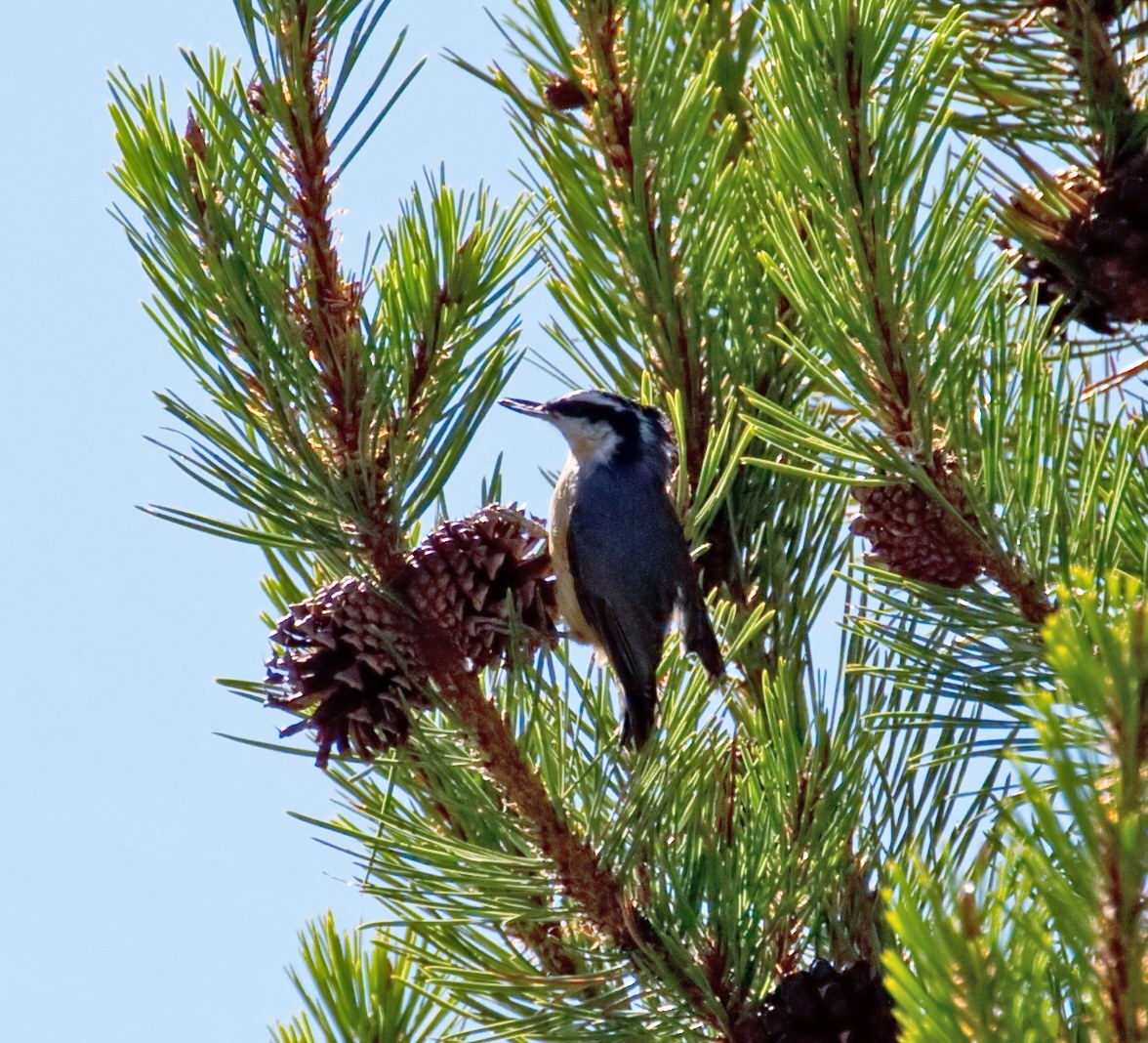
Red-breasted Nuthatch
Sitta canadensis
A tiny, tin-horn-voiced nuthatch of conifer forests, with rusty-orange underparts and a bold black eye-stripe bordered by white.
- Size
- 10-12 cm (4-4.75 in) long, 19-21 cm (7.5-8 in) wingspan
- Habitat
- coniferous and mixed forests
- Type
- songbird
Spotted a bird like this?
Identify any bird from a photo, free.
Overview
The Red-breasted Nuthatch is a small, energetic bird of coniferous and mixed forests, smaller and more colorful than its relative the White-breasted Nuthatch. It has blue-gray upperparts, a black cap, and a bold black eye-stripe bordered above by a white eyebrow, with rusty-orange underparts that give the species its name (males typically show deeper rust color than females).
Like other nuthatches, it has a compact body, short tail, and long straight bill, and is well known for creeping headfirst down tree trunks and branches while foraging.
How to identify it
Key Field Marks
- Rusty-orange underparts (deeper in males, paler in females)
- Black cap and bold black eye-stripe bordered by a white eyebrow stripe
- Blue-gray upperparts and short tail
- Small size, smaller than the White-breasted Nuthatch
Similar Species
- White-breasted Nuthatch: larger, with plain white underparts (only rusty on the flanks) and no bold black eye-stripe.
- Brown-headed Nuthatch: has a brown cap rather than black, and lacks the strong rusty underparts, restricted to southeastern pine forests.
- Black-capped Chickadee: superficially similar black-and-white head pattern but has a black bib (not an eye-stripe) and lacks the nuthatch's bark-creeping behavior and rusty underparts.
Habitat & range
Habitat
Red-breasted Nuthatches are strongly associated with coniferous and mixed forests, especially spruce, fir, and pine, though they also use mixed woodlands during migration and winter.
Range
They breed across the boreal forest of Canada and Alaska, the northern United States, and higher-elevation coniferous forests in the western mountains and Appalachians, and winter more widely across the U.S.
Migration
This species is an irregular, irruptive migrant: in years of poor cone crops in the north, large numbers move south and east well beyond their typical winter range, while in other years many stay in or near their breeding range.
Behavior & voice
Behavior
Red-breasted Nuthatches forage actively on tree trunks and branches, often descending headfirst, and are known to smear sticky conifer resin around the entrance to their nest cavity, possibly to deter predators or competitors.
Voice
Their call is a nasal, high-pitched, tin-horn-like "yank-yank," higher-pitched and more repetitive than the White-breasted Nuthatch's call, often the first clue to their presence in a conifer stand.
Feeding
They eat insects and spiders gleaned from bark during the breeding season, and rely heavily on conifer seeds in fall and winter, often caching seeds in bark crevices for later use.
Nesting & Breeding
Pairs excavate their own nest cavity in soft or decayed wood, unusual among nuthatches, and famously apply conifer pitch around the entrance hole. They typically lay 5-6 eggs in a single brood.
Frequently asked questions
Why do Red-breasted Nuthatches smear pitch around their nest hole?
They apply sticky conifer resin around the entrance to the nest cavity, which is thought to deter predators, competitors, or parasites from entering, and the nuthatches themselves often dive straight through the opening to avoid the sticky residue.
What causes Red-breasted Nuthatch irruptions?
In years when conifer cone crops fail across the northern boreal forest, large numbers of Red-breasted Nuthatches move south and east in search of food, sometimes appearing far outside their usual range.
How can I tell a Red-breasted from a White-breasted Nuthatch?
Red-breasted Nuthatches are smaller, have rusty-orange underparts, and show a bold black eye-stripe bordered by white, while White-breasted Nuthatches have plain white underparts and no eye-stripe.
What does the Red-breasted Nuthatch sound like?
It gives a high, nasal, repetitive "yank-yank" call, often compared to a tiny tin horn, higher-pitched than the White-breasted Nuthatch's call.
What habitat do Red-breasted Nuthatches prefer?
They are closely tied to coniferous and mixed forests, especially those with spruce, fir, or pine, where conifer seeds form a major part of their winter diet.
Red-breasted Nuthatch guides
In-depth guides for identifying, finding, and understanding Red-breasted Nuthatch.
Other birds you may enjoy

Black Redstart
13-14.5 cm (5.1-5.7 in) long, 23-26 cm wingspan

Black-throated Sparrow
12-14 cm (4.7-5.5 in) long, about 19-20 cm (7.5-8 in) wingspan

Greater Bird-of-paradise
Body about 43 cm; males with additional flank plumes up to 50 cm and long tail wires

Blue Tit
11-12 cm (4.3-4.7 in) long, 17-20 cm wingspan

Red-billed Quelea
11.5–13 cm long, wingspan about 20–22 cm
White-plumed Antbird
13-14 cm (5-5.5 in) long

Pyrrhuloxia
19-22 cm (7.5-8.7 in) long, 30 cm wingspan

Blue-gray Tanager
16-18 cm (6-7 in) long

Blackburnian Warbler
11-13 cm (4.3-5.1 in) long, 20-22 cm wingspan

Bluethroat
13-14 cm (5.1-5.5 in) long, 20-22 cm wingspan

Eurasian Nuthatch
12-14.5 cm (4.7-5.7 in) long, 22.5-27 cm wingspan

Wood Thrush
19-21 cm (7.5-8.3 in) long, about 33 cm (13 in) wingspan