
Red-breasted Nuthatch Identification Guide
The Red-breasted Nuthatch is a small, tin-horn-voiced songbird of North American conifer forests known for creeping headfirst down tree trunks.
Read the full Red-breasted Nuthatch encyclopedia entry →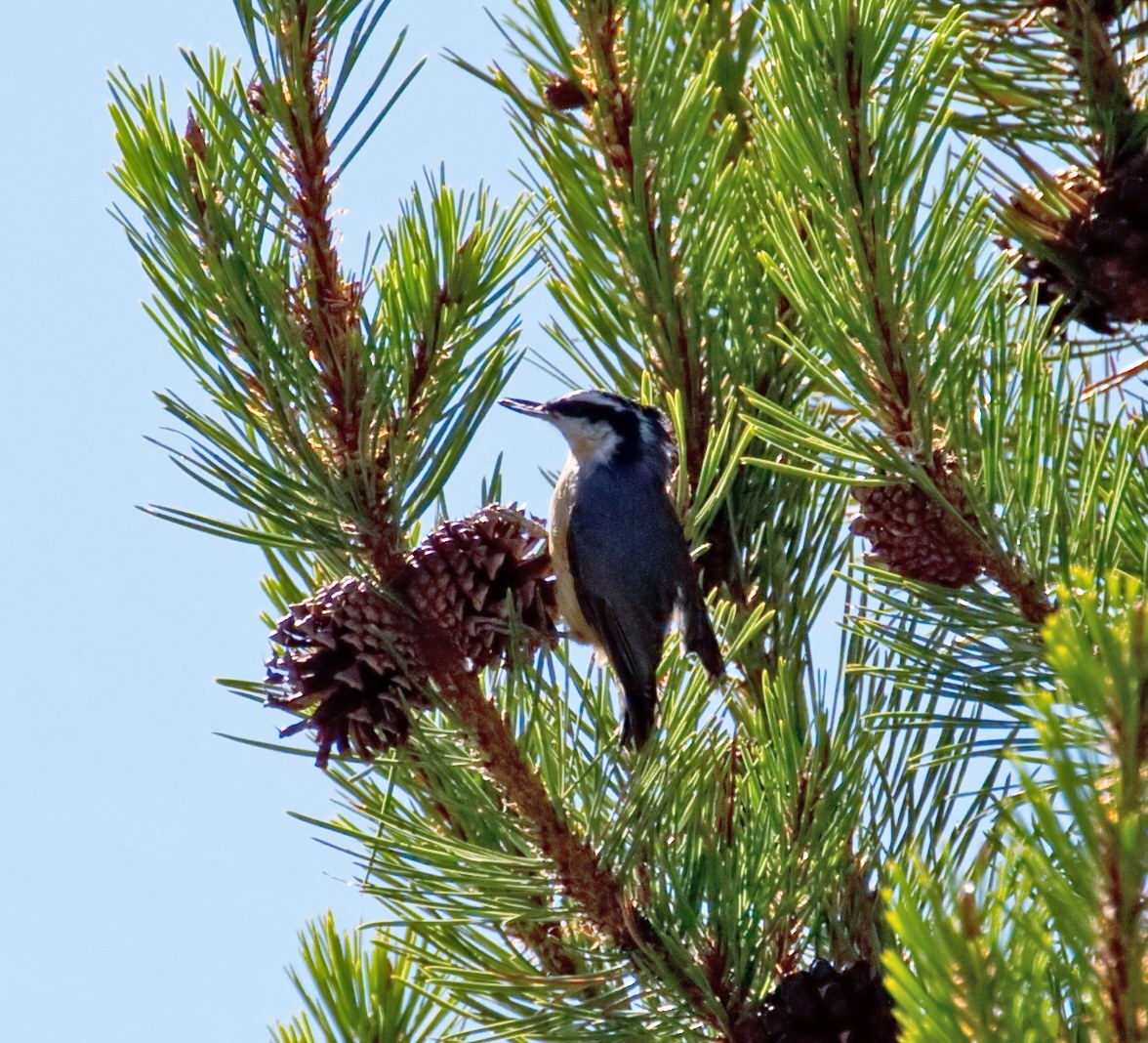
Key Field Marks
- Size & shape: Very small (11 cm), compact, short-tailed songbird with a large head, short neck, and straight, sharply pointed bill.
- Plumage: Blue-gray upperparts; rich rusty-orange underparts (deeper and more saturated in males, paler buffy-orange in females); bold black eyeline bordered above by a white eyebrow stripe and a black crown.
- Bill & legs: Bill straight, thin, and pointed, used for wedging seeds into bark; legs and strong feet built for climbing.
- Behavior: Highly acrobatic — the classic nuthatch trait of creeping headfirst down tree trunks and along the undersides of branches, unlike woodpeckers or creepers that only move upward or in spirals. Often forages actively in conifer canopy, wedging seeds into bark crevices to hammer them open.
Separating It From Similar Species
- Vs. White-breasted Nuthatch: White-breasted is larger, has clean white underparts (no rusty wash) and a white face without a black eyeline, and prefers deciduous/mixed woods rather than conifers.
- Vs. Brown-headed Nuthatch / Pygmy Nuthatch: Both of those have brown or gray-brown caps rather than the Red-breasted's solid black crown, and lack the bold black eyestripe and rusty underparts.
- Vs. chickadees: Chickadees have black caps and bibs but a longer tail and lack the nuthatch's stubby-tailed, top-heavy silhouette and headfirst-down-trunk creeping habit.
Where & When To See It
A conifer specialist, closely tied to spruce, fir, pine, and other coniferous or mixed forest across Canada, the northern and western United States, and the Appalachian and western mountain ranges south into higher elevations. Populations are irruptive — in years of poor conifer cone crops, large numbers move south and to lower elevations in fall and winter ("irruption years"), sometimes appearing at feeders far outside the normal breeding range. Resident year-round where conifers are consistently productive.
Voice & Song Cues
The signature sound is a nasal, tin-horn or toy-trumpet "yank-yank-yank," higher-pitched, faster, and more nasal than the slower, lower "yank" of White-breasted Nuthatch. Often the first clue to its presence in a conifer stand well before it's seen.
Frequently asked questions
How do I tell a Red-breasted Nuthatch from a White-breasted Nuthatch?
Look for rusty-orange underparts and a bold black eyeline on Red-breasted versus clean white underparts and a plain white face on the larger White-breasted Nuthatch; voice also differs — Red-breasted's call is higher, faster, and more nasal.
Why do Red-breasted Nuthatches sometimes show up far south of their usual range?
They are irruptive migrants — when conifer cone crops fail in the boreal forest, large numbers move south and to lower elevations in search of food, sometimes turning up at feeders well outside the typical range.
What habitat should I search for Red-breasted Nuthatches?
Coniferous and mixed forests with spruce, fir, or pine are the best bet, including mountain forests in the West and boreal forest across Canada and the northern U.S.
What is that tin-horn or toy-trumpet sound in a pine forest?
That nasal, repeated 'yank-yank-yank' call is the classic vocalization of the Red-breasted Nuthatch, often heard before the bird is spotted.