
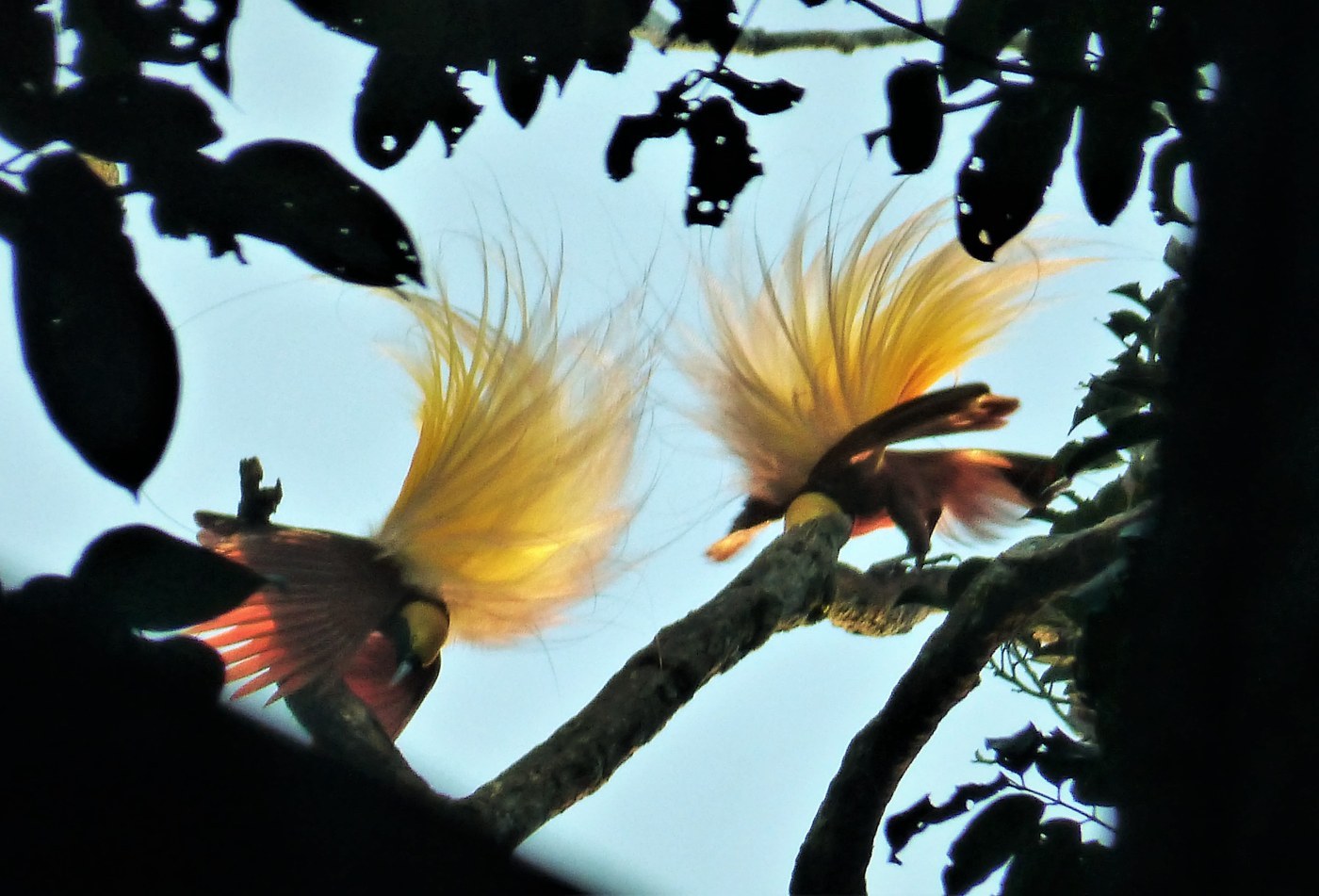
Raggiana Bird-of-paradise
Paradisaea raggiana
The national bird of Papua New Guinea, known for the male's spectacular fanned display of orange-red flank plumes.
- Size
- Body 34 cm (13 in); males with long ornamental flank plumes adding 40+ cm
- Habitat
- Lowland and hill rainforest, forest edge and secondary growth
- Type
- songbird
Spotted a bird like this?
Identify any bird from a photo, free.
Overview
The Raggiana Bird-of-paradise is a medium-sized member of the bird-of-paradise family (Paradisaeidae) and is the national bird of Papua New Guinea, appearing on the country's flag and coat of arms.
Males are strikingly plumed: a maroon-brown body, an iridescent green throat patch, a yellow crown and nape, and long, flowing flank plumes in shades of orange to deep red that erupt from beneath the wings. Females and juveniles are far plainer, with brownish plumage and no ornamental plumes, typical of the sexual dimorphism seen throughout the family.
How to identify it
Key field marks
- Adult male: yellow crown, dark green iris-ringed face, emerald throat shield, and cascading orange-red flank plumes
- Female/immature: uniform rich brown body with no elongated plumes, paler yellowish throat
- Loud, far-carrying calls often given from display perches high in the canopy
Similar species
- Greater Bird-of-paradise and Lesser Bird-of-paradise have very similar plume displays but differ in plume color (more golden-yellow) and range (they occur on different islands, with limited overlap)
- Count Raggi's plumes are typically a deeper orange-red compared to the golden tones of related species
Habitat & range
Habitat
Inhabits lowland, hill, and mid-montane rainforest, forest edges, and disturbed or secondary forest, generally below 1,800 m elevation.
Range
Endemic to New Guinea, found across much of eastern and southeastern Papua New Guinea.
Migration
Non-migratory; individuals remain within a home range year-round, with males defending traditional display sites (leks).
Behavior & voice
Behavior
Males gather at communal display trees (leks) where they perform elaborate courtship displays, raising and vibrating their flank plumes into a shimmering fan while calling and bouncing along branches.
Voice
Loud, harsh, far-carrying calls, including a repeated "wak-wak-wak" advertising call given by displaying males.
Feeding
Primarily frugivorous, favoring figs and other soft fruits, supplemented with insects and small animals; plays an important role in rainforest seed dispersal.
Nesting and breeding
Polygynous mating system; females alone build a bulky cup nest in a tree fork and raise a single egg without any help from the male.
Frequently asked questions
Why is the Raggiana Bird-of-paradise important to Papua New Guinea?
It is the country's national bird and appears on its flag and national emblem.
What do male Raggiana Birds-of-paradise use their plumes for?
They fan and vibrate their long orange-red flank plumes during lek displays to attract females.
Do female Raggiana Birds-of-paradise have showy plumage?
No, females are plain brown and lack the male's ornamental plumes.
What do Raggiana Birds-of-paradise eat?
Mostly fruit, especially figs, along with insects and small vertebrates.
Raggiana Bird-of-paradise guides
In-depth guides for identifying, finding, and understanding Raggiana Bird-of-paradise.
Other birds you may enjoy

Black Redstart
13-14.5 cm (5.1-5.7 in) long, 23-26 cm wingspan

Black-throated Sparrow
12-14 cm (4.7-5.5 in) long, about 19-20 cm (7.5-8 in) wingspan

Greater Bird-of-paradise
Body about 43 cm; males with additional flank plumes up to 50 cm and long tail wires

Blue Tit
11-12 cm (4.3-4.7 in) long, 17-20 cm wingspan

Red-billed Quelea
11.5–13 cm long, wingspan about 20–22 cm
White-plumed Antbird
13-14 cm (5-5.5 in) long

Pyrrhuloxia
19-22 cm (7.5-8.7 in) long, 30 cm wingspan

Blue-gray Tanager
16-18 cm (6-7 in) long

Blackburnian Warbler
11-13 cm (4.3-5.1 in) long, 20-22 cm wingspan

Bluethroat
13-14 cm (5.1-5.5 in) long, 20-22 cm wingspan

Eurasian Nuthatch
12-14.5 cm (4.7-5.7 in) long, 22.5-27 cm wingspan

Wood Thrush
19-21 cm (7.5-8.3 in) long, about 33 cm (13 in) wingspan