
Raggiana Bird-of-paradise Identification Guide
Papua New Guinea's national bird, a spectacular canopy species whose males display cascading orange-red flank plumes over a velvety maroon-brown body during elaborate group courtship dances.
Read the full Raggiana Bird-of-paradise encyclopedia entry →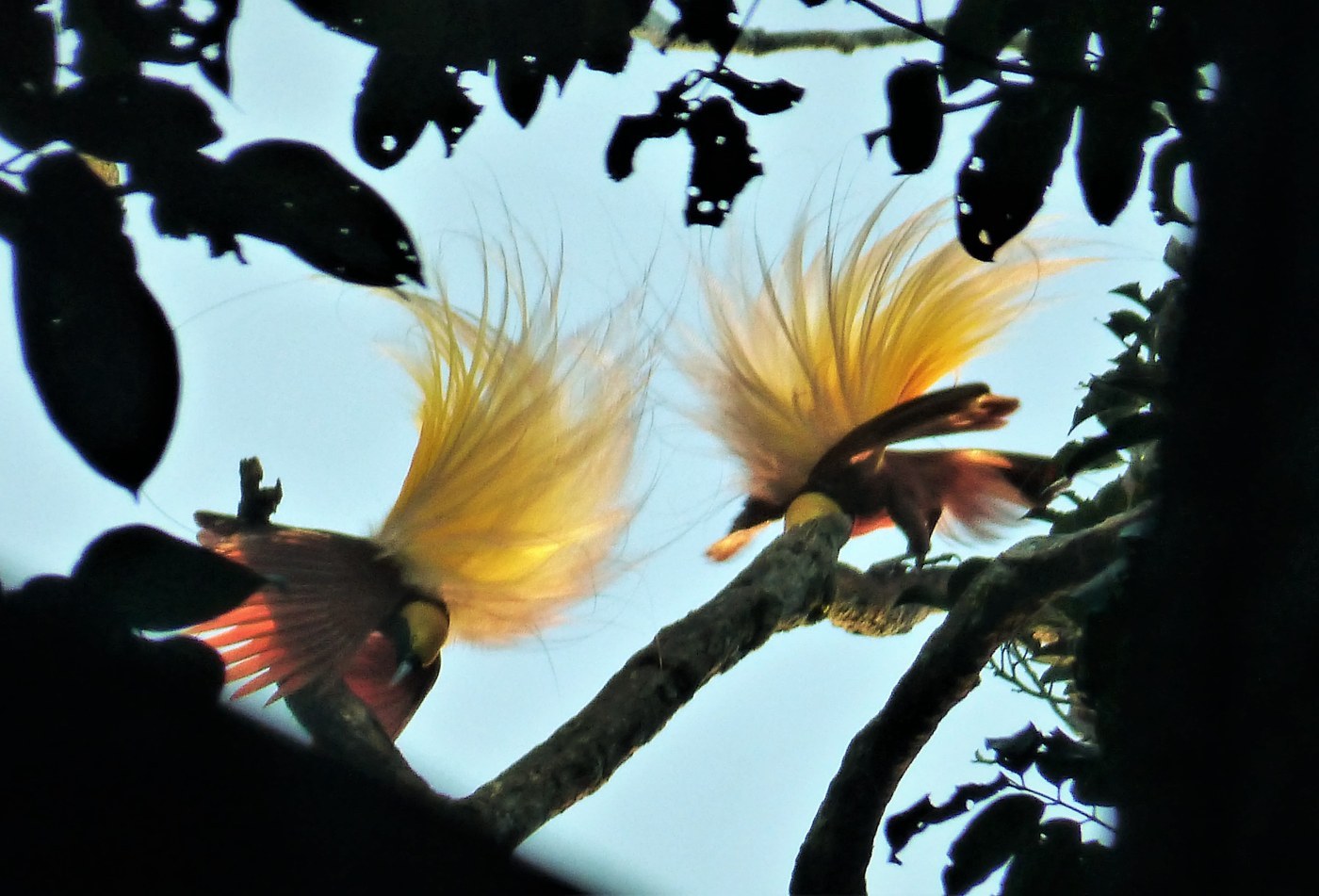
Key Field Marks
- Size & shape: Medium-sized bird-of-paradise (male body about 34 cm / 13 in, with plumes adding significant additional length), with a fairly stout body and short, stout bill typical of the genus Paradisaea.
- Male plumage: Deep maroon-brown body, an iridescent yellow crown and emerald-green throat patch, a pale yellow nape/mantle collar, and — the signature feature — long, cascading, filamentous flank plumes in shades of orange to orange-red that fan out dramatically during display; central tail wires are long and dark.
- Female/immature plumage: Entirely different — plain rich brown overall with no plumes, a duller head, and no iridescent throat or crown patch, easily mistaken for an unrelated species if seen without a displaying male nearby.
- Behavior: Males gather at traditional display trees ("leks") where multiple males display together, calling loudly and shaking their fanned plumes upside down while clinging to a branch.
Separating from Similar Species
- Count Raggiana's Bird-of-paradise vs. other Paradisaea species: Plume color is the key distinguishing feature among the greater birds-of-paradise complex — Raggiana's plumes are orange to orange-red, whereas Greater Bird-of-paradise has yellow-cream plumes, Lesser Bird-of-paradise has richer yellow plumes, and Goldie's Bird-of-paradise (restricted range) has pinkish plumes; range typically resolves any remaining ambiguity since these species are largely allopatric or narrowly parapatric.
- Female-plumaged birds: Female Raggiana's is very similar to females of other Paradisaea species; best identified by locality/range rather than plumage alone.
Where & When to See It
- Habitat: Lowland and hill rainforest, forest edge, and secondary growth up to around 1,500 m elevation.
- Range: Endemic to eastern and southeastern New Guinea (Papua New Guinea); the national bird of Papua New Guinea and featured on its flag.
- Season: Resident year-round; lek displays peak during the main breeding season but can be observed at traditional display trees across much of the year.
Voice & Behavior Cues
- Loud, far-carrying, raucous calls — a series of harsh, ringing "wonk" or "wau-wau-wau" notes given by displaying males and used to advertise lek location.
- The best way to see this species is to visit a known, traditional lek/display tree at dawn, when multiple males gather to perform simultaneously, fanning their orange plumes and calling loudly.
Frequently asked questions
What is the best field mark for a male Raggiana Bird-of-paradise?
Cascading orange to orange-red flank plumes over a maroon-brown body, combined with an iridescent yellow crown and green throat patch, distinguish it from other similar-looking greater birds-of-paradise, which have differently colored plumes.
Why do female Raggiana's Birds-of-paradise look so plain?
As in most birds-of-paradise, only males have evolved elaborate ornamental plumage for courtship display; females remain camouflaged plain brown since they alone build the nest and raise young.
Where is the best place to see a Raggiana Bird-of-paradise displaying?
Visit a traditional lek (display tree) in lowland or hill rainforest in eastern or southeastern Papua New Guinea at dawn, when multiple males gather to call and fan their plumes together.
Is the Raggiana Bird-of-paradise found anywhere outside Papua New Guinea?
It is essentially endemic to eastern and southeastern New Guinea and is the national bird of Papua New Guinea, not occurring naturally elsewhere.