
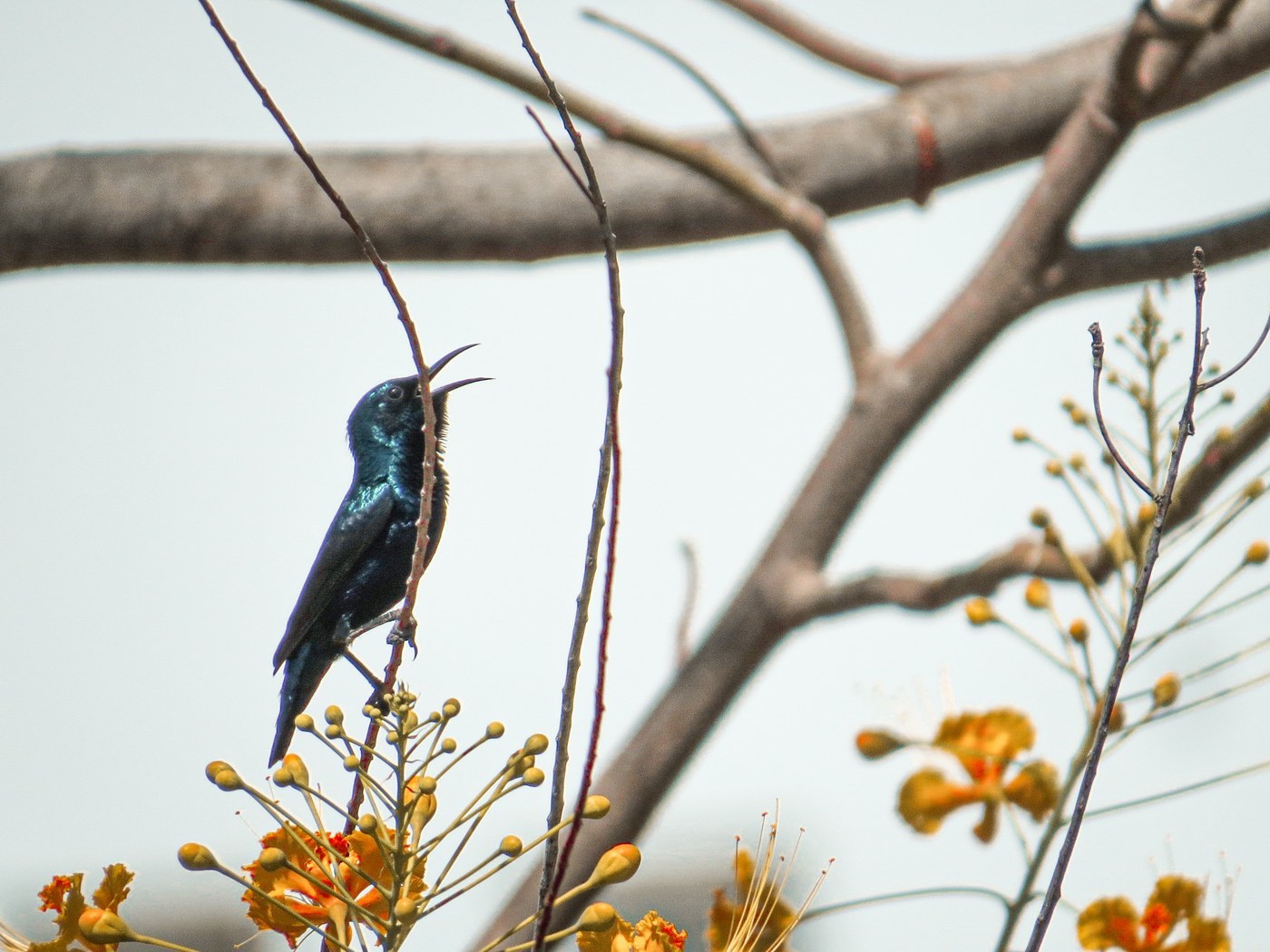
Purple Sunbird
Cinnyris asiaticus
A tiny, hyperactive sunbird whose breeding male glitters iridescent purple-black in the sun.
- Size
- 10-11 cm (4-4.3 in) long, tiny-bodied
- Habitat
- gardens, scrublands, forest edges, cultivated land, and urban parks
- Type
- songbird
Spotted a bird like this?
Identify any bird from a photo, free.
Overview
The Purple Sunbird is one of the most familiar small nectar-feeding birds of South Asia, common in gardens, hedges, and flowering trees across the Indian subcontinent. Breeding males appear almost entirely black at a distance, but in good light their plumage flashes an intense iridescent purple, blue, and green sheen across the head, back, and throat.
Outside the breeding season, males molt into a duller "eclipse" plumage that resembles the female — yellowish underparts with olive-brown upperparts — but retain a broad blackish stripe running down the center of the throat and belly, a useful clue even when the iridescent colors are absent. Females lack this stripe and are uniformly olive above and pale yellow below.
Despite its small size, the Purple Sunbird is a bold, active bird, constantly flitting between flowering shrubs and hovering briefly to probe blossoms with its slender, downcurved bill.
How to identify it
Key field marks
- Very small size with a thin, strongly downcurved bill adapted for probing flowers
- Breeding male: glossy black appearing purple, blue, or green iridescent in direct light
- Non-breeding/eclipse male: yellow below with a dark central stripe from throat to belly, olive-brown above
- Female: plain olive-brown above, pale yellowish below, no dark throat stripe
- Short tail, constant restless movement between flowers
Similar species
The Purple-rumped Sunbird shows a maroon back and purple rump with a maler more colorful pattern year-round, making eclipse-plumage confusion unlikely. Loten's Sunbird is larger with a longer bill and a maroon breast band. Female sunbirds of different species are notoriously similar and are best separated by range and by the presence/absence of the male's dark throat stripe when present.
Habitat & range
Purple Sunbirds occupy an enormous range across the Indian subcontinent, from Pakistan through India, Nepal, Sri Lanka, and Bangladesh, into parts of Southeast Asia and the Arabian Peninsula. They favor open, flower-rich habitats: gardens, scrub, farmland edges, mangroves, and dry deciduous forest, generally avoiding dense unbroken forest.
The species is largely resident, though some local, altitudinal movements occur in response to flowering patterns, with birds concentrating wherever nectar-rich blooms are abundant.
Behavior & voice
Voice
The song is a fast, high-pitched jumble of sharp notes, often delivered from an exposed perch; the call is a sharp, metallic "tsit" or "chwit" repeated rapidly.
Feeding
Purple Sunbirds feed mainly on nectar, clinging to flowers or hovering briefly like a tiny hummingbird-analogue, and supplement their diet with small insects and spiders, especially when feeding nestlings.
Nesting and breeding
The nest is a distinctive hanging, pear-shaped pouch woven from plant fibers, cobwebs, and debris, suspended from a thin branch or even man-made structures. The female does most of the nest building and incubates 2-3 eggs alone, though both parents help feed the chicks.
Frequently asked questions
Why does a Purple Sunbird look black instead of purple?
Its iridescent feathers only flash purple, blue, or green in direct sunlight; in shade or flat light the same feathers look plain black.
How can I tell a male from a female Purple Sunbird?
Breeding males are glossy black-purple all over; females are olive above and yellow below with no dark markings, while non-breeding males look similar to females but keep a dark stripe down the throat and belly.
Do Purple Sunbirds migrate?
They are mostly resident, making only short local movements to follow flowering trees and shrubs rather than true long-distance migration.
What do Purple Sunbirds eat besides nectar?
They also take small insects and spiders, which are especially important protein sources when raising chicks.
Purple Sunbird guides
In-depth guides for identifying, finding, and understanding Purple Sunbird.
Other birds you may enjoy

Black Redstart
13-14.5 cm (5.1-5.7 in) long, 23-26 cm wingspan

Black-throated Sparrow
12-14 cm (4.7-5.5 in) long, about 19-20 cm (7.5-8 in) wingspan

Greater Bird-of-paradise
Body about 43 cm; males with additional flank plumes up to 50 cm and long tail wires

Blue Tit
11-12 cm (4.3-4.7 in) long, 17-20 cm wingspan

Red-billed Quelea
11.5–13 cm long, wingspan about 20–22 cm
White-plumed Antbird
13-14 cm (5-5.5 in) long

Pyrrhuloxia
19-22 cm (7.5-8.7 in) long, 30 cm wingspan

Blue-gray Tanager
16-18 cm (6-7 in) long

Blackburnian Warbler
11-13 cm (4.3-5.1 in) long, 20-22 cm wingspan

Bluethroat
13-14 cm (5.1-5.5 in) long, 20-22 cm wingspan

Eurasian Nuthatch
12-14.5 cm (4.7-5.7 in) long, 22.5-27 cm wingspan

Wood Thrush
19-21 cm (7.5-8.3 in) long, about 33 cm (13 in) wingspan