
Purple Sunbird Identification Guide
A widespread South and Southwest Asian sunbird whose breeding males turn almost entirely glossy purple-black, while females and non-breeding males are plain yellowish-olive.
Read the full Purple Sunbird encyclopedia entry →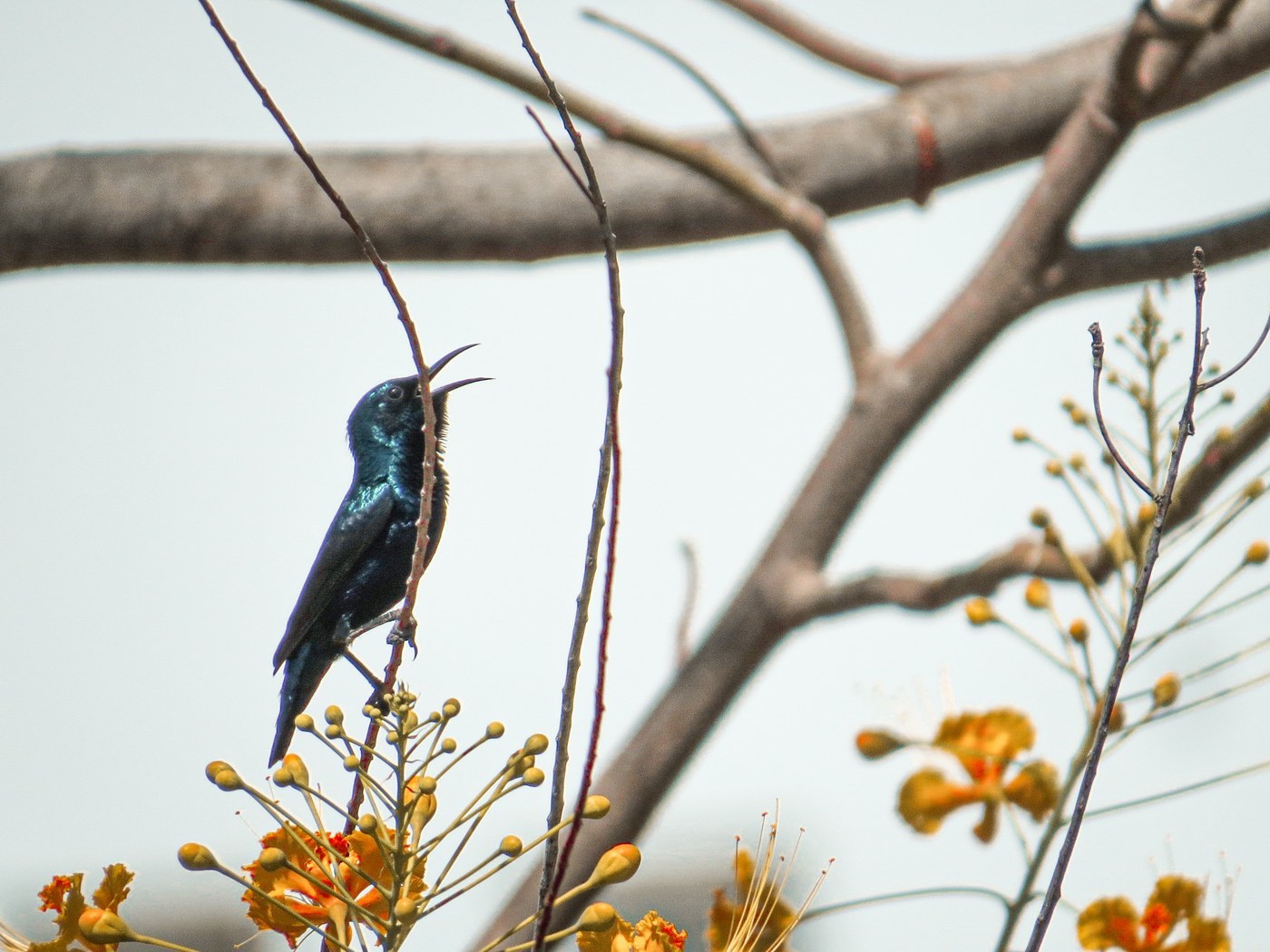
Key Field Marks
- Size & shape: Small (10 cm / 4 in) with a thin, strongly decurved bill and a fairly short tail, typical sunbird proportions.
- Breeding male: Almost entirely iridescent purple-black, shimmering blue-green in certain light, sometimes with small maroon-red pectoral tufts visible at the shoulder during display; wings and tail are dark and unglossed by comparison.
- Non-breeding male ("eclipse"): Reverts to a female-like yellowish-olive plumage but retains a broad dark blackish stripe down the center of the throat and belly, a useful diagnostic even outside breeding season.
- Female: Olive-gray above, dull yellow below, with a plain face and no throat stripe — much plainer than the male.
- Behavior: Highly active and pugnacious at flowering shrubs, frequently hovers briefly, and males sing from prominent perches.
Separating from Similar Species
- Purple-rumped Sunbird: Male Purple Sunbird in full breeding dress is glossy purple-black essentially all over, versus Purple-rumped's more restricted maroon/purple patches and pale grayish belly.
- Female sunbirds generally: Female Purple Sunbird's plain olive-above/dull yellow-below look without a throat patch or strong facial pattern helps separate it from Purple-rumped (whitish throat) and Loten's (breast band) females.
- Non-breeding/eclipse males: The central dark throat-to-belly stripe running through otherwise female-like plumage is unique among regional sunbirds and confirms male Purple Sunbird even out of breeding dress.
Where & When to See It
- Habitat: Extremely wide-ranging — gardens, scrub, dry thorn forest, cultivation, mangroves, and semi-desert with flowering plants; highly tolerant of human settlement.
- Range: From the Middle East and Arabian Peninsula across the Indian subcontinent to Southeast Asia; largely resident, with some local seasonal movements tied to flowering.
- Season: Present year-round across most of its range; breeding males are easiest to identify in their glossy plumage during the breeding season, which varies regionally but often coincides with the dry-to-wet season transition.
Voice & Behavior Cues
- Song is a fast, sharp, wiry twittering, often delivered from a bare twig or wire; calls include sharp "chwit" or "swee" notes.
- Watch for males performing a brief courtship display in which the small red pectoral (shoulder) tufts are flared, visible mainly at close range.
Frequently asked questions
How can I recognize a male Purple Sunbird in breeding plumage?
Look for an almost entirely glossy purple-black body with iridescent blue-green sheen in good light; it lacks the pale belly and localized patches seen in related sunbirds.
How do I identify a non-breeding male Purple Sunbird?
It looks largely female-like (olive above, yellowish below) but retains a distinctive dark stripe running down the center of the throat and belly, which the true female lacks.
What is the difference between Purple Sunbird and Purple-rumped Sunbird?
Purple Sunbird males are glossy purple-black over nearly the whole body, while Purple-rumped Sunbird males show more restricted maroon/purple areas with pale grayish, yellow-tinged underparts.
What habitat is best for finding Purple Sunbirds?
They are habitat generalists found in gardens, scrub, dry forest, and cultivated areas across South Asia and the Middle East, usually near flowering shrubs or trees.