
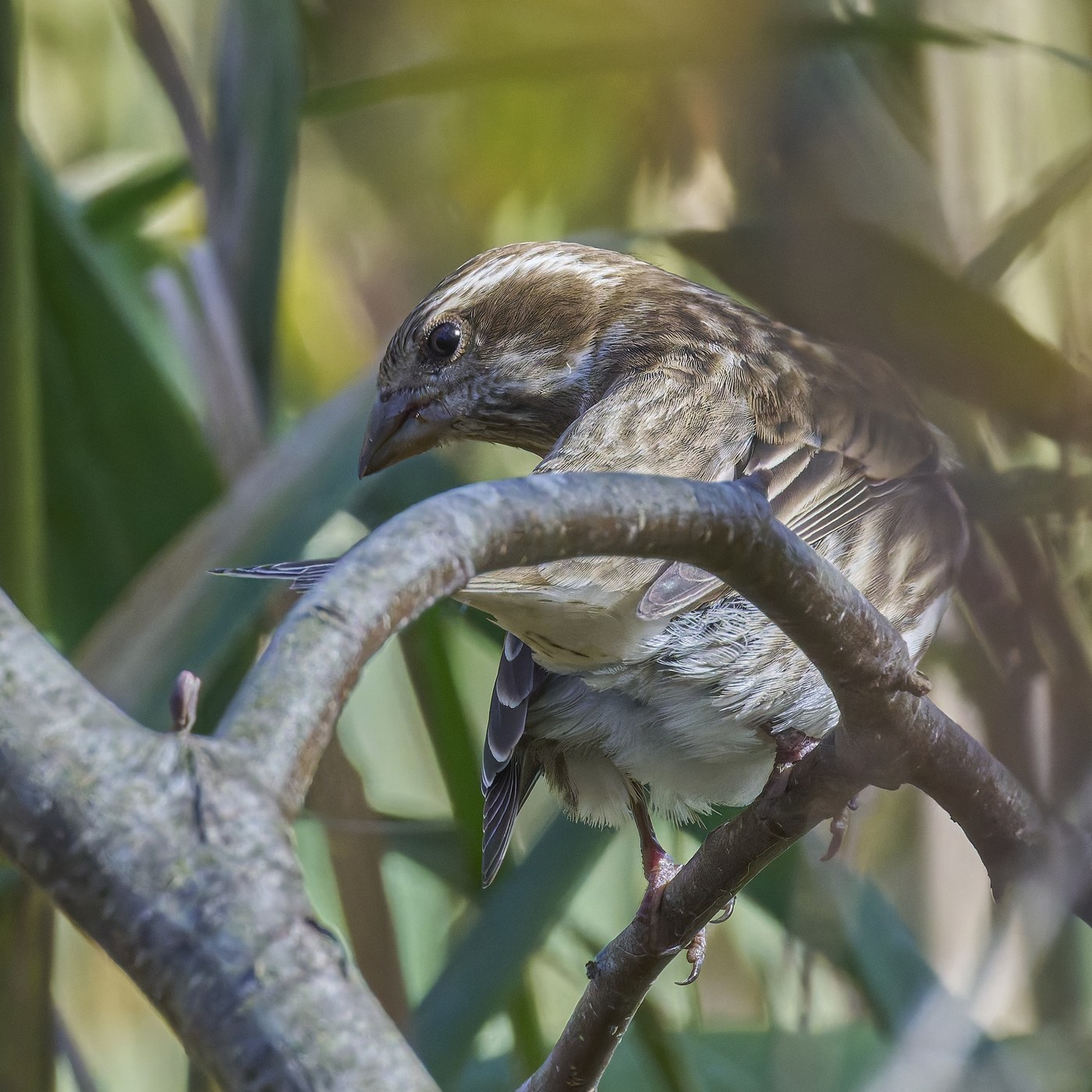
Purple Finch
Haemorhous purpureus
A stocky finch with a raspberry-red wash over the head, back, and breast in males, often confused with the House Finch.
- Size
- 12-16 cm (4.7-6.3 in) long, 22-26 cm wingspan
- Habitat
- coniferous and mixed forests, woodland edges, and in winter, feeders and shrubby areas
- Type
- songbird
Spotted a bird like this?
Identify any bird from a photo, free.
Overview
The Purple Finch is a stocky, big-headed finch whose common name is somewhat misleading; adult males are not truly purple but rather washed in a rich raspberry-red or wine color across the head, throat, back, and breast, blending into brown-streaked wings and a notched tail. The overall effect has been described as looking like a sparrow dipped in raspberry juice.
Females and immature males lack any red and instead show a bold face pattern with a strong white eyebrow stripe and dark cheek patch on a heavily streaked brown-and-white body, a pattern quite different from the plainer-faced female House Finch.
How to identify it
Key field marks
- Male: raspberry-red wash over the head, breast, and back, with brown-streaked wings
- Female/immature: bold white eyebrow stripe and dark cheek patch on a streaked brown body
- Stout, conical bill and a distinctly notched tail
- Stockier and shorter-tailed than a House Finch, with a large-headed look
Similar species
- House Finch males show red concentrated on the head, throat, and rump with brown-streaked flanks, rather than an all-over raspberry wash, and females lack the Purple Finch's bold facial pattern.
- Cassin's Finch, found in western mountains, has a more sharply demarcated bright red cap and paler, less saturated body color; ranges overlap only in parts of the West.
Habitat & range
Purple Finches breed across southern Canada, the Pacific Northwest, and the northeastern United States, in coniferous and mixed forests. In winter, the species is more widespread across the eastern and central US, becoming a familiar visitor to backyard feeders, though numbers vary considerably from year to year.
Migration is somewhat irregular, tied to seed crop abundance; in years of poor cone crops farther north, larger numbers move south, a pattern known as an irruption.
Behavior & voice
Purple Finches forage in trees and shrubs, often in small flocks outside the breeding season, eating tree seeds, buds, and berries, and readily visiting feeders stocked with sunflower seeds. During breeding season they also take more insects.
The song is a rich, rapid, warbling series of notes, often likened to a House Finch's song but more musical and less scratchy; the call note is a sharp, distinctive "pik" or "tick." Nests are cup-shaped, built by females on a horizontal branch of a conifer, usually well out from the trunk, with clutches typically of three to five pale blue-green eggs marked with dark spots.
Frequently asked questions
How do you tell a Purple Finch from a House Finch?
Male Purple Finches show an overall raspberry-red wash covering the head, back, and breast, while male House Finches have red concentrated mainly on the head, throat, and rump with clearly brown-streaked flanks; female Purple Finches also have a much bolder facial pattern with a strong white eyebrow.
What does a Purple Finch sound like?
A fast, rich, musical warbling song, plus a sharp 'pik' call note given in flight or while perched.
What do Purple Finches eat?
Tree seeds, buds, and berries make up most of the diet, supplemented by insects during the breeding season; they readily visit feeders for sunflower seeds.
Where do Purple Finches live?
They breed in coniferous and mixed forests of Canada, the northeastern US, and the Pacific Northwest, and winter more widely across the eastern and central United States.
Are Purple Finches actually purple?
Not literally; the reddish coloring of adult males is better described as raspberry or wine-colored rather than true purple.
Purple Finch guides
In-depth guides for identifying, finding, and understanding Purple Finch.
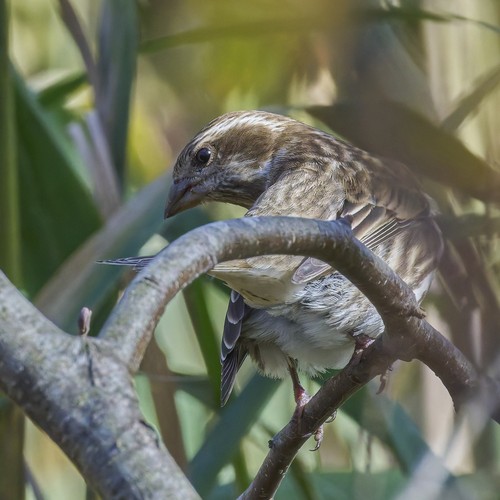
Purple Finch identified by the community
Real birds identified with Bird Identifier.
Other birds you may enjoy

Black Redstart
13-14.5 cm (5.1-5.7 in) long, 23-26 cm wingspan

Black-throated Sparrow
12-14 cm (4.7-5.5 in) long, about 19-20 cm (7.5-8 in) wingspan

Greater Bird-of-paradise
Body about 43 cm; males with additional flank plumes up to 50 cm and long tail wires

Blue Tit
11-12 cm (4.3-4.7 in) long, 17-20 cm wingspan

Red-billed Quelea
11.5–13 cm long, wingspan about 20–22 cm
White-plumed Antbird
13-14 cm (5-5.5 in) long

Pyrrhuloxia
19-22 cm (7.5-8.7 in) long, 30 cm wingspan

Blue-gray Tanager
16-18 cm (6-7 in) long

Blackburnian Warbler
11-13 cm (4.3-5.1 in) long, 20-22 cm wingspan

Bluethroat
13-14 cm (5.1-5.5 in) long, 20-22 cm wingspan

Eurasian Nuthatch
12-14.5 cm (4.7-5.7 in) long, 22.5-27 cm wingspan

Wood Thrush
19-21 cm (7.5-8.3 in) long, about 33 cm (13 in) wingspan