Purple Finch Identification Guide
A stocky North American finch whose males show a raspberry-red wash over the head, back, and breast rather than a sharply defined red cap, distinguishing it from the more common House Finch.
Read the full Purple Finch encyclopedia entry →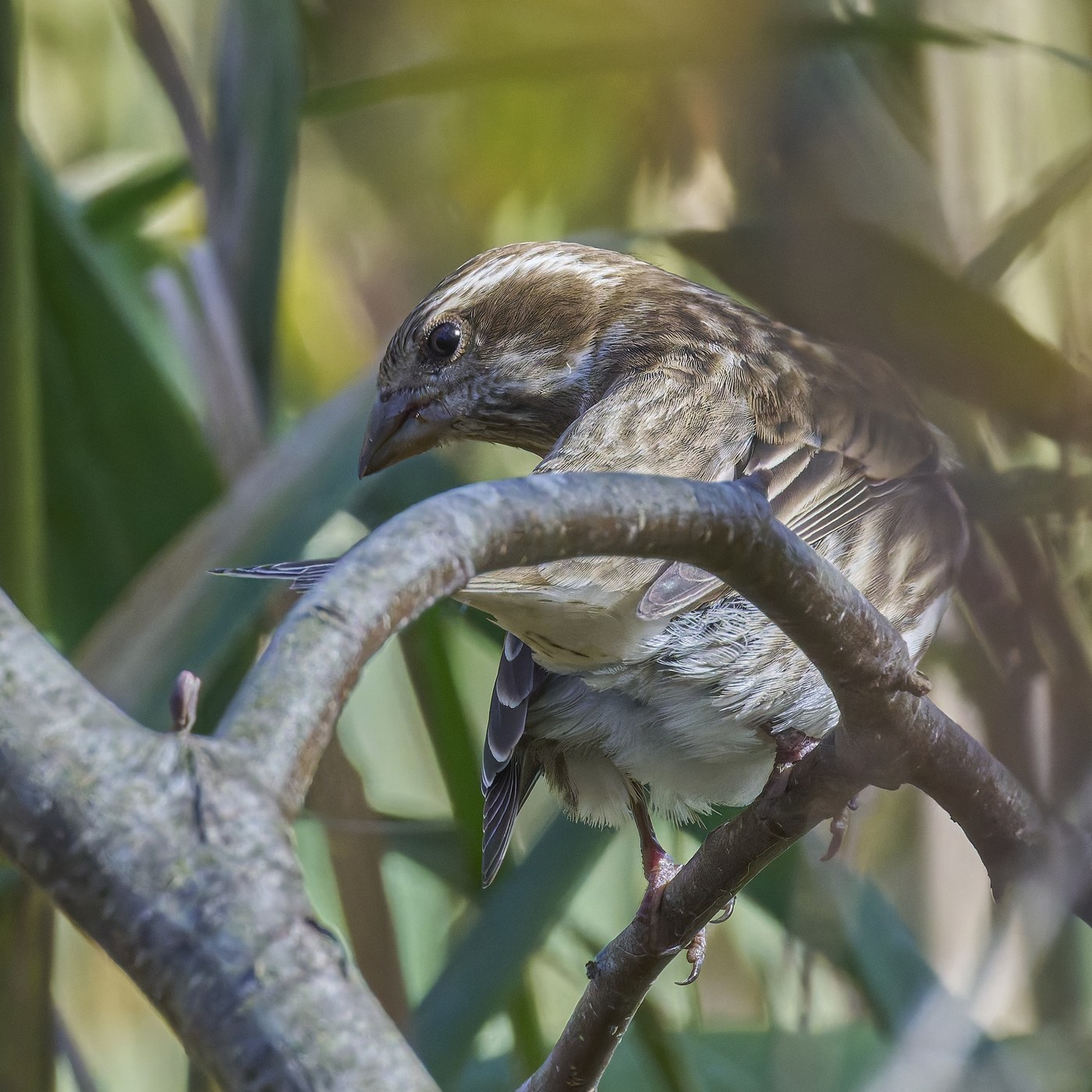
Key Field Marks
- Size & shape: A chunky finch about 5–6 inches long with a large, conical bill and a distinctly notched tail.
- Male plumage: Overall body suffused with a raspberry-pink to wine-red wash covering the head, back, and breast, blending into the brown wings rather than being sharply capped — described classically as looking "dipped in raspberry juice."
- Underparts: Clean, unstreaked pinkish-red or whitish belly and flanks — the lack of streaking on the sides is a key mark separating males from House Finch.
- Female plumage: Brown and heavily streaked overall, with a bold whitish eyebrow stripe and dark cheek patch (auricular) forming a strong facial pattern, plus a large bill.
Separating It From Similar Species
- House Finch: Male shows red confined mainly to the head, throat, and rump with a brown back, and has clear dark streaking down the flanks/belly — Purple Finch males lack flank streaking and show red extending onto the back.
- Cassin's Finch (western species): Male shows a more sharply demarcated bright red crown contrasting with a pink-washed (not red) back and a straighter-edged bill profile; ranges mostly separate (Cassin's is a montane western bird).
- Female Purple Finch vs. female House Finch: Purple Finch female shows a much bolder facial pattern with a strong white eyebrow and dark cheek; House Finch female is plainer-faced with diffuse streaking and no strong head pattern.
Habitat, Range & Season
Breeds in coniferous and mixed forest across Canada, the northeastern United States, and the Pacific coast. In winter, it becomes an irruptive migrant, moving irregularly southward into the eastern and central United States in variable numbers depending on conifer seed crops — some winters bring large influxes, others very few birds. Look for it at feeders (especially sunflower seed) and in mixed woodland during fall through spring in much of its winter range.
Behavior
Often forages in small flocks, visiting bird feeders readily during irruption winters, favoring sunflower seeds; also feeds on buds, seeds, and berries in trees and shrubs.
Voice
A rich, rapid, warbling song, faster and more musical than House Finch's song; call note is a distinctive, sharp "pik" or dry "tik" given in flight, useful for picking migrating birds out overhead.
Frequently asked questions
What is the easiest way to tell a male Purple Finch from a male House Finch?
Purple Finch shows red extending onto the back with no streaking on the belly or flanks, giving a 'dipped in raspberry juice' look, while House Finch has a brown back, red largely confined to the head/throat/rump, and clear dark streaking down the sides.
How do you identify a female Purple Finch?
Look for a bold white eyebrow stripe and dark cheek patch on a heavily streaked brown bird with a large bill — a much stronger facial pattern than the plainer female House Finch.
Is the Purple Finch present year-round?
It breeds in coniferous forest across Canada, the Northeast, and the Pacific coast, but is an irruptive winter visitor farther south, with numbers varying year to year based on food supply.
How does Purple Finch differ from Cassin's Finch?
Cassin's Finch male shows a more sharply defined bright red crown against a pinker back and occurs mainly in western montane conifer forest, while Purple Finch shows a more diffuse red wash and has a broader range across the north and east.
Purple Finch identified by the community
Recent Purple Finch sightings identified with Bird Identifier.