
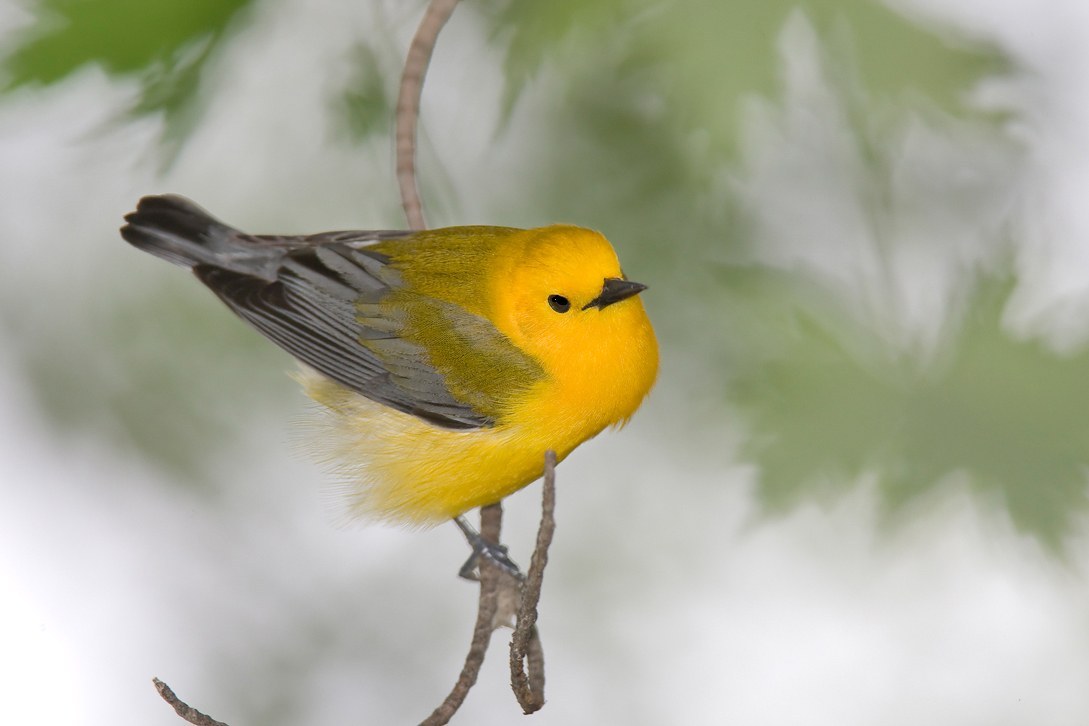
Prothonotary Warbler
Protonotaria citrea
A brilliant golden-yellow warbler of southern swamps, unique among eastern warblers for nesting in tree cavities near or over water.
- Size
- 13-14 cm (5-5.5 in) long, 22 cm wingspan
- Habitat
- wooded swamps, bottomland forest, and flooded timber near water
- Type
- songbird
Spotted a bird like this?
Identify any bird from a photo, free.
Overview
The Prothonotary Warbler is one of the most vividly colored warblers in North America, with a glowing golden-yellow head and underparts that seem to almost glow in the dim light of a swamp forest. Blue-gray wings and tail contrast with the warm yellow body and unstreaked olive-yellow back, and the bird's large, dark eye stands out sharply against the bright plumage.
Its name comes from the golden robes worn by papal clerks known as prothonotaries in the Roman Catholic Church, an allusion inspired by the bird's brilliant coloring. It is the only eastern warbler that nests in cavities, giving it an ecology quite different from most of its relatives.
How to identify it
Key field marks
- Brilliant golden-yellow head and underparts
- Blue-gray wings and tail, olive-yellow back
- Large, dark eye with no eyering or eyeline
- No wingbars
- Stout, all-dark bill
Similar species
Yellow Warbler is superficially similar in overall yellow tone but has yellow (not blue-gray) wings often with yellow edging, a smaller bill, and a preference for more open shrubby habitat rather than flooded forest. Blue-winged Warbler shows a black eyeline and white wingbars, both lacking in Prothonotary Warbler.
Habitat & range
Prothonotary Warblers breed in wooded swamps, flooded bottomland forest, and other wetland woodlands across the southeastern and lower midwestern United States, always near standing or slow-moving water, where they use natural cavities and old woodpecker holes, often quite low over the water.
They winter in mangrove forests and other wet lowland habitats from southern Mexico and Central America into northern South America.
Behavior & voice
Behavior and voice
Prothonotary Warblers forage actively in shrubs and low branches over water, gleaning insects, spiders, and snails, and they will also make short sallies to catch flying insects.
The song is a loud, ringing, repetitive series of notes on essentially one pitch, often rendered as "tweet-tweet-tweet-tweet-tweet."
Nesting
Unlike most warblers, Prothonotary Warblers nest in cavities, using old woodpecker holes, natural tree hollows, or readily accepting nest boxes placed over or near water. Clutches typically contain 3-7 eggs, and pairs may raise two broods in a season where habitat is good.
Frequently asked questions
Why is it called the Prothonotary Warbler?
Its brilliant golden-yellow plumage recalled the golden robes worn by prothonotaries, senior clerks in the Roman Catholic Church, which inspired the bird's name.
What makes the Prothonotary Warbler unusual among warblers?
It is the only warbler in the eastern United States that nests in cavities, such as old woodpecker holes or natural tree hollows, typically over or very near water.
Where does the Prothonotary Warbler live?
It breeds in wooded swamps and flooded bottomland forest across the southeastern and lower midwestern U.S. and winters mainly in mangrove forests from Central America into northern South America.
How do you tell a Prothonotary Warbler from a Yellow Warbler?
Prothonotary Warbler has blue-gray (not yellow) wings and tail and a larger bill, and it favors flooded forest rather than the open shrubby habitats Yellow Warblers prefer.
What does a Prothonotary Warbler eat?
Mainly insects, spiders, and snails gleaned from vegetation near or over water.
Prothonotary Warbler guides
In-depth guides for identifying, finding, and understanding Prothonotary Warbler.
Other birds you may enjoy

Black Redstart
13-14.5 cm (5.1-5.7 in) long, 23-26 cm wingspan

Black-throated Sparrow
12-14 cm (4.7-5.5 in) long, about 19-20 cm (7.5-8 in) wingspan

Greater Bird-of-paradise
Body about 43 cm; males with additional flank plumes up to 50 cm and long tail wires

Blue Tit
11-12 cm (4.3-4.7 in) long, 17-20 cm wingspan

Red-billed Quelea
11.5–13 cm long, wingspan about 20–22 cm
White-plumed Antbird
13-14 cm (5-5.5 in) long

Pyrrhuloxia
19-22 cm (7.5-8.7 in) long, 30 cm wingspan

Blue-gray Tanager
16-18 cm (6-7 in) long

Blackburnian Warbler
11-13 cm (4.3-5.1 in) long, 20-22 cm wingspan

Bluethroat
13-14 cm (5.1-5.5 in) long, 20-22 cm wingspan

Eurasian Nuthatch
12-14.5 cm (4.7-5.7 in) long, 22.5-27 cm wingspan

Wood Thrush
19-21 cm (7.5-8.3 in) long, about 33 cm (13 in) wingspan