
Prothonotary Warbler Identification Guide
A glowing golden-yellow warbler of flooded bottomland forest, easily recognized by its unmarked yellow head, blue-gray wings, and preference for cavity nesting over water.
Read the full Prothonotary Warbler encyclopedia entry →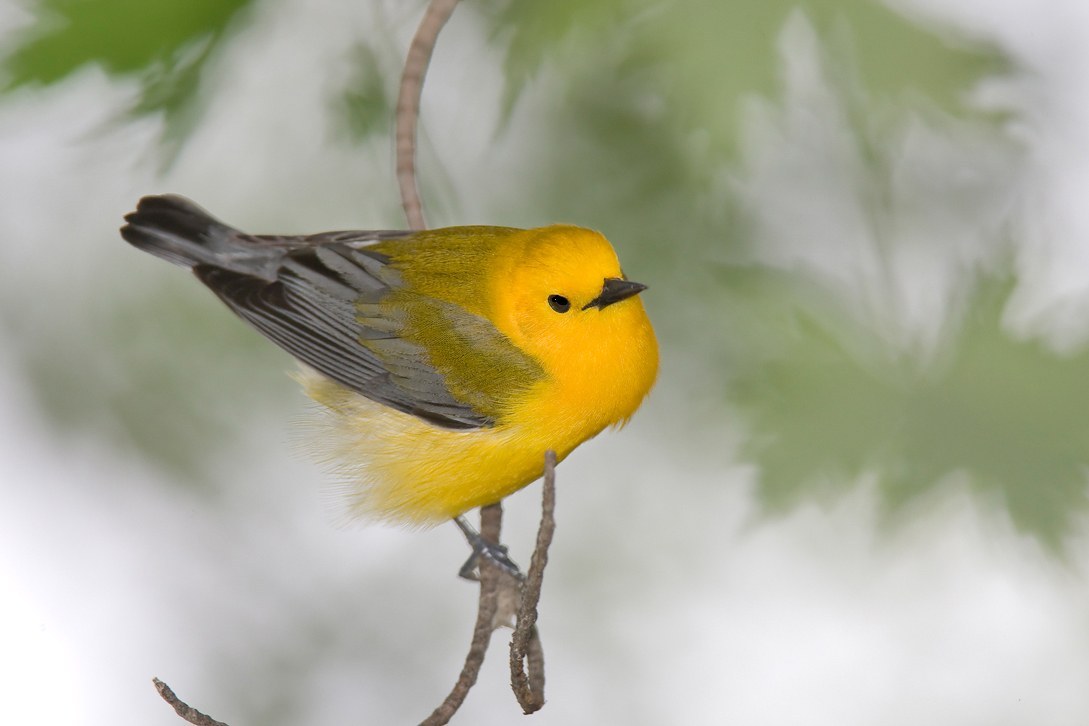
Key Field Marks
- Size & shape: A chunky, large-headed warbler about 5.5 inches long, with a notably long, thick, dagger-like black bill for a warbler.
- Plumage: Head, throat, and breast are a rich, unbroken golden-yellow with no facial markings such as an eyeline — the plain bright face is a key mark.
- Wings & back: Wings and tail are blue-gray with no wingbars, contrasting with the yellow head and olive-yellow back.
- Tail: Shows white patches visible from below in flight/spread tail.
- Eyes: Solid black eyes stand out clearly against the plain yellow face with no surrounding pattern.
Separating It From Similar Species
- Yellow Warbler: Also all-yellow, but shows yellow (not blue-gray) wing edging, fine chestnut streaking on the breast in males, and a thinner bill; lacks the blue-gray wings.
- Blue-winged Warbler: Has a black eyeline through a yellow face and white wingbars on blue-gray wings — Prothonotary lacks both the eyeline and wingbars.
- Yellow-throated Vireo: Superficially similar yellow-and-gray pattern but has bold white wingbars, yellow "spectacles," and a heavier, hook-tipped vireo bill; behavior is slower and more deliberate than the active warbler.
Habitat, Range & Season
Breeds in flooded bottomland hardwood forest, wooded swamps, and river/lake edges across the southeastern and lower midwestern United States, generally near standing or slow-moving water with dead snags. It is the only eastern warbler that nests almost exclusively in tree cavities, including old woodpecker holes, readily using nest boxes placed over water. It winters in mangroves and lowland forest from Central America into northern South America. Present on breeding grounds roughly April through August.
Behavior
Forages actively low over water and along flooded logs and branches, often flicking its tail; frequently seen investigating cavities and nest boxes, a habit that separates it from nearly all other warblers.
Voice
A loud, ringing, repetitive series of clear, sweet notes, "tweet-tweet-tweet-tweet-tweet," all on one pitch — far-carrying and simple compared to more complex warbler songs, often the first clue to a bird's presence in dense swamp vegetation.
Frequently asked questions
How is the Prothonotary Warbler different from the Yellow Warbler?
Prothonotary Warbler has blue-gray (not yellow-edged) wings and no breast streaking, plus a heavier bill, while Yellow Warbler shows yellowish wing edging and, in males, fine chestnut streaking below.
Why is the Prothonotary Warbler unusual among warblers?
It is the only eastern North American warbler that nests in tree cavities, often old woodpecker holes over water, and readily uses artificial nest boxes.
What habitat should I search for a Prothonotary Warbler?
Flooded bottomland hardwood forest, wooded swamps, and shaded riverbanks or lake edges with dead snags, mainly in the southeastern and lower midwestern United States during breeding season.
What does the Prothonotary Warbler's song sound like?
A loud, ringing series of clear notes all on one pitch, often rendered as 'tweet-tweet-tweet-tweet-tweet.'