
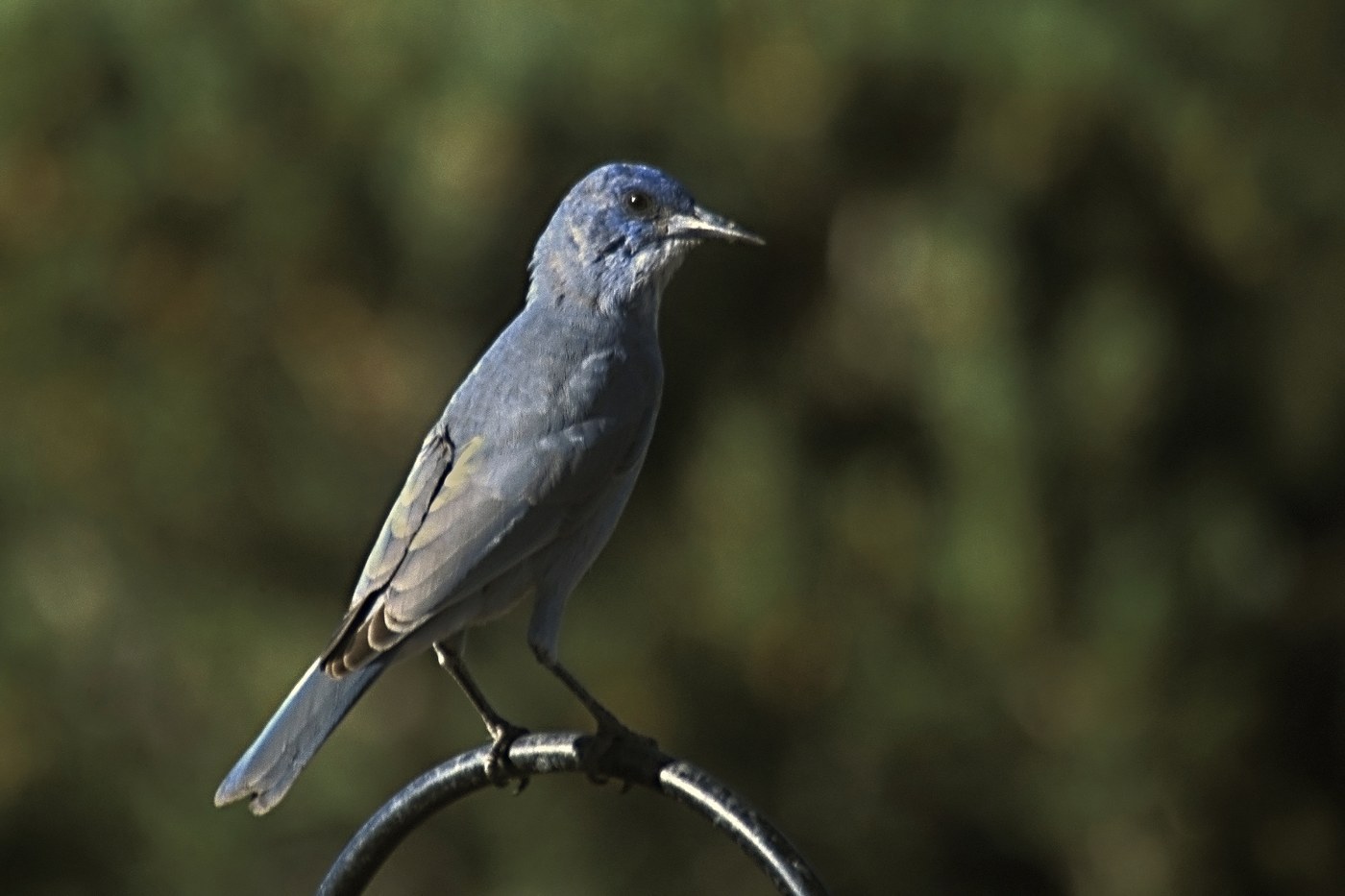
Pinyon Jay
Gymnorhinus cyanocephalus
A uniformly blue, crestless, highly social jay of pinyon-juniper woodlands that lives in large, noisy flocks year-round.
- Size
- 25-29 cm (10-11.5 in) long, 45-46 cm wingspan
- Habitat
- pinyon-juniper woodlands of the interior western United States
- Type
- songbird
Spotted a bird like this?
Identify any bird from a photo, free.
Overview
The Pinyon Jay is a distinctive, uniformly dull blue corvid, lacking the crest, white markings, or bold facial patterns of most other jays. It has a shorter tail and longer, more slender bill than typical jays, an adaptation for extracting seeds from pinyon pine cones.
This species is exceptionally social, living in large, cohesive flocks of dozens to hundreds of birds year-round, and has one of the most specialized ecological relationships of any North American bird, depending heavily on pinyon pine seed crops and serving as a critical seed disperser for pinyon pine forests.
How to identify it
Key Field Marks
- Uniform dull to deep blue plumage overall, with a paler, streaked throat
- No crest
- Shorter tail than other jays
- Long, slender, slightly downcurved bill
- Typically seen in large, noisy flocks rather than pairs
Similar Species
- Woodhouse's Scrub-Jay shows white underparts and a blue necklace, unlike the entirely blue Pinyon Jay, and is usually seen alone or in pairs rather than large flocks.
- Clark's Nutcracker is pale gray with bold black-and-white wings and tail, quite different from the uniformly blue Pinyon Jay.
Habitat & range
Habitat
Pinyon Jays are closely tied to pinyon-juniper woodland, particularly areas with mature, cone-producing pinyon pines, though they also use adjacent sagebrush and ponderosa pine habitat.
Range
Found across the Great Basin, Colorado Plateau, and southern Rocky Mountains, including Nevada, Utah, Colorado, Arizona, New Mexico, and parts of California, Oregon, and Idaho.
Migration
This species is largely resident but highly nomadic within its range, with flocks moving widely in search of pinyon pine seed crops, which vary greatly from year to year.
Behavior & voice
Behavior
Pinyon Jays are among the most social of all corvids, living in permanent flocks that cooperate in foraging, breeding, and predator defense; flocks may include over 100 individuals and remain together across seasons. They cache tens of thousands of pinyon seeds each year, relying on spatial memory to relocate them.
Voice
The most frequent call is a nasal, crow-like caw or a rolling kraaa, often given constantly as flocks move and forage together.
Feeding
Pinyon pine seeds are the dietary staple, especially in fall and winter, supplemented by other seeds, berries, and insects, particularly during the breeding season.
Nesting
Pinyon Jays breed colonially, with many pairs nesting in loose clusters within the same stand of trees; the timing of breeding is closely tied to pinyon pine cone crops, and pairs may nest as early as late winter in years with abundant stored seed.
Frequently asked questions
Why are Pinyon Jays considered vulnerable?
Their population has declined sharply in recent decades due to loss and degradation of pinyon-juniper woodland habitat, along with increased wildfire and drought affecting pinyon pine seed crops.
How social are Pinyon Jays?
They are extremely social, living in permanent flocks of dozens to over a hundred birds that forage, breed, and defend against predators together year-round.
What do Pinyon Jays eat?
They rely heavily on pinyon pine seeds, which they cache extensively for later use, supplemented by other seeds, berries, and insects.
How can you identify a Pinyon Jay?
Look for a uniformly dull blue, crestless jay with a long, slender bill, typically seen moving through pinyon-juniper woodland in large, noisy flocks.
Pinyon Jay guides
In-depth guides for identifying, finding, and understanding Pinyon Jay.
Other birds you may enjoy

Black Redstart
13-14.5 cm (5.1-5.7 in) long, 23-26 cm wingspan

Black-throated Sparrow
12-14 cm (4.7-5.5 in) long, about 19-20 cm (7.5-8 in) wingspan

Greater Bird-of-paradise
Body about 43 cm; males with additional flank plumes up to 50 cm and long tail wires

Blue Tit
11-12 cm (4.3-4.7 in) long, 17-20 cm wingspan

Red-billed Quelea
11.5–13 cm long, wingspan about 20–22 cm
White-plumed Antbird
13-14 cm (5-5.5 in) long

Pyrrhuloxia
19-22 cm (7.5-8.7 in) long, 30 cm wingspan

Blue-gray Tanager
16-18 cm (6-7 in) long

Blackburnian Warbler
11-13 cm (4.3-5.1 in) long, 20-22 cm wingspan

Bluethroat
13-14 cm (5.1-5.5 in) long, 20-22 cm wingspan

Eurasian Nuthatch
12-14.5 cm (4.7-5.7 in) long, 22.5-27 cm wingspan

Wood Thrush
19-21 cm (7.5-8.3 in) long, about 33 cm (13 in) wingspan