
Pinyon Jay Identification Guide
A crestless, dull-blue corvid of the pinyon-juniper woodlands, recognized by its short tail, spike-like bill, streaked whitish throat, and highly social flocking habits.
Read the full Pinyon Jay encyclopedia entry →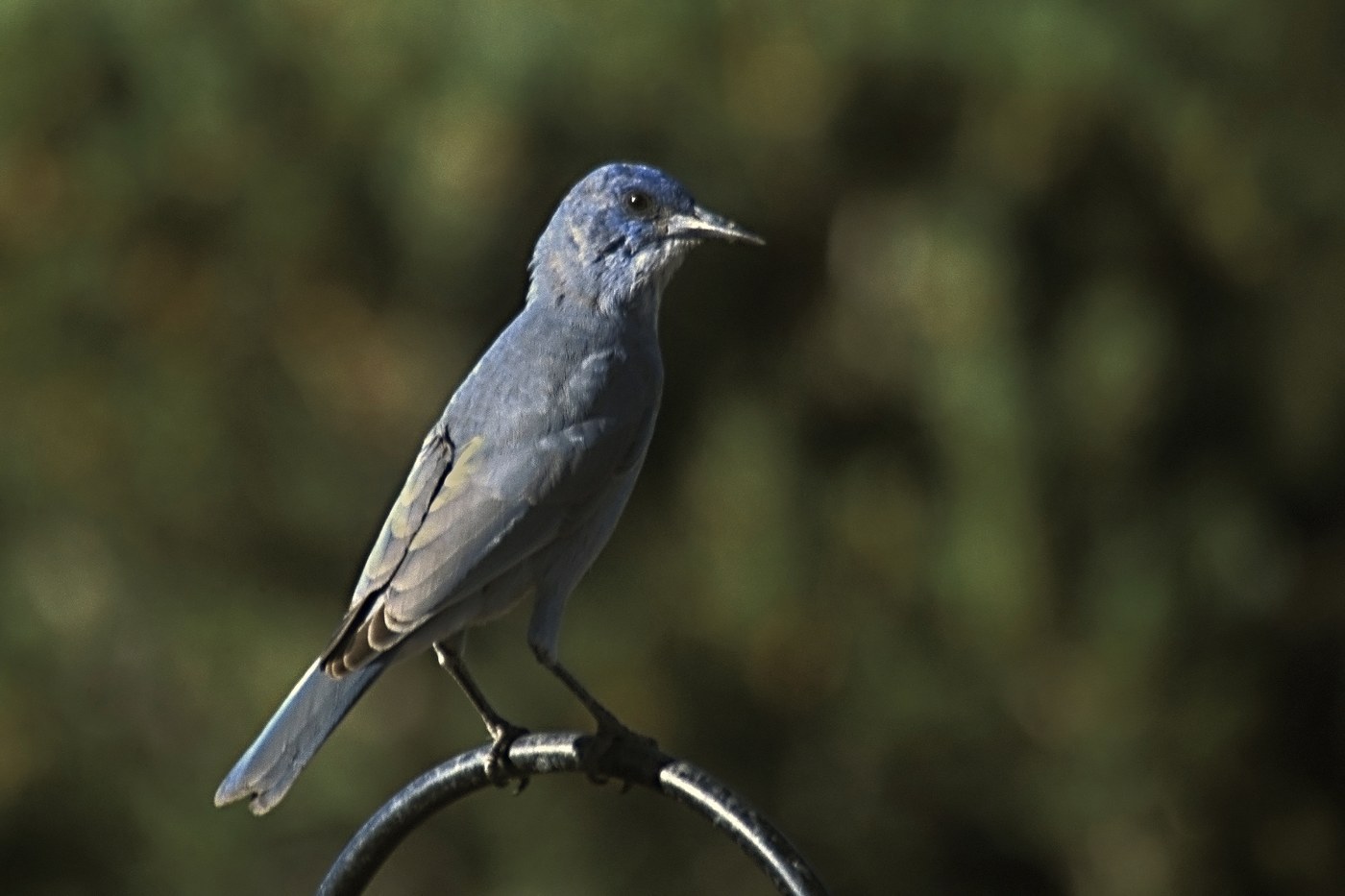
Key Field Marks
- Size & shape: A medium-sized corvid, 25–29 cm (10–11.5 in), with a notably short tail compared to other jays, giving it a stubby, crow-like silhouette rather than the elongated look of a typical jay.
- Plumage: Fairly uniform dull blue overall, without the crest, wing markings, or facial pattern found on many other jays; the throat is whitish and lightly streaked, contrasting subtly with the surrounding blue.
- Bill: Long, thin, and spike-like — proportionately longer and more pointed than the bills of scrub-jays, an adaptation for extracting seeds from pine cones.
- No crest: Unlike Blue Jay or Steller's Jay, Pinyon Jay has a smoothly rounded head with no crest at all.
Behavior
Pinyon Jays are intensely social, living in large, noisy flocks year-round, breeding colonially, and even foraging and moving together as a coordinated group. They are renowned for caching enormous numbers of pinyon pine seeds each autumn — a single flock can cache tens of thousands of seeds — and their memory for retrieving these caches is a well-studied behavior. Flocks fly with a distinctive direct, crow-like flight, calling constantly.
How to Tell It From Similar Species
- California/Woodhouse's Scrub-Jay: Has a longer tail, more contrasting blue-and-grey plumage, and is typically solitary or in pairs rather than large flocks; also lacks the Pinyon Jay's short-tailed, chunky silhouette.
- Mountain Bluebird: Superficially blue but much smaller, slimmer-billed, and not corvid-shaped at all.
- Clark's Nutcracker: Also a pine-seed specialist corvid but is grey with bold black-and-white wings and tail, quite different from the uniformly blue Pinyon Jay.
Habitat & Range
Pinyon Jays are found across the interior western United States, tightly associated with pinyon-juniper woodlands of the Great Basin, Colorado Plateau, and southern Rocky Mountain foothills. Their populations track pinyon pine cone crops, and flocks may wander outside typical range in years of poor seed production.
Voice
Gives nasal, crow-like "kaw" or "krrawk" calls along with softer mewing notes; flocks are almost constantly vocal in flight, which along with their tight group movement is often the first clue to their presence.
Frequently asked questions
How do you tell a Pinyon Jay from a Scrub-Jay?
Pinyon Jay has a much shorter tail, a more uniform dull-blue color without strong contrast, a longer spike-like bill, and travels in large, noisy flocks, while scrub-jays are longer-tailed, more contrastingly patterned, and usually seen alone or in pairs.
Why are Pinyon Jays associated with pinyon pines?
They rely heavily on pinyon pine seeds, which they harvest and cache in huge numbers each fall to survive winter and feed nestlings the following spring, making their populations closely tied to pine cone crops.
Do Pinyon Jays have a crest like a Blue Jay?
No, Pinyon Jays have a smoothly rounded head with no crest at all, unlike Blue Jay or Steller's Jay.
Where can I find Pinyon Jays?
In pinyon-juniper woodlands across the interior western United States, including the Great Basin, Colorado Plateau, and southern Rocky Mountain foothills, usually in large, vocal flocks.