
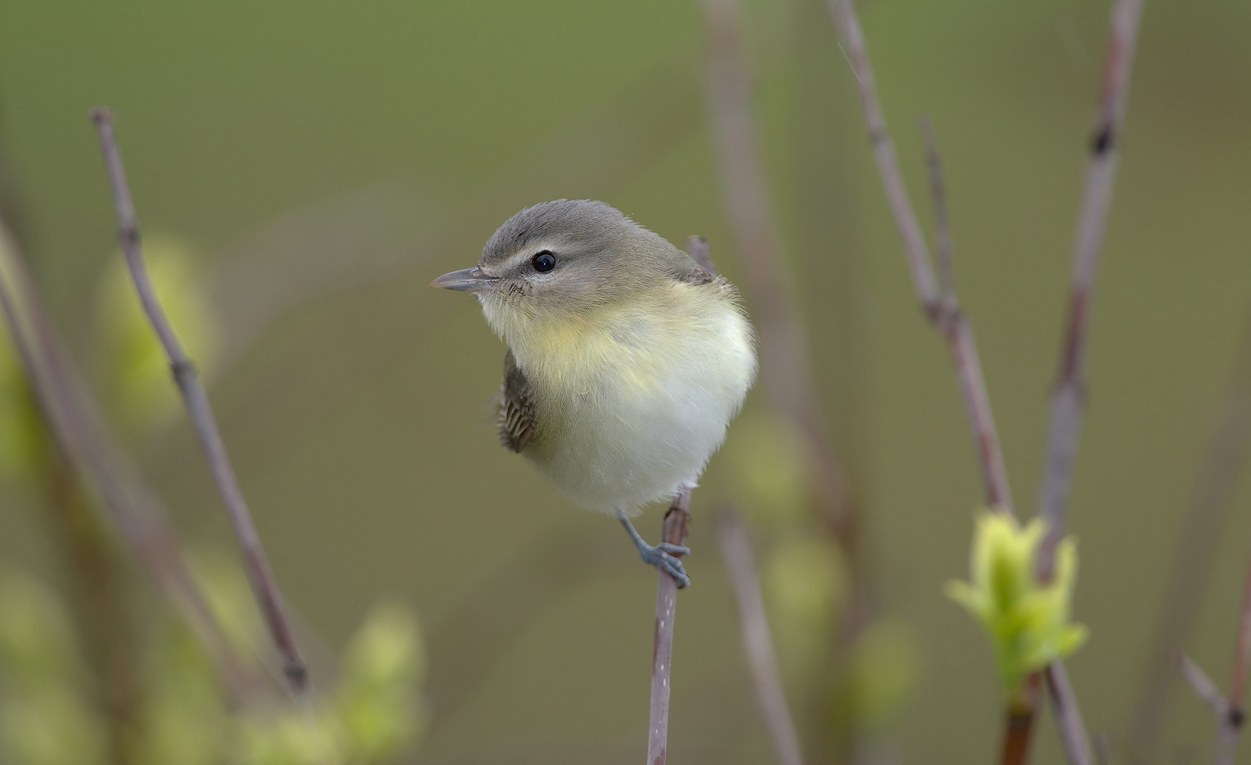
Philadelphia Vireo
Vireo philadelphicus
The smallest eastern vireo, with a yellow-washed underside and dark eye line, breeding in northern second-growth woodlands and often confused with Warbling Vireo and Tennessee Warbler.
- Size
- 11-13 cm (4.5-5 in) long, 19-21 cm wingspan
- Habitat
- second-growth deciduous woods and aspen stands of boreal Canada and the northern US
- Type
- songbird
Spotted a bird like this?
Identify any bird from a photo, free.
Overview
The Philadelphia Vireo is the smallest of the eastern vireos and one of the trickier ones to identify, sharing a generally plain appearance with the Warbling Vireo but usually showing a variable yellow wash across the throat and breast. It has olive upperparts, a dark line through the eye, and a pale eyebrow, with no wing bars.
It breeds in the boreal forest and adjacent northern states, favoring young second-growth deciduous woodland and aspen groves, and is often overlooked amid more numerous Red-eyed and Warbling Vireos.
How to identify it
Key field marks
- Small size, olive upperparts
- Yellowish wash on throat and breast (variable, sometimes faint)
- Dark eye line, pale eyebrow, dark eye
- No wing bars
Similar species
- Warbling Vireo: typically whiter below with little to no yellow wash, slightly larger and longer-billed.
- Red-eyed Vireo: bolder black-bordered gray crown and red eye.
- Tennessee Warbler: thinner, more pointed bill and more active, warbler-like foraging behavior.
Habitat & range
Range and habitat
Philadelphia Vireo breeds across the boreal forest of Canada and the northern tier of the US, favoring open, brushy second-growth deciduous woodland, forest edges, and aspen stands rather than mature closed-canopy forest.
Migration
A long-distance migrant, wintering from southern Mexico through Central America.
Behavior & voice
Behavior
Forages methodically for insects in the mid-canopy of deciduous trees, moving more slowly and deliberately than warblers sharing the same habitat.
Voice
The song resembles Red-eyed Vireo's short repeated phrases but is higher-pitched, slower, and sweeter.
Feeding
Mostly insects gleaned from foliage; adds berries and small fruit to the diet during migration.
Nesting and breeding
Builds a hanging cup nest suspended from a forked branch in a deciduous tree or shrub. The female incubates 3-5 eggs for roughly 2 weeks.
Frequently asked questions
How do you tell a Philadelphia Vireo from a Warbling Vireo?
Philadelphia Vireo usually shows a yellowish wash on the throat and breast and is slightly smaller, while Warbling Vireo is typically whiter below with a slightly longer bill; song differences also help separate them.
Where does the Philadelphia Vireo breed?
In boreal forest and second-growth deciduous woodland across Canada and the northern United States.
Is the Philadelphia Vireo hard to identify?
Yes, it is considered one of the trickier vireos to identify due to its similarity to Warbling Vireo and Tennessee Warbler.
Where does the Philadelphia Vireo winter?
From southern Mexico through Central America.
Philadelphia Vireo guides
In-depth guides for identifying, finding, and understanding Philadelphia Vireo.
Other birds you may enjoy

Black Redstart
13-14.5 cm (5.1-5.7 in) long, 23-26 cm wingspan

Black-throated Sparrow
12-14 cm (4.7-5.5 in) long, about 19-20 cm (7.5-8 in) wingspan

Greater Bird-of-paradise
Body about 43 cm; males with additional flank plumes up to 50 cm and long tail wires

Blue Tit
11-12 cm (4.3-4.7 in) long, 17-20 cm wingspan

Red-billed Quelea
11.5–13 cm long, wingspan about 20–22 cm
White-plumed Antbird
13-14 cm (5-5.5 in) long

Pyrrhuloxia
19-22 cm (7.5-8.7 in) long, 30 cm wingspan

Blue-gray Tanager
16-18 cm (6-7 in) long

Blackburnian Warbler
11-13 cm (4.3-5.1 in) long, 20-22 cm wingspan

Bluethroat
13-14 cm (5.1-5.5 in) long, 20-22 cm wingspan

Eurasian Nuthatch
12-14.5 cm (4.7-5.7 in) long, 22.5-27 cm wingspan

Wood Thrush
19-21 cm (7.5-8.3 in) long, about 33 cm (13 in) wingspan