
Philadelphia Vireo Identification Guide
A small, plain, yellow-washed vireo of northern woodlands, easily confused with Warbling and Red-eyed Vireos but told by its throat color and eyeline.
Read the full Philadelphia Vireo encyclopedia entry →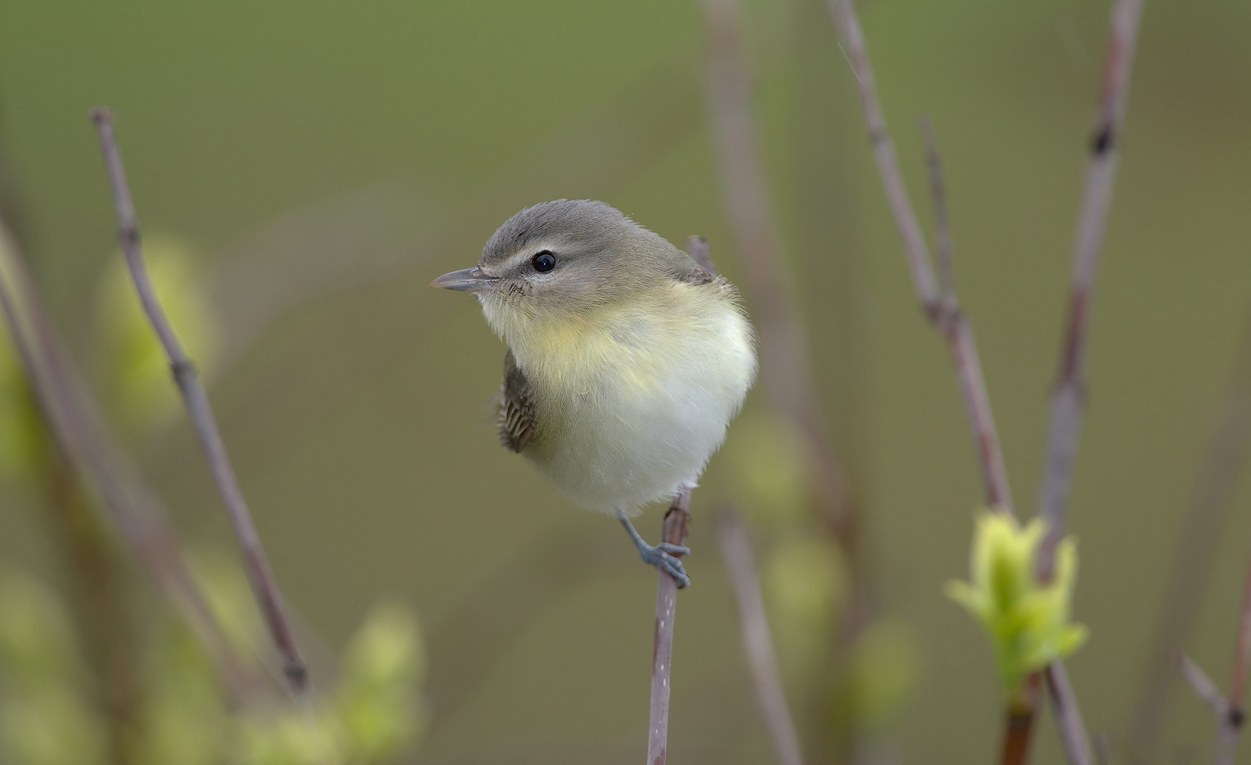
Key Field Marks
- Size and shape: Small for a vireo, with the typical stubby, slightly hooked-tip bill of the family and a rounded head.
- Plumage: Olive-green upperparts and yellow-washed underparts, with the yellow strongest on the throat and breast and fading toward a paler or whitish belly. A dark line through the eye (loral spot/eyeline) contrasts with a pale, unbordered supercilium above it.
- No strong wing bars, unlike some warblers it can be confused with.
Separating It From Similar Species
- Warbling Vireo: Paler and grayer overall, with much less yellow below (often just a faint wash on the flanks) and a less contrasting face pattern.
- Red-eyed Vireo: Larger, with a gray crown bordered by a black line above the white supercilium, a red eye in adults, and whiter (less yellow) underparts.
- Tennessee Warbler: Similar olive-and-yellow tones but has a thinner, sharper warbler bill rather than the heavier, hook-tipped vireo bill, and forages more actively.
- The concentration of yellow on the throat and breast (versus an evenly pale body) combined with the vireo's heavier bill is the most reliable combination of marks.
Where and When to See It
Breeds across the boreal forest of Canada and the extreme northern United States, favoring second-growth deciduous and mixed woodland edges, aspen stands, and shrubby regenerating forest. A long-distance migrant, it passes through the eastern and central United States in spring and fall on its way to and from wintering grounds in Central America (from Mexico to Panama).
Behavior
Forages deliberately and somewhat slowly compared to warblers, gleaning insects from leaves, often fairly high in the canopy, which can make it a challenging bird to view well.
Voice
Song resembles the Red-eyed Vireo's but is slower-paced, huskier, and more monotonous, with shorter phrases repeated in a measured rhythm. The call is a nasal, slightly whiny "vreeo."
Frequently asked questions
How do you separate a Philadelphia Vireo from a Warbling Vireo?
Philadelphia Vireo shows much more yellow on the throat and breast and a more contrasting dark eyeline, while Warbling Vireo is paler, grayer, and shows little to no yellow below.
How do you separate a Philadelphia Vireo from a Red-eyed Vireo?
Red-eyed Vireo is larger with a gray crown bordered by a black line, a red eye, and whiter underparts, while Philadelphia Vireo is smaller, lacks the bordered crown, and shows yellow-washed underparts.
Could a Philadelphia Vireo be mistaken for a warbler?
Yes, especially Tennessee Warbler, but the vireo's heavier, hook-tipped bill and slower, more deliberate foraging style help distinguish it.
Where does the Philadelphia Vireo breed and winter?
It breeds in second-growth boreal woodlands across Canada and the northern U.S., and winters in Central America.