
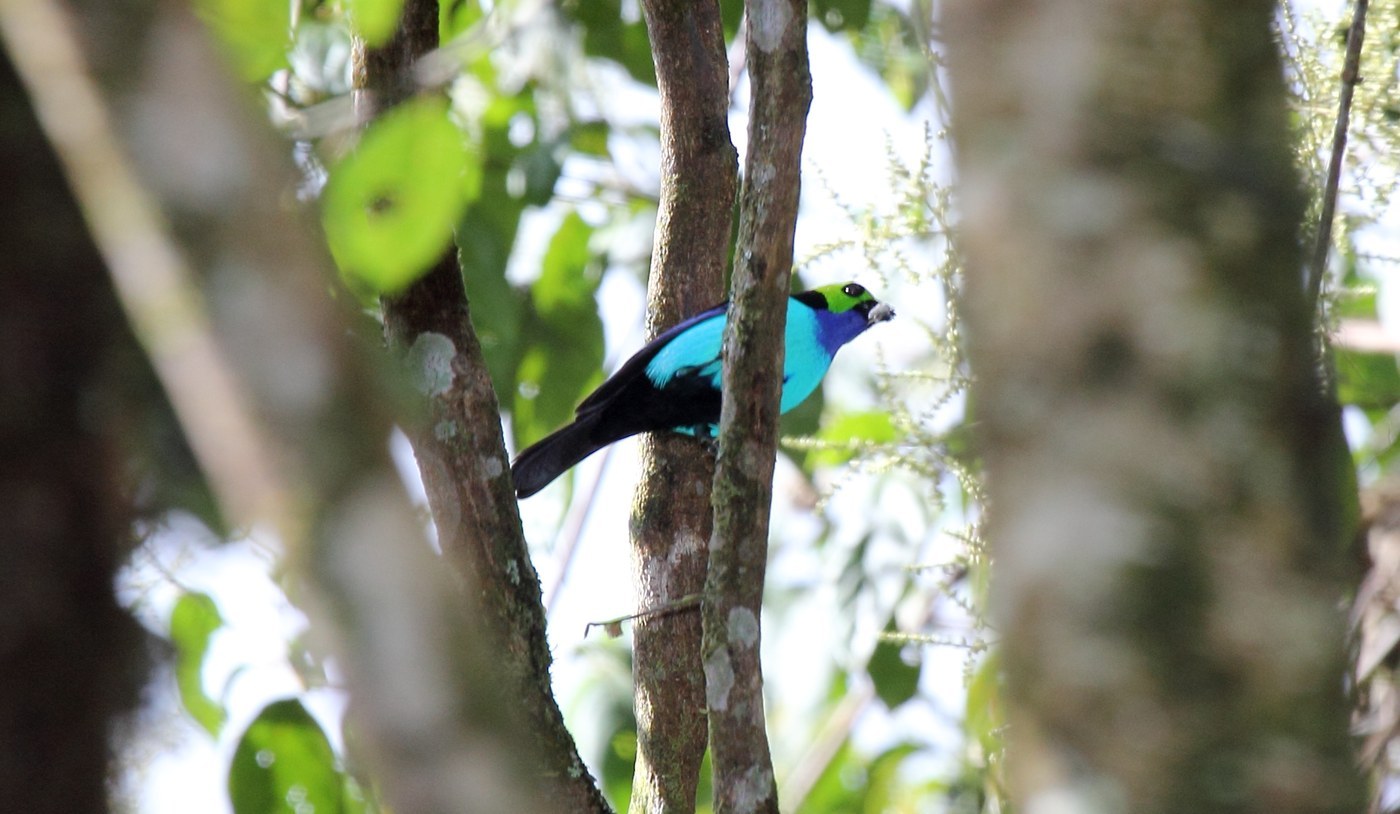
Paradise Tanager
Tangara chilensis
One of the most vividly multicolored birds in the Amazon, with a turquoise head, black back, sky-blue underparts, and a glowing yellow-to-red rump.
- Size
- 14-15 cm (5.5-6 in) long, 22-24 cm wingspan
- Habitat
- humid lowland and foothill forest canopy and edges
- Type
- songbird
Spotted a bird like this?
Identify any bird from a photo, free.
Overview
The Paradise Tanager is among the most spectacularly colored birds of the Amazon basin, seemingly painted with a different color for nearly every part of its small body. The head glows turquoise-green, the back and wings are jet black, the underparts shimmer pale sky-blue to violet, the throat shows a purple-blue patch, and the lower back and rump blaze with a saturated yellow, orange, or red patch depending on the subspecies.
Despite its brilliant palette, this small tanager can be surprisingly easy to overlook high in the forest canopy, where it moves quickly through mixed-species flocks; it is often first detected by its thin, high-pitched calls before being spotted against the leaves.
How to identify it
Key field marks
- Turquoise-green head and nape
- Jet-black back, wings, and tail
- Pale sky-blue to lilac underparts
- Purple-blue throat patch
- Bright yellow, orange, or red lower back/rump patch, varying by subspecies and region
Similar species
- Green-headed Tanager (Atlantic Forest, Brazil) has a similar color scheme but shows more green on the head and an orange throat rather than purple, and the two species do not overlap in range.
- Opal-crowned Tanager and Opal-rumped Tanager share some blue and black patterning but lack the combination of turquoise head and multicolored rump seen in the Paradise Tanager.
Habitat & range
Habitat
Inhabits the canopy and edges of humid lowland and foothill forest, including várzea (seasonally flooded) forest and adjacent secondary growth.
Range
Widespread across the western and central Amazon basin, including Colombia, Ecuador, Peru, Bolivia, and Brazil.
Migration
Resident and non-migratory, though flocks may wander locally in search of fruiting trees.
Behavior & voice
Behavior
Active and highly social, almost always found in small groups traveling with mixed-species canopy flocks that may include other tanagers, honeycreepers, and dacnis.
Voice
A thin, high, insect-like "tsi" or "tsit" note, often the first clue to its presence high in the canopy.
Feeding
Forages mainly for small fruit and berries in the canopy, gleaning insects from foliage and occasionally taking nectar.
Nesting
Builds a small cup nest in canopy vegetation; nesting biology is not fully documented but is presumed similar to other Tangara tanagers, with a clutch of 2 eggs.
Frequently asked questions
Why is the Paradise Tanager so colorful?
Its multicolored plumage of turquoise, black, blue, purple, and yellow-to-red likely functions in species and mate recognition among the many similarly patterned tanagers sharing Amazonian canopy flocks.
How do you identify a Paradise Tanager?
Look for a turquoise-green head, black back, pale blue underparts, a purple-blue throat, and a bright yellow, orange, or red rump patch.
What does a Paradise Tanager eat?
Mainly small fruit and berries, supplemented with insects gleaned from canopy foliage and occasional nectar.
Where does the Paradise Tanager live?
In the canopy of humid lowland and foothill forest across the western and central Amazon basin.
Paradise Tanager guides
In-depth guides for identifying, finding, and understanding Paradise Tanager.
Other birds you may enjoy

Black Redstart
13-14.5 cm (5.1-5.7 in) long, 23-26 cm wingspan

Black-throated Sparrow
12-14 cm (4.7-5.5 in) long, about 19-20 cm (7.5-8 in) wingspan

Greater Bird-of-paradise
Body about 43 cm; males with additional flank plumes up to 50 cm and long tail wires

Blue Tit
11-12 cm (4.3-4.7 in) long, 17-20 cm wingspan

Red-billed Quelea
11.5–13 cm long, wingspan about 20–22 cm
White-plumed Antbird
13-14 cm (5-5.5 in) long

Pyrrhuloxia
19-22 cm (7.5-8.7 in) long, 30 cm wingspan

Blue-gray Tanager
16-18 cm (6-7 in) long

Blackburnian Warbler
11-13 cm (4.3-5.1 in) long, 20-22 cm wingspan

Bluethroat
13-14 cm (5.1-5.5 in) long, 20-22 cm wingspan

Eurasian Nuthatch
12-14.5 cm (4.7-5.7 in) long, 22.5-27 cm wingspan

Wood Thrush
19-21 cm (7.5-8.3 in) long, about 33 cm (13 in) wingspan