
Paradise Tanager Identification Guide
One of the most vividly colored Amazonian birds, combining a turquoise head, scarlet rump, and lime-yellow underparts in a single small tanager.
Read the full Paradise Tanager encyclopedia entry →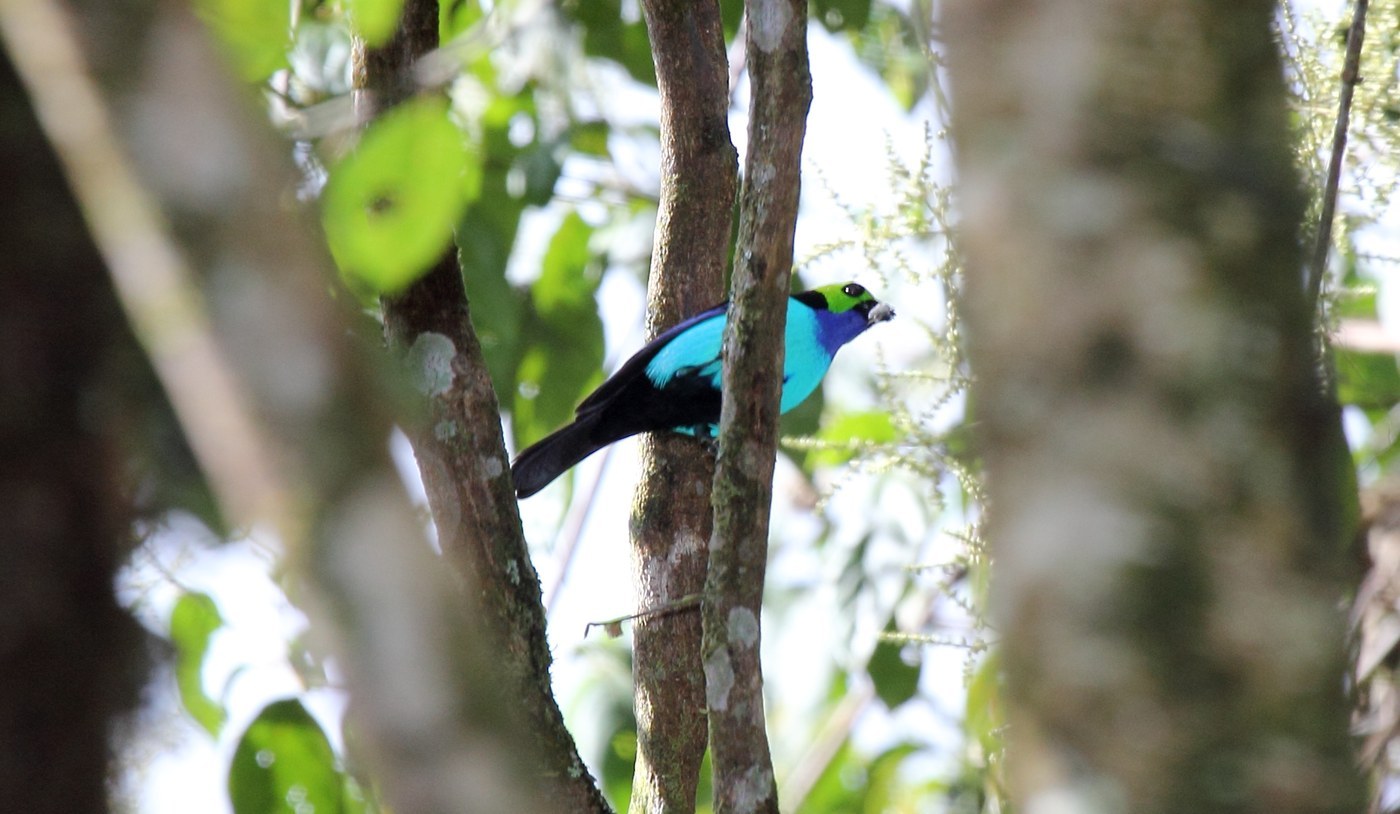
Key Field Marks
- Size & shape: A small tanager around 15 cm long, compact and short-tailed like other Tangara tanagers.
- Head: Bright turquoise-green crown and face with a small black mask around the eye and a contrasting sky-blue throat patch.
- Body: Black back, wings, and tail; bright lime-yellow to yellow-green underparts; and a vivid scarlet-red rump that flashes prominently, especially in flight.
- Behavior: Usually found in small groups within mixed-species canopy flocks, gleaning fruit and insects from foliage high in the forest canopy or at forest edge.
Separating It from Similar Species
- Other Tangara tanagers (e.g., Green-and-gold Tanager, Opal-crowned Tanager): No other species combines a turquoise head, black mask, blue throat, red rump, and yellow underparts in the same way — once seen well, Paradise Tanager is essentially unmistakable.
- Confusion is more likely from brief or poor views; look specifically for the scarlet rump patch, which is diagnostic when visible.
Where & When to See It
- Range: Widespread across the Amazon basin, including Brazil, Peru, Ecuador, Colombia, Venezuela, Bolivia, and the Guianas.
- Habitat: Canopy and edge of humid lowland and foothill (terra firme and várzea) tropical forest.
- Season: Resident year-round with no significant migration; best located by joining mixed-species canopy flocks, often first detected by voice.
Voice
High-pitched, thin "seet" or "tsit" calls given frequently as birds move through the canopy in flocks; not known for an elaborate song.
Frequently asked questions
What is the most distinctive feature of a Paradise Tanager?
The combination of a turquoise head, black mask, blue throat patch, scarlet rump, and lime-yellow underparts — a color pattern unmatched by any other bird in its range.
Where do Paradise Tanagers live?
The canopy of humid lowland and foothill forest across the Amazon basin in South America.
Do Paradise Tanagers flock with other species?
Yes, they commonly join mixed-species canopy foraging flocks along with other tanagers and small insectivorous birds.
What color is a Paradise Tanager's rump?
Bright scarlet red, a key diagnostic flash of color visible especially in flight.