
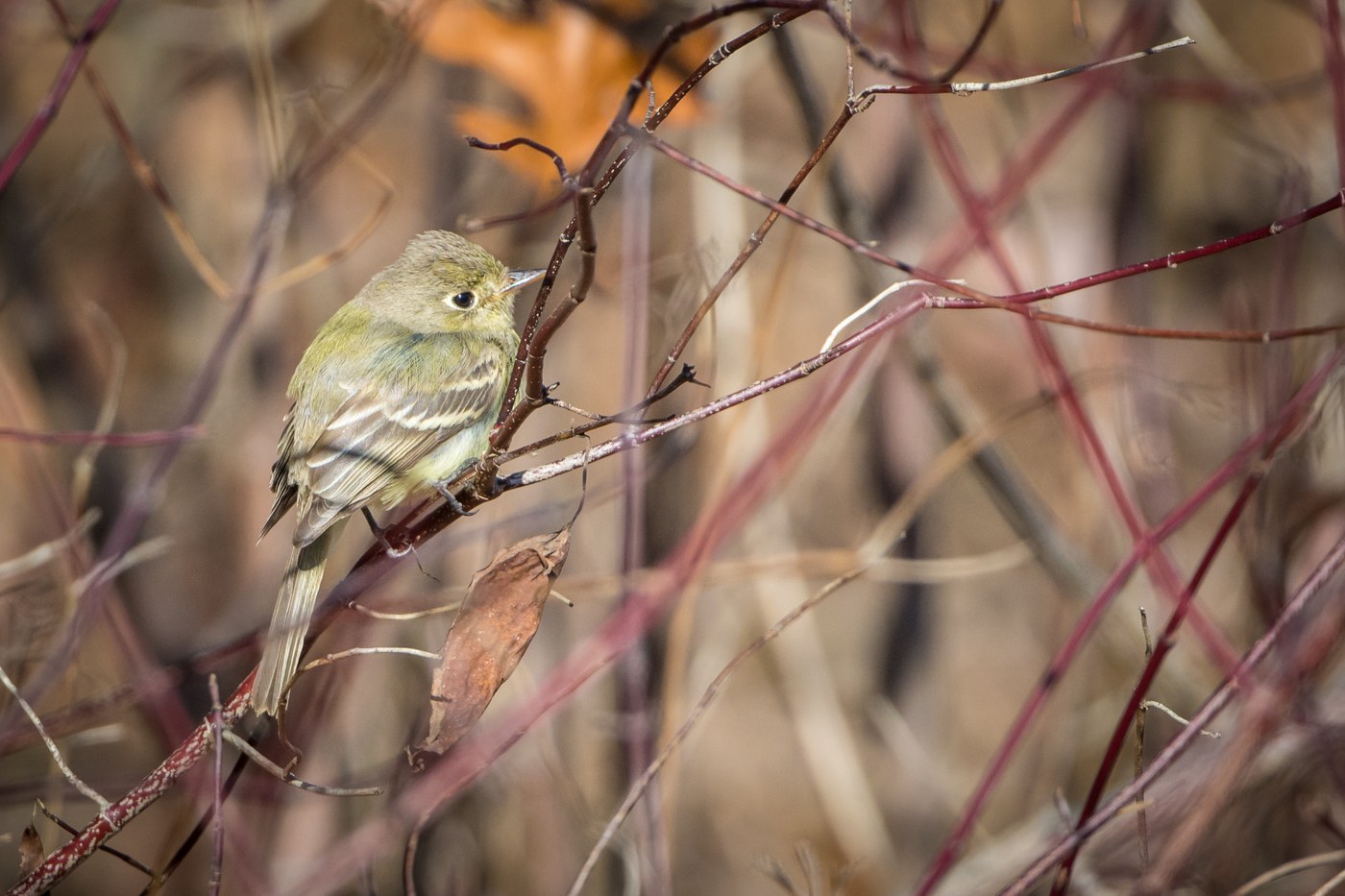
Pacific-slope Flycatcher
Empidonax difficilis
A yellowish-toned Empidonax flycatcher of shady Pacific coastal forests, nearly identical to the Cordilleran Flycatcher and best told apart by range and call.
- Size
- 13-15 cm (5-6 in) long, 21-22 cm wingspan
- Habitat
- humid coastal and coniferous forests along the Pacific coast of North America
- Type
- songbird
Spotted a bird like this?
Identify any bird from a photo, free.
Overview
The Pacific-slope Flycatcher is a small, yellowish-washed member of the Empidonax genus found in humid, shady forests along the Pacific coast of North America. It shows olive-green upperparts, a teardrop-shaped white eye-ring that often points upward behind the eye, and pale yellowish underparts and wing bars. It was formerly considered the same species as the Cordilleran Flycatcher under the name "Western Flycatcher," until the two were split in 1989 based on subtle vocal and genetic differences, though they remain virtually identical in appearance.
This flycatcher favors cool, moist, shaded forest understory, often near streams or ravines, where its soft, upslurred call notes can be heard from the shadows of dense conifer or mixed forest.
How to identify it
Key Field Marks
- Olive-green upperparts with a yellowish wash overall, including the throat and belly
- Bold, teardrop-shaped whitish eye-ring, often pointed at the rear
- Two pale wing bars
- Small size typical of Empidonax flycatchers
Similar Species
- Cordilleran Flycatcher is essentially identical in plumage; the two are distinguished mainly by range (Pacific-slope along the coast, Cordilleran in the interior Rockies and Great Basin) and by subtle differences in call notes.
- Hammond's Flycatcher is grayer overall with a less yellow wash and shorter primary projection.
- Voice, especially the sharp tseet or pseet call, is often the most reliable way to confirm identification within its range.
Habitat & range
Pacific-slope Flycatchers breed in humid coniferous and mixed forests along the Pacific coast, from southeastern Alaska through British Columbia, Washington, Oregon, and California, typically in shaded understory near streams, ravines, or dense canopy cover.
The species winters primarily in Mexico, migrating along the Pacific coast and through the interior in spring and fall.
Behavior & voice
Voice
Gives a sharp, upslurred pseet or tseet call and a soft, three-parted song, subtly different in cadence from the closely related Cordilleran Flycatcher.
Feeding
Sallies from a shaded perch in the forest understory to catch flying insects, and also hover-gleans prey from foliage.
Nesting
Builds a cup nest of moss, grass, and plant fibers, often placed in a crevice, on a stump, in a tree cavity, or on a human structure such as a building ledge, typically near water in shaded forest.
Frequently asked questions
How is the Pacific-slope Flycatcher different from the Cordilleran Flycatcher?
The two species are nearly identical in appearance and were once considered a single species; they are best distinguished by range, with Pacific-slope found along the coast and Cordilleran in the interior Rocky Mountain region, and by subtle differences in their call notes.
How do I identify a Pacific-slope Flycatcher?
Look for a small, yellowish-washed flycatcher with a teardrop-shaped whitish eye-ring, olive-green upperparts, and pale wing bars, typically found in shaded, humid Pacific coastal forest.
Where does the Pacific-slope Flycatcher live?
It breeds in humid coniferous and mixed forests along the Pacific coast from Alaska to California, favoring shaded understory near streams and ravines.
Where do Pacific-slope Flycatchers spend the winter?
They migrate to winter primarily in Mexico.
Pacific-slope Flycatcher guides
In-depth guides for identifying, finding, and understanding Pacific-slope Flycatcher.
Other birds you may enjoy

Black Redstart
13-14.5 cm (5.1-5.7 in) long, 23-26 cm wingspan

Black-throated Sparrow
12-14 cm (4.7-5.5 in) long, about 19-20 cm (7.5-8 in) wingspan

Greater Bird-of-paradise
Body about 43 cm; males with additional flank plumes up to 50 cm and long tail wires

Blue Tit
11-12 cm (4.3-4.7 in) long, 17-20 cm wingspan

Red-billed Quelea
11.5–13 cm long, wingspan about 20–22 cm
White-plumed Antbird
13-14 cm (5-5.5 in) long

Pyrrhuloxia
19-22 cm (7.5-8.7 in) long, 30 cm wingspan

Blue-gray Tanager
16-18 cm (6-7 in) long

Blackburnian Warbler
11-13 cm (4.3-5.1 in) long, 20-22 cm wingspan

Bluethroat
13-14 cm (5.1-5.5 in) long, 20-22 cm wingspan

Eurasian Nuthatch
12-14.5 cm (4.7-5.7 in) long, 22.5-27 cm wingspan

Wood Thrush
19-21 cm (7.5-8.3 in) long, about 33 cm (13 in) wingspan