
Pacific-slope Flycatcher Identification Guide
A small, yellowish Empidonax flycatcher of Pacific coastal forests, best distinguished from its near-identical relative the Cordilleran Flycatcher by voice and range.
Read the full Pacific-slope Flycatcher encyclopedia entry →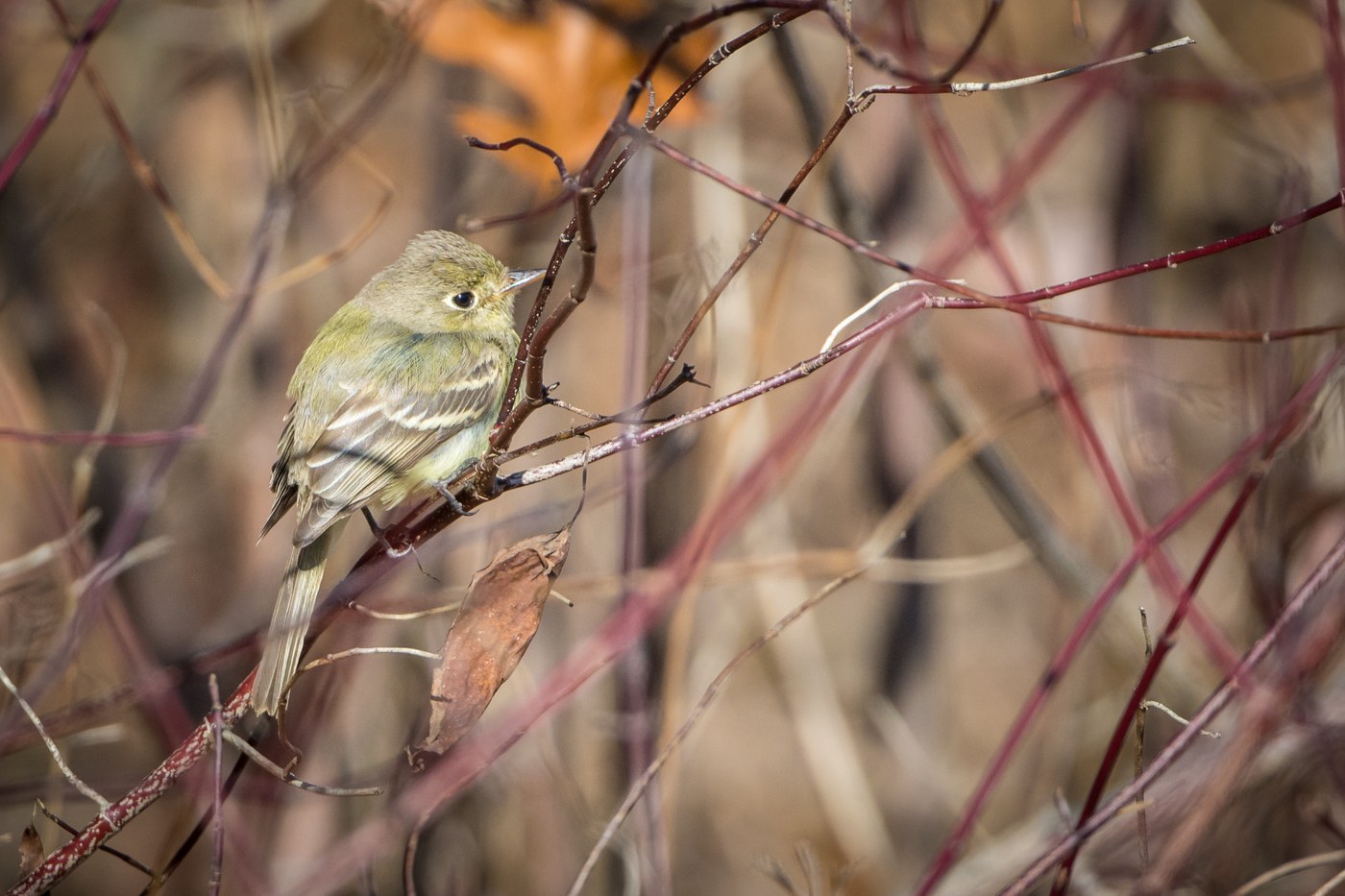
Key Field Marks
- Small flycatcher (about 14-15 cm) with olive-brown to greenish-brown upperparts and a notable yellowish wash on the throat, breast, and belly — more extensive yellow than most other Empidonax flycatchers.
- Pale, almond- or teardrop-shaped eye-ring that appears peaked or angled behind the eye, rather than a simple round ring.
- Two whitish to buffy wing bars on otherwise dark wings.
- Bill is blackish above with a pale orange or yellowish lower mandible.
- Upright posture typical of flycatchers, often flicking wings and tail while perched.
Similar Species
- Cordilleran Flycatcher: essentially identical in plumage; the two were formerly treated as a single species ("Western Flycatcher"). They are best separated by voice and range — Cordilleran breeds in the Rocky Mountains and interior ranges, Pacific-slope along the Pacific coast and coastal mountains — with a zone of overlap/ambiguity in parts of the interior where visual identification alone is unreliable.
- Other Empidonax (e.g., Least Flycatcher, Hammond's Flycatcher, Dusky Flycatcher): generally grayer and less yellow overall, with different eye-ring shapes and habitat preferences; voice remains the most reliable way to confirm identification among Empidonax species.
Habitat, Range & Season
- Breeds in shady, moist coniferous and mixed forest, wooded canyons, and ravines near water from southeastern Alaska south through coastal British Columbia, Washington, Oregon, and California.
- Winters primarily in Mexico.
- Often found in shadier, denser forest than more open-country flycatchers.
Voice
- Call is a sharp, rising "psweet" or "suweet."
- Song is a series of thin, high-pitched notes, often rendered as "psit ... psit ... pseet."
- Voice is the most reliable way to distinguish this species from the very similar Cordilleran Flycatcher, whose call is subtly sharper and more emphatic.
Behavior Notes
- Sits upright on a perch and sallies out to catch flying insects, often returning to the same or a nearby perch.
- Frequently flicks its wings and tail while perched, a common Empidonax behavior.
Frequently asked questions
How do you tell Pacific-slope Flycatcher from Cordilleran Flycatcher?
The two look essentially identical in plumage and are best separated by voice and geography: Pacific-slope breeds along the Pacific coast and coastal mountains, while Cordilleran breeds in the Rocky Mountains and interior ranges.
What is the best field mark for a Pacific-slope Flycatcher?
A yellowish wash on the throat and underparts combined with a peaked, teardrop-shaped pale eye-ring, more extensive yellow than most other Empidonax flycatchers show.
Where does the Pacific-slope Flycatcher breed?
In shady, moist coniferous and mixed forest, wooded canyons, and ravines near water along the Pacific coast from southeastern Alaska through California.
What does a Pacific-slope Flycatcher sound like?
A sharp, rising call often written as 'psweet' or 'suweet,' and a song of thin, high notes rendered as 'psit...psit...pseet.'