
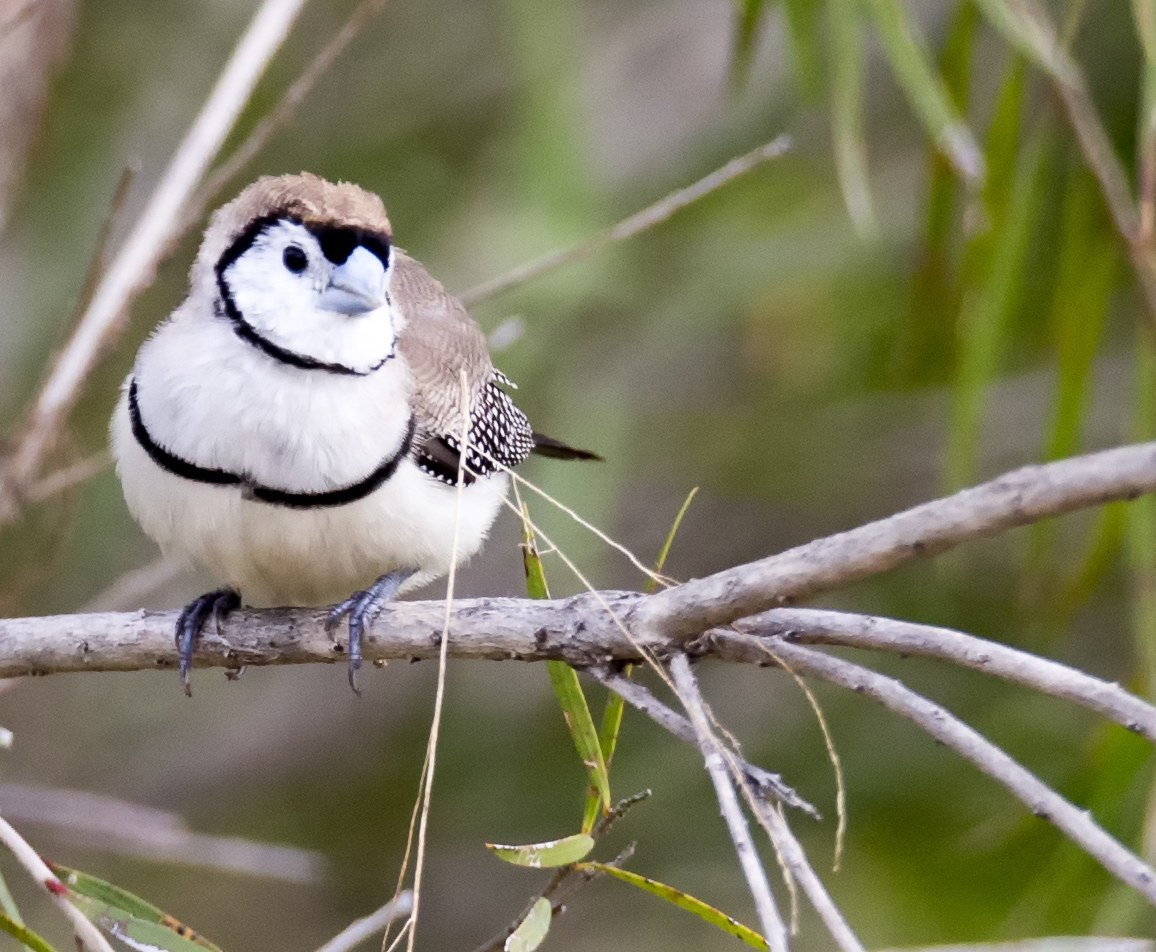
Owl Finch
Taeniopygia bichenovii
A small Australian grass finch with a distinctive white, black-ringed face resembling an owl's, paired with two crisp black breast bars.
- Size
- About 10–11 cm (4 in) long; small, round-bodied finch
- Habitat
- Dry grassy woodland, scrub, and grassland edges across Australia
- Type
- songbird
Spotted a bird like this?
Identify any bird from a photo, free.
Overview
Overview
The Owl Finch, more formally known as the Double-barred Finch, is a small Australian estrildid finch named for its striking facial pattern. A ring of black feathering encircles an otherwise white face, giving the bird a distinctive owl-like appearance.
Plumage
The upperparts are soft grey-brown, and the white breast is crossed by two narrow black bars, one across the upper breast and one lower down. The rump is either white or black depending on the subspecies (the eastern and northern forms differ in this trait), and the wings show small white spots. Sexes look similar.
How to identify it
Field Marks
- White face fully outlined in black, giving an owl-like look
- Grey-brown back and wings with fine white spotting
- Two distinct black bars crossing the white breast
- Rump color (white or black) varies by subspecies/region
Similar Species
The combination of an owl-like ringed white face and double breast bars is unique among Australian finches, making this species easy to separate from similar-sized grass finches such as the Zebra Finch, which lacks the facial ring and shows chestnut flanks instead.
Habitat & range
Habitat & Range
Owl Finches are widespread across much of mainland Australia, favoring dry grassy woodland, open scrub, grassland edges, and areas near water where grass seed is available. Two recognized forms occupy somewhat different regions: a black-rumped form in the north and east and a white-rumped form further inland and to the south, with a zone of overlap and intergradation.
The species is largely sedentary to locally nomadic, moving in response to seeding grasses and water availability rather than undertaking long-distance migration.
Behavior & voice
Behavior
Owl Finches are sociable, usually encountered in small flocks that forage together on the ground and low vegetation, sometimes joining mixed-species feeding groups with other grass finches.
Voice
The call is a soft, nasal "tiaa" or buzzy "eent"; the song is a simple, quiet series of piping and buzzing notes.
Feeding
Birds feed chiefly on fallen and ripening grass seeds taken from the ground or directly from seed heads, adding small insects to the diet, particularly when feeding young.
Nesting & Breeding
Pairs build a bulky, domed grass nest with a side entrance, sited in shrubs, low trees, or grass tussocks. Clutches typically number four to six white eggs, incubated and raised by both parents.
Frequently asked questions
Why is it called the Owl Finch?
Its white face is fully ringed in black, creating a pattern that resembles the facial disc of an owl.
Is Owl Finch the same as Double-barred Finch?
Yes, Owl Finch is an alternate common name for the Double-barred Finch, Taeniopygia bichenovii.
What are the two black bars on its breast?
They are narrow black bands crossing the white breast, one upper and one lower, a signature field mark of the species.
Where are Owl Finches found?
They occur across much of mainland Australia in dry grassy woodland and scrub habitats.
What do Owl Finches eat?
Mostly grass seeds gathered from the ground or seed heads, plus small insects.
Owl Finch guides
In-depth guides for identifying, finding, and understanding Owl Finch.
Other birds you may enjoy

Black Redstart
13-14.5 cm (5.1-5.7 in) long, 23-26 cm wingspan

Black-throated Sparrow
12-14 cm (4.7-5.5 in) long, about 19-20 cm (7.5-8 in) wingspan

Greater Bird-of-paradise
Body about 43 cm; males with additional flank plumes up to 50 cm and long tail wires

Blue Tit
11-12 cm (4.3-4.7 in) long, 17-20 cm wingspan

Red-billed Quelea
11.5–13 cm long, wingspan about 20–22 cm
White-plumed Antbird
13-14 cm (5-5.5 in) long

Pyrrhuloxia
19-22 cm (7.5-8.7 in) long, 30 cm wingspan

Blue-gray Tanager
16-18 cm (6-7 in) long

Blackburnian Warbler
11-13 cm (4.3-5.1 in) long, 20-22 cm wingspan

Bluethroat
13-14 cm (5.1-5.5 in) long, 20-22 cm wingspan

Eurasian Nuthatch
12-14.5 cm (4.7-5.7 in) long, 22.5-27 cm wingspan

Wood Thrush
19-21 cm (7.5-8.3 in) long, about 33 cm (13 in) wingspan