
Owl Finch Identification Guide
A small Australian grassfinch with a distinctive white, owl-like face bordered in black and one or two dark bands across the breast.
Read the full Owl Finch encyclopedia entry →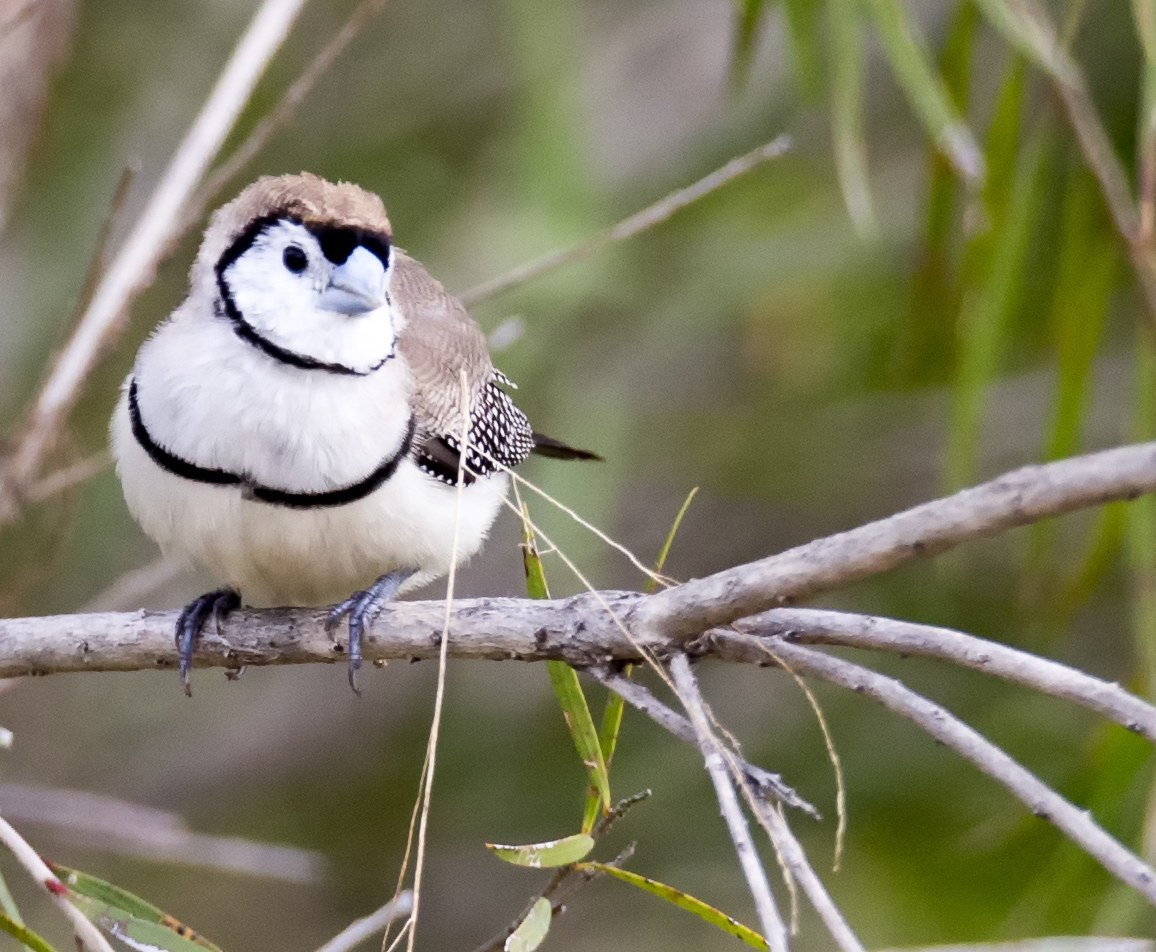
Key Field Marks
- Small estrildid finch (about 10-11 cm) with a plain white face bordered by a black eye-patch and crown, giving an owl-like facial impression.
- Black bill; brown back and wings finely spotted or barred with white; a black band crosses the upper breast, with a second dark band lower on the flanks/belly in most populations ("double-barred" pattern).
- Rump color varies by subspecies: white-rumped birds in eastern Australia, black-rumped birds in northern Australia.
- Sexes look similar, making this species difficult to sex by plumage alone.
Similar Species
- Zebra Finch: has an orange-red bill, orange cheek patches, and fine barring on the throat — features the Owl Finch lacks; Owl Finch's plain white face and black bill are diagnostic by comparison.
- Within Owl Finch populations, the two subspecies are distinguished mainly by rump color (white vs. black), which is otherwise the main plumage variation in the species.
Habitat, Range & Season
- Endemic to Australia, found in grassy woodland, savanna, and scrub, usually near water, across northern and eastern parts of the continent.
- Often seen in small flocks moving through grass and low shrubs; year-round resident within its native range.
- A popular aviary species elsewhere in the world, so escaped or released birds can occasionally turn up outside Australia, though these are not wild populations.
Voice
- Calls are soft, nasal, and buzzy — often described as a quiet "beep" or short nasal note — quieter and less musical than many other Australian finches.
- Contact calls are used to maintain flock cohesion while foraging.
Behavior Notes
- Highly social, usually found in small flocks feeding on grass seeds close to the ground.
- Builds an untidy, domed grass nest, often in a shrub or tree fork, sometimes closely spaced with other pairs.
Frequently asked questions
What makes the Owl Finch's face distinctive?
It has a plain white face bordered by a black patch around the eyes and crown, which together create the owl-like appearance that gives the species its name.
How do you tell an Owl Finch from a Zebra Finch?
Owl Finch has a black bill and a plain white face with no orange cheek patch, while Zebra Finch has an orange-red bill, orange cheek patches, and fine throat barring.
Where is the Owl Finch found in the wild?
It is native only to Australia, inhabiting grassy woodland, savanna, and scrub near water across the northern and eastern parts of the continent.
Do the two Owl Finch subspecies look different?
The main difference is rump color: one subspecies has a white rump (found mainly in eastern Australia) and the other has a black rump (found mainly in northern Australia).