
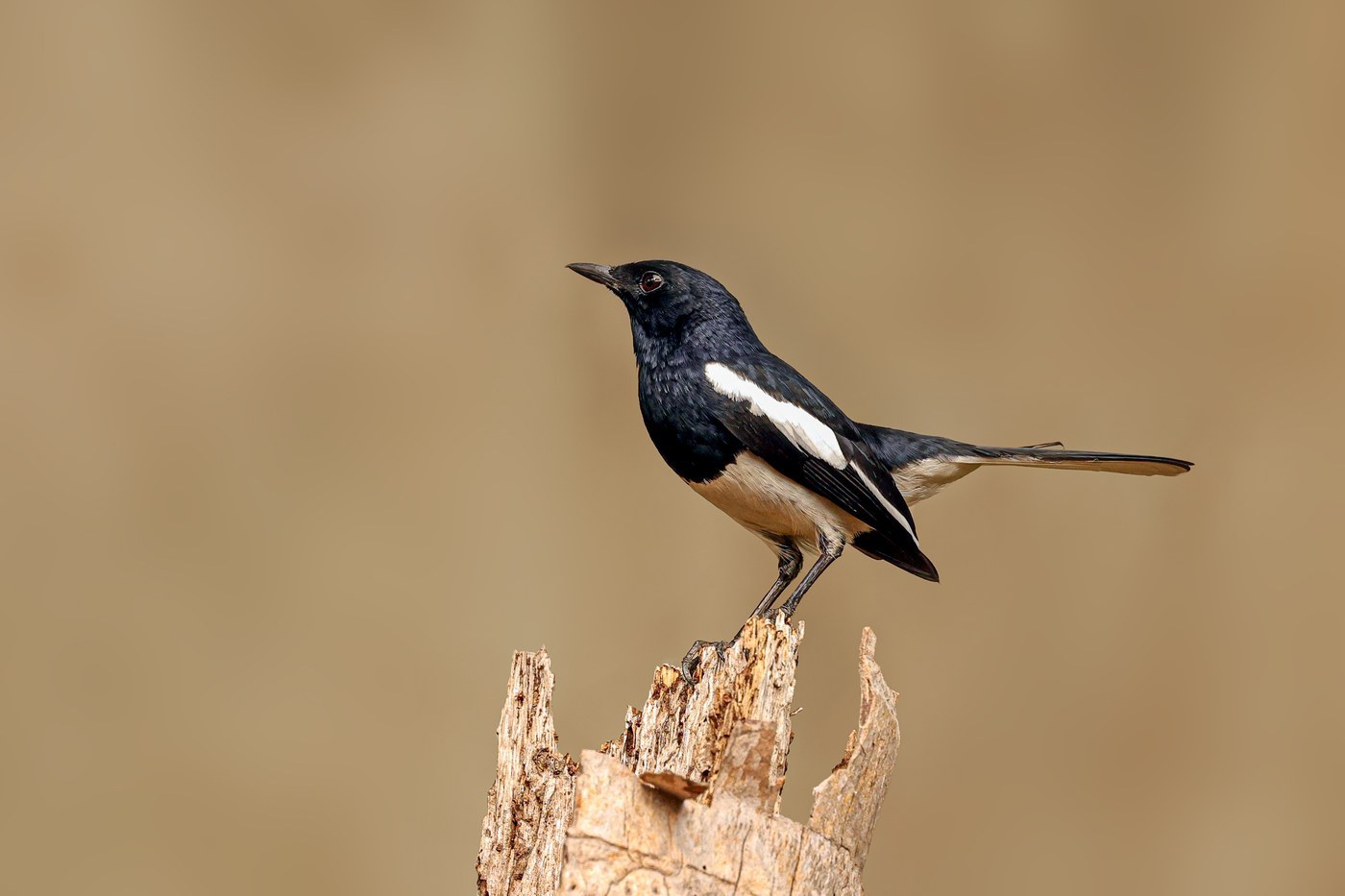
Oriental Magpie-Robin
Copsychus saularis
A bold black-and-white songster related to robins and chats, prized for its rich, melodious dawn song.
- Size
- 19-21 cm (7.5-8.3 in) long
- Habitat
- gardens, parks, open woodland, and cultivated land across South and Southeast Asia
- Type
- songbird
Spotted a bird like this?
Identify any bird from a photo, free.
Overview
The Oriental Magpie-Robin is a familiar and much-loved garden bird across South and Southeast Asia, known for its glossy black-and-white plumage and its rich, varied song, which has made it a popular cage bird in parts of its range historically and a national bird symbol in some countries. The adult male is glossy blue-black on the head, throat, back, and tail, with a crisp white belly and prominent white wing patches and outer tail feathers visible especially in flight.
Females show the same pattern but with the black replaced by dark grey, giving a slightly softer contrast. Both sexes habitually hold the tail cocked upward, a characteristic posture shared with many chats and robins, and often flick it while foraging.
How to identify it
Key field marks
- Male: glossy black head, throat, back, and tail; white belly and white patches on wings and outer tail
- Female: same pattern but grey instead of black
- Frequently cocks tail upward while perched or foraging
- Confident, often tame behavior around gardens and buildings
Similar species
The Indian Robin is smaller, with a white shoulder patch (not wing bar) and chestnut undertail coverts, and prefers drier, scrubbier habitat. True magpies are much larger with long graduated tails and lack the robin-like cocked-tail posture.
Habitat & range
This species ranges widely across the Indian subcontinent, Sri Lanka, Bangladesh, and through Southeast Asia into southern China and Indonesia. It thrives in gardens, parks, open woodland, cultivated land, and areas near human habitation, generally avoiding dense unbroken forest and very arid regions.
Oriental Magpie-Robins are largely resident, defending year-round territories, though some local dispersal of young birds occurs.
Behavior & voice
Voice
The song is a rich, loud, and highly varied mix of clear whistles and warbled phrases, often delivered from a prominent perch at dawn, and the species is also an accomplished mimic of other birds' calls; the call note is a harsh "chr-r-r" scold.
Feeding
Magpie-Robins forage mostly on the ground and in low vegetation, hopping and running after insects, earthworms, and other invertebrates, and occasionally take small lizards or fruit.
Nesting and breeding
They nest in tree cavities, wall crevices, or nest boxes, building a loose cup of grass, rootlets, and feathers. Both parents may help provision the 3-5 chick brood, and males are highly territorial, singing persistently to defend their territory and attract mates.
Frequently asked questions
Why is the Oriental Magpie-Robin considered a good singer?
It has a rich, varied, and melodious song delivered in long bursts, often at dawn, and can also mimic the calls of other bird species.
How do you tell a male from a female Oriental Magpie-Robin?
Males show glossy black on the head, throat, back, and tail, while females show the same pattern in dark grey instead of black.
Why does the Oriental Magpie-Robin cock its tail?
Like many robins and chats, it habitually holds its tail raised and flicks it while foraging or perched, a characteristic posture of the group.
What does the Oriental Magpie-Robin eat?
Mainly insects and earthworms gleaned from the ground, along with occasional small lizards and fruit.
Oriental Magpie-Robin guides
In-depth guides for identifying, finding, and understanding Oriental Magpie-Robin.
Other birds you may enjoy

Black Redstart
13-14.5 cm (5.1-5.7 in) long, 23-26 cm wingspan

Black-throated Sparrow
12-14 cm (4.7-5.5 in) long, about 19-20 cm (7.5-8 in) wingspan

Greater Bird-of-paradise
Body about 43 cm; males with additional flank plumes up to 50 cm and long tail wires

Blue Tit
11-12 cm (4.3-4.7 in) long, 17-20 cm wingspan

Red-billed Quelea
11.5–13 cm long, wingspan about 20–22 cm
White-plumed Antbird
13-14 cm (5-5.5 in) long

Pyrrhuloxia
19-22 cm (7.5-8.7 in) long, 30 cm wingspan

Blue-gray Tanager
16-18 cm (6-7 in) long

Blackburnian Warbler
11-13 cm (4.3-5.1 in) long, 20-22 cm wingspan

Bluethroat
13-14 cm (5.1-5.5 in) long, 20-22 cm wingspan

Eurasian Nuthatch
12-14.5 cm (4.7-5.7 in) long, 22.5-27 cm wingspan

Wood Thrush
19-21 cm (7.5-8.3 in) long, about 33 cm (13 in) wingspan