
Oriental Magpie-Robin Identification Guide
A confident, tail-cocking black-and-white songbird common in gardens and villages across South and Southeast Asia, prized for its rich musical song.
Read the full Oriental Magpie-Robin encyclopedia entry →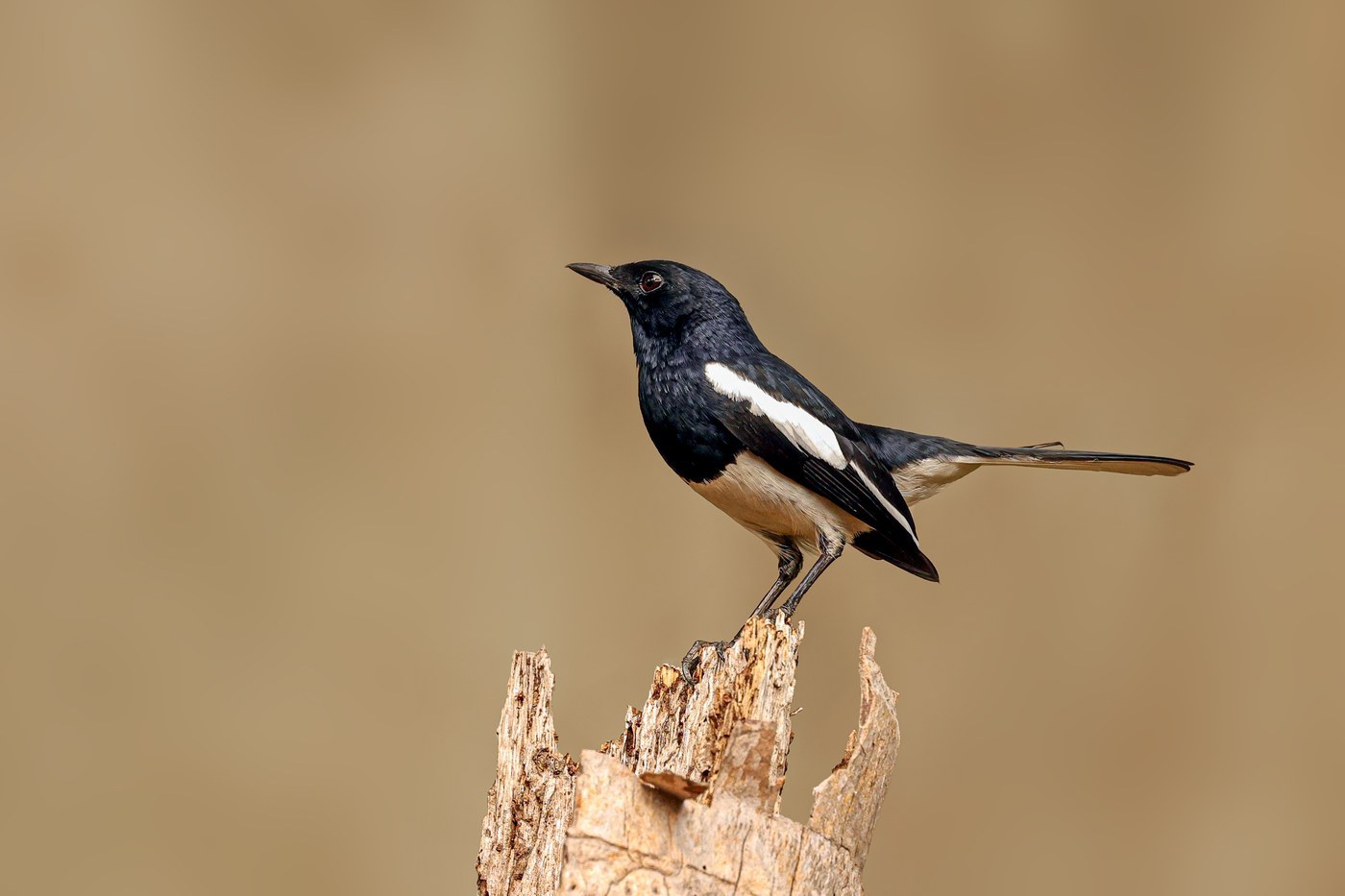
Key Field Marks
- Size & shape: A medium-sized, slender songbird (about 19–21 cm / 7.5–8 in) with a fairly long tail that it habitually holds cocked upward, giving it a jaunty, robin-like posture.
- Plumage (male): Glossy black head, throat, and upperparts with a bold white belly and white patches on the wings and outer tail feathers, producing a striking pied (black-and-white) pattern, especially obvious in flight and when the tail is flicked.
- Plumage (female): Similar pattern to the male but with the black replaced by dark grey, giving a softer, less glossy appearance overall.
- Bill & legs: Slim, straight black bill and blackish legs, typical of an active insectivorous chat.
- Behavior: Bold and confiding, often seen on lawns, low perches, and rooftops; frequently cocks and fans its tail while foraging on the ground for insects, and males sing persistently from prominent perches, especially at dawn.
Separating It From Similar Species
- Oriental Pied Starling / other pied birds: Overall shape (slim body, long cocked tail) and behavior (ground-foraging chat with a bounding, tail-flicking gait) distinguish the magpie-robin from more heavy-bodied starlings with different flight and foraging styles.
- White-rumped Shama: Found in some of the same regions but has a much longer, graduated tail and a chestnut (not white) belly, clearly different from the magpie-robin's shorter tail and white underparts.
- Within most of its range, the combination of glossy black-and-white plumage, cocked tail, and garden-loving confiding behavior makes the Oriental Magpie-Robin essentially unmistakable.
Habitat & Range
Widespread and common across the Indian subcontinent and much of Southeast Asia, from Pakistan and India east through Bangladesh, Sri Lanka, Myanmar, Thailand, Indochina, southern China, and into Indonesia and the Philippines (where introduced populations also occur). It thrives in gardens, parks, farmland, forest edges, and around human habitation, generally avoiding dense unbroken forest interior. It is largely resident/non-migratory throughout its range.
Voice
A rich, melodious, varied song of clear whistled phrases, often delivered from a rooftop, wire, or treetop perch, especially at dawn; renowned as one of the finest songsters in the region, which has historically also made it popular in the cagebird trade. Calls include a harsh, scolding cheh-cheh alarm note.
Frequently asked questions
What is the most obvious field mark of the Oriental Magpie-Robin?
A glossy black-and-white (or grey-and-white in females) plumage combined with a long tail that is habitually cocked upward, especially while foraging on lawns or low perches.
How does it differ from the White-rumped Shama?
The Oriental Magpie-Robin has a shorter tail and a white belly, while the White-rumped Shama has a much longer, graduated tail and a chestnut-colored belly.
Where do Oriental Magpie-Robins typically live?
They are common around human habitation across South and Southeast Asia, favoring gardens, parks, farmland, and forest edges rather than deep forest interior.
Why is the Oriental Magpie-Robin well known locally?
It is celebrated for its rich, melodious song, often delivered at dawn from a prominent perch, which has made it a culturally significant songbird across much of its range.