
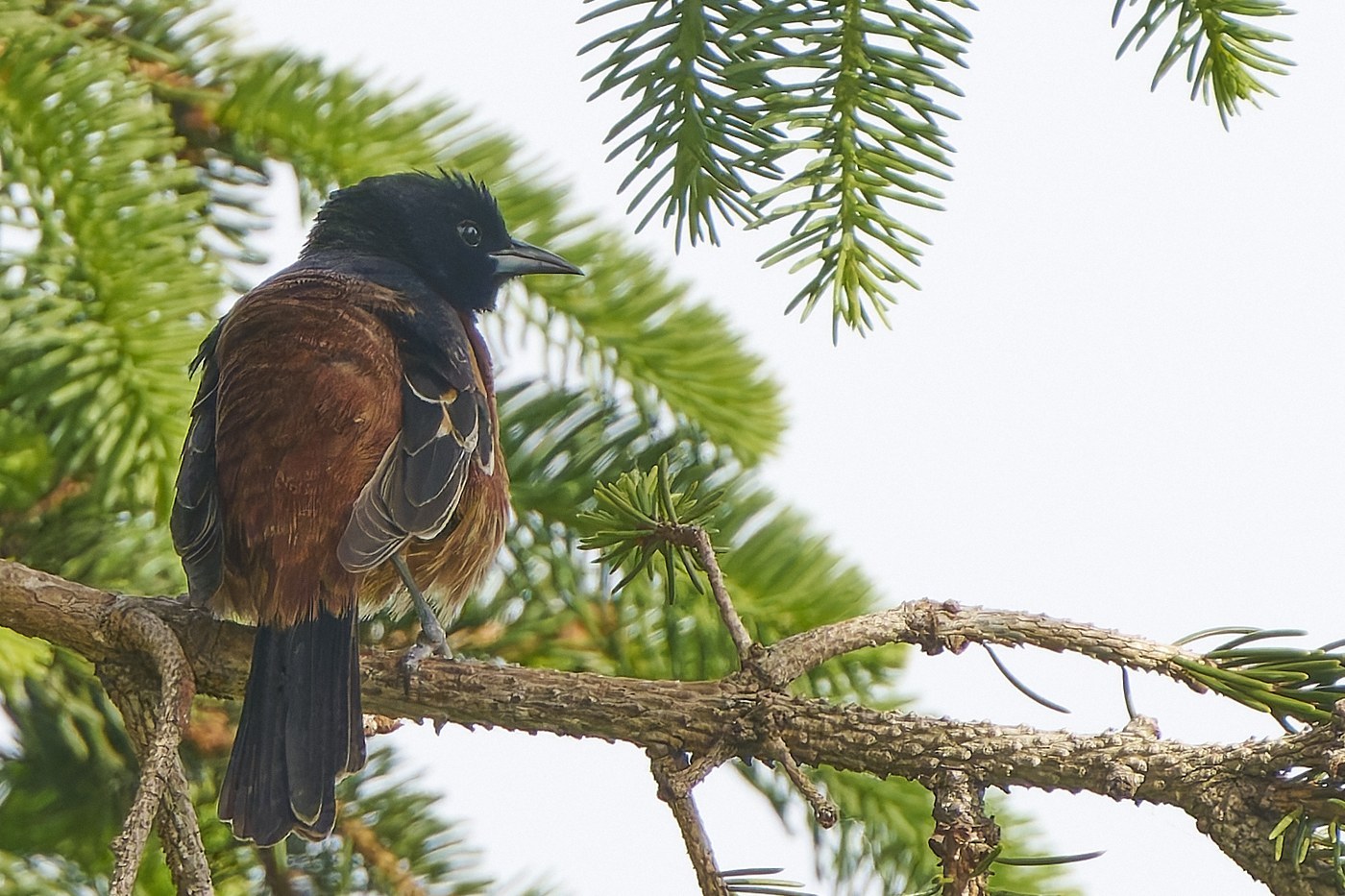
Orchard Oriole
Icterus spurius
The smallest North American oriole, with adult males showing a deep chestnut-and-black plumage rather than the bright orange of most other orioles.
- Size
- 15-18 cm (6-7 in) long, 25 cm wingspan
- Habitat
- open woodlands, orchards, shade trees, riparian groves, and shrubby edges
- Type
- songbird
Spotted a bird like this?
Identify any bird from a photo, free.
Overview
The Orchard Oriole is the smallest and one of the most subtly colored orioles in North America. Adult males are strikingly dark, with a black head, back, wings, and tail contrasting with rich chestnut underparts, rump, and shoulder patch, a color combination unlike the bright orange of most related orioles. Females and immature birds are olive-yellow above and yellow below with dark wings showing white wingbars, while first-spring males show a distinctive intermediate plumage with a black throat patch on an otherwise female-like body.
Despite its name, the Orchard Oriole is found in a wide variety of open, semi-wooded habitats beyond literal orchards, and it is one of the earliest orioles to depart for its wintering grounds each fall.
How to identify it
Key Field Marks
- Small size and slim build compared to other orioles
- Adult male: black hood, back, wings, and tail with deep chestnut underparts and rump
- Female/immature: olive-yellow above, yellow-olive below, two white wingbars
- First-year male: yellow-green body with a black throat/bib patch
- Fairly short, slightly downcurved bill
Similar Species
- Baltimore Oriole males are bright orange and black, quite different from the chestnut Orchard Oriole male.
- Hooded Oriole males are brighter orange-yellow with a black face and bib, larger overall, with a more strongly curved bill.
- Female Orchard Orioles can resemble female Baltimore Orioles but are smaller, brighter yellow-green, and lack strong orange tones.
Habitat & range
Habitat
Orchard Orioles favor open woodland edges, scattered shade trees, riparian groves, orchards, parks, and shrubby fields, generally avoiding dense unbroken forest.
Range
Breeds across the eastern and central United States into southern Canada and south into Mexico. Winters from southern Mexico through Central America to northern South America.
Migration
A long-distance neotropical migrant, the Orchard Oriole is notable for departing its breeding grounds unusually early, often beginning fall migration by midsummer.
Behavior & voice
Behavior
Orchard Orioles are active foragers, gleaning insects from foliage and often visiting nectar sources and fruiting trees. They are less territorial than many orioles and sometimes nest in loose colonies.
Voice
The song is a rich, rapid, whistled warble, often ending in a distinctive downslurred note, faster and more chattery than the Baltimore Oriole's song.
Feeding
Feeds primarily on insects and spiders gleaned from leaves and branches during the breeding season, supplemented with fruit and flower nectar, especially before migration.
Nesting & Breeding
The female weaves a tightly constructed, pouch-like hanging nest of grass, typically suspended from a fork of a tree branch. She incubates 3-7 eggs, and pairs sometimes nest in loose association with other Orchard Orioles.
Frequently asked questions
Why is the male Orchard Oriole chestnut instead of orange?
Orchard Orioles are a distinct species from the brighter orange orioles like the Baltimore Oriole, and their evolutionary lineage produces a deep chestnut-and-black plumage in adult males rather than orange.
What is the smallest oriole in North America?
The Orchard Oriole is the smallest North American oriole, noticeably more compact than Baltimore, Bullock's, or Hooded Orioles.
When do Orchard Orioles migrate?
They are early migrants, often beginning their journey south to Central and South America as early as midsummer, well before many other songbirds.
What does a female Orchard Oriole look like?
Females are olive-yellow above and yellow-olive below with two white wingbars, lacking the black-and-chestnut pattern of adult males.
Where do Orchard Orioles build their nests?
They weave a pouch-like hanging nest of grass, usually suspended from a fork in a tree branch in open woodland or shade trees.
Orchard Oriole guides
In-depth guides for identifying, finding, and understanding Orchard Oriole.
Other birds you may enjoy

Black Redstart
13-14.5 cm (5.1-5.7 in) long, 23-26 cm wingspan

Black-throated Sparrow
12-14 cm (4.7-5.5 in) long, about 19-20 cm (7.5-8 in) wingspan

Greater Bird-of-paradise
Body about 43 cm; males with additional flank plumes up to 50 cm and long tail wires

Blue Tit
11-12 cm (4.3-4.7 in) long, 17-20 cm wingspan

Red-billed Quelea
11.5–13 cm long, wingspan about 20–22 cm
White-plumed Antbird
13-14 cm (5-5.5 in) long

Pyrrhuloxia
19-22 cm (7.5-8.7 in) long, 30 cm wingspan

Blue-gray Tanager
16-18 cm (6-7 in) long

Blackburnian Warbler
11-13 cm (4.3-5.1 in) long, 20-22 cm wingspan

Bluethroat
13-14 cm (5.1-5.5 in) long, 20-22 cm wingspan

Eurasian Nuthatch
12-14.5 cm (4.7-5.7 in) long, 22.5-27 cm wingspan

Wood Thrush
19-21 cm (7.5-8.3 in) long, about 33 cm (13 in) wingspan