
Orchard Oriole Identification Guide
North America's smallest oriole, with adult males showing a distinctive deep chestnut-and-black plumage unlike the brighter orange of other orioles.
Read the full Orchard Oriole encyclopedia entry →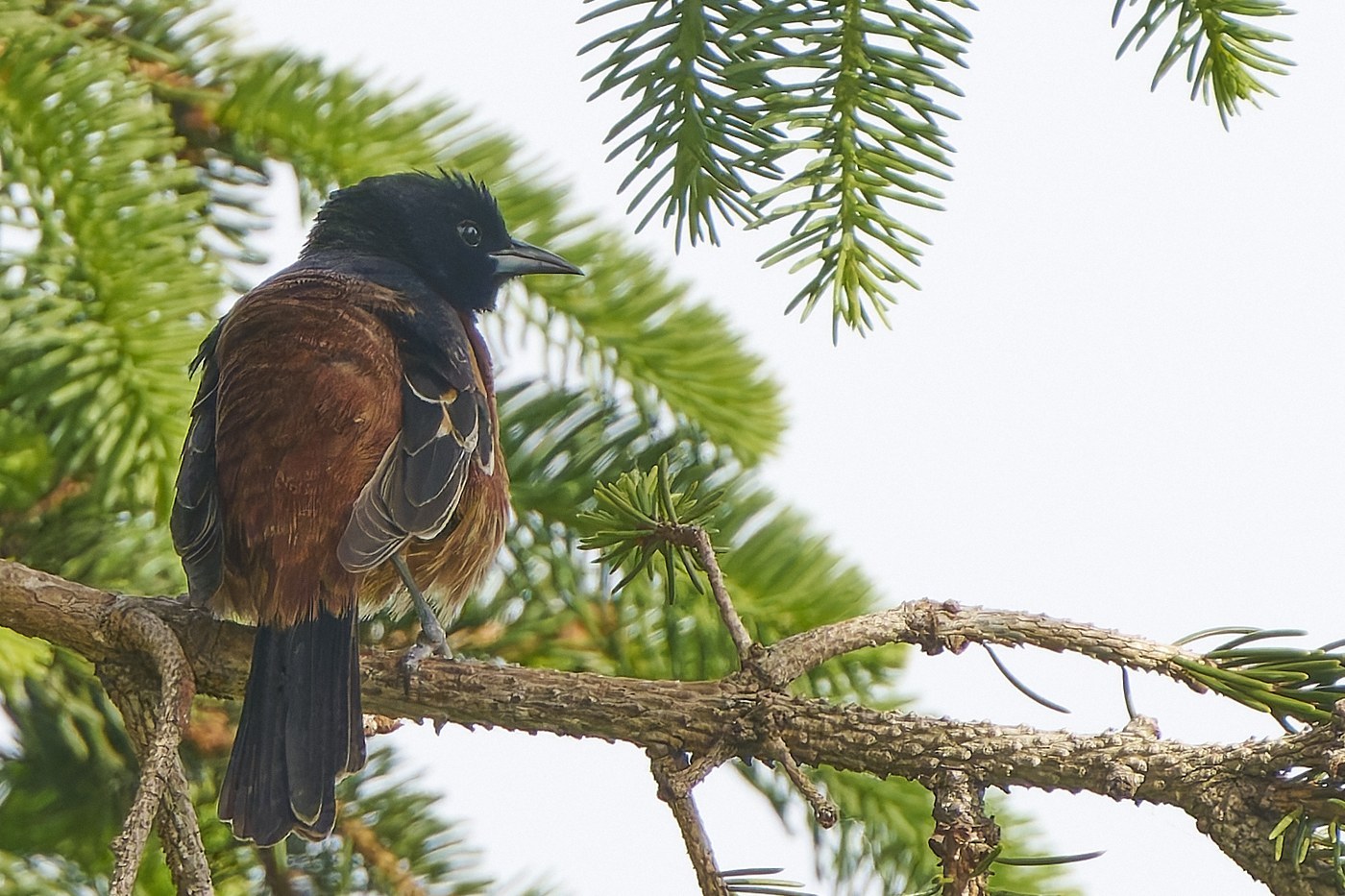
Key Field Marks
- Size & shape: A small, slim oriole (about 16–18 cm / 6–7 in), noticeably smaller and more compact than Baltimore Oriole, with a fine, slightly downcurved bill.
- Plumage (adult male): Black head, back, wings, and tail contrast with rich chestnut (dark burnt-orange to maroon) underparts and rump — much deeper and darker than the bright orange of a Baltimore Oriole.
- Plumage (female/immature male): Females and first-year males are olive-yellow above and yellow below with two whitish wing bars; first-spring males typically show a distinctive black throat patch (bib) on an otherwise female-like body — a useful age/sex clue unique among common orioles.
- Wing bars: White wing bars present in all plumages, more subdued than in Baltimore Oriole.
- Behavior: Active and often somewhat inconspicuous for an oriole, foraging briskly through foliage for insects and nectar; nests are woven cup-shaped structures (shallower than Baltimore Oriole's hanging pouch) slung in the fork of orchard or shade trees, often in loose colonies.
Separating It From Similar Species
- Baltimore Oriole: Larger, with bright orange (not deep chestnut) underparts in adult males and a more strongly hooked bill; female Baltimore Orioles are more orange-toned than the cleaner yellow of female Orchard Orioles.
- Hooded Oriole: Adult male Hooded Oriole is bright orange-yellow with a black throat and face mask, quite different from Orchard's solid black hood and chestnut body; ranges overlap only in the southwest.
- Bullock's Oriole: Shows a bold black-and-orange face pattern with a large white wing patch, unlike the Orchard Oriole's simpler black-hood/chestnut-body combination.
- The first-spring male's black bib on a yellow-green body is unique — no other North American oriole shows this specific combination, making it a reliable diagnostic plumage once learned.
Habitat & Range
Breeds across much of the eastern and central United States into southern Canada and south through Mexico to northern South America, favoring open habitats with scattered trees: orchards, farmland edges, riparian groves, shade trees in towns, and shelterbelts. It is one of the earliest-departing songbirds in fall, often heading south by mid-to-late summer, and winters mainly from southern Mexico to northern South America.
Voice
Song is a fast, rich, whistled jumble of notes, often ending in a distinctive downslurred "wheer" — more hurried and less measured than Baltimore Oriole's fluty whistles. The call is a sharp chuck or a rapid chatter.
Frequently asked questions
How do you tell an Orchard Oriole from a Baltimore Oriole?
Orchard Oriole is smaller with deep chestnut (not bright orange) underparts on adult males; females and immatures are cleaner yellow rather than the more orange-tinged females of Baltimore Oriole.
What does a first-year male Orchard Oriole look like?
It resembles a female — olive-yellow with white wing bars — but shows a distinctive solid black throat patch, a combination unique among North American orioles.
When does the Orchard Oriole leave for migration?
It is one of the earliest fall migrants among songbirds, often departing breeding areas by mid-to-late summer, well before many other neotropical migrants.
What kind of habitat does Orchard Oriole prefer?
Open country with scattered trees, such as orchards, farmland edges, shade trees in towns, and riparian groves, rather than dense unbroken forest.