
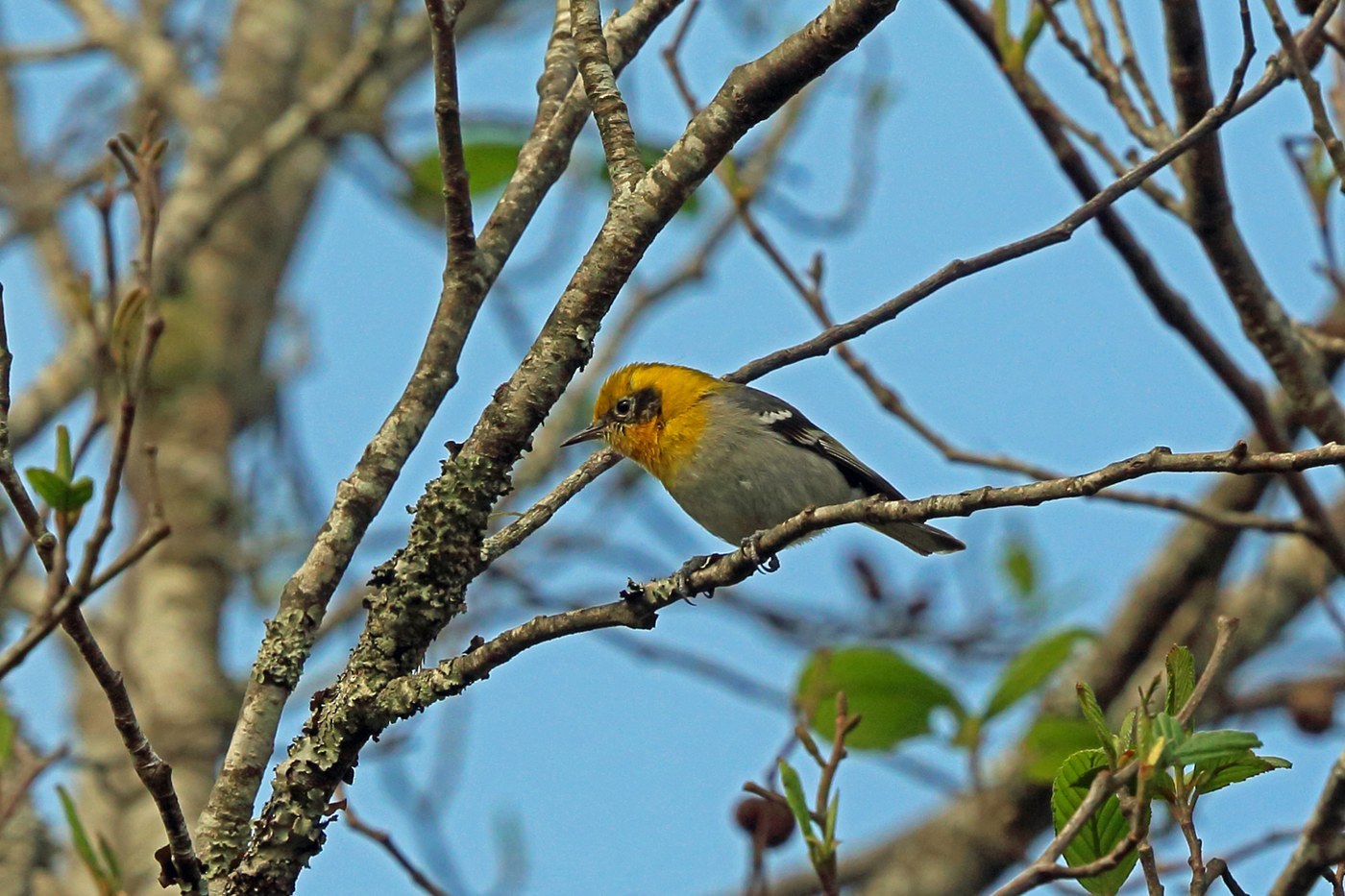
Olive Warbler
Peucedramus taeniatus
A pine-forest specialist with a tawny-orange head and black mask, now classified in its own unique family separate from true warblers.
- Size
- 12-14 cm (5-5.5 in) long
- Habitat
- high-elevation pine and pine-oak forests in mountains
- Type
- songbird
Spotted a bird like this?
Identify any bird from a photo, free.
Overview
The Olive Warbler looks and behaves much like a classic wood-warbler, but genetic studies revealed it belongs to its own distinct family, Peucedramidae, making it a lone evolutionary branch rather than a true member of the New World warbler family. It lives high in the pine forests of the mountains of the southwestern United States and Mexico.
Males are especially striking, with a warm tawny-orange head and throat set against a black face mask, gray back, and white wing bars. Females and immatures show a similar pattern but with dull yellow replacing the orange, giving the species a subdued, elegant look overall.
How to identify it
Key field marks
- Male: tawny-orange head and throat with a black mask through the eye
- Female/immature: dull yellowish head and throat with a fainter gray mask
- Gray back and flanks
- Two white wing bars
- Slim build, often forages high in pine canopy
Similar species
Male Olive Warblers are distinctive and unlikely to be confused with anything else. Female and immature birds can suggest a female Hermit Warbler or Townsend's Warbler at a glance, but Olive Warbler has a slimmer build, a different face pattern lacking a yellow crown patch, and habitually forages very high in pines.
Habitat & range
Habitat
Olive Warblers are habitat specialists of open, mature pine and pine-oak forest, usually foraging high in the canopy of ponderosa and Apache pines at elevations generally above 2,100 m (7,000 ft).
Range
In the US the species occurs in the mountains of southeastern Arizona and southwestern New Mexico. Its range extends much more broadly south through the highlands of Mexico to Nicaragua, where it is more common.
Migration
Olive Warblers are largely non-migratory or make only short elevational movements, descending to lower elevations in winter rather than undertaking long-distance migration like most true warblers.
Behavior & voice
Behavior
Olive Warblers forage methodically and often high overhead in the outer branches of pines, gleaning insects from needle clusters and bark crevices; their habits can resemble those of kinglets or titmice as much as typical warblers.
Voice
The song is a clear, whistled series often rendered as "peter-peter-peter," recalling a Tufted Titmouse in cadence though thinner in tone. The call is a soft, high chip.
Nesting
Nests are placed high in pine trees, far out on horizontal branches, and are built as small, well-concealed cups. Females typically lay 2-4 eggs, and because nests are so high and hard to observe, detailed breeding behavior is less well studied than for many other songbirds.
Frequently asked questions
Is the Olive Warbler a true warbler?
No, despite its name and warbler-like appearance, genetic studies place it in its own unique family, Peucedramidae, separate from the New World wood-warblers.
What does a male Olive Warbler look like?
Males have a tawny-orange head and throat, a black mask through the eye, a gray back, and white wing bars.
Where do Olive Warblers live?
They live in high-elevation pine and pine-oak forests in the mountains of southeastern Arizona and southwestern New Mexico, and more widely through the mountains of Mexico and northern Central America.
Do Olive Warblers migrate?
They are largely resident, though they may move to lower elevations outside the breeding season rather than migrating long distances.
Olive Warbler guides
In-depth guides for identifying, finding, and understanding Olive Warbler.
Other birds you may enjoy

Black Redstart
13-14.5 cm (5.1-5.7 in) long, 23-26 cm wingspan

Black-throated Sparrow
12-14 cm (4.7-5.5 in) long, about 19-20 cm (7.5-8 in) wingspan

Greater Bird-of-paradise
Body about 43 cm; males with additional flank plumes up to 50 cm and long tail wires

Blue Tit
11-12 cm (4.3-4.7 in) long, 17-20 cm wingspan

Red-billed Quelea
11.5–13 cm long, wingspan about 20–22 cm
White-plumed Antbird
13-14 cm (5-5.5 in) long

Pyrrhuloxia
19-22 cm (7.5-8.7 in) long, 30 cm wingspan

Blue-gray Tanager
16-18 cm (6-7 in) long

Blackburnian Warbler
11-13 cm (4.3-5.1 in) long, 20-22 cm wingspan

Bluethroat
13-14 cm (5.1-5.5 in) long, 20-22 cm wingspan

Eurasian Nuthatch
12-14.5 cm (4.7-5.7 in) long, 22.5-27 cm wingspan

Wood Thrush
19-21 cm (7.5-8.3 in) long, about 33 cm (13 in) wingspan