
Olive Warbler Identification Guide
A pine-forest specialist of the Southwest and Mexican highlands whose orange-headed males and unique taxonomy set it apart from all true wood-warblers.
Read the full Olive Warbler encyclopedia entry →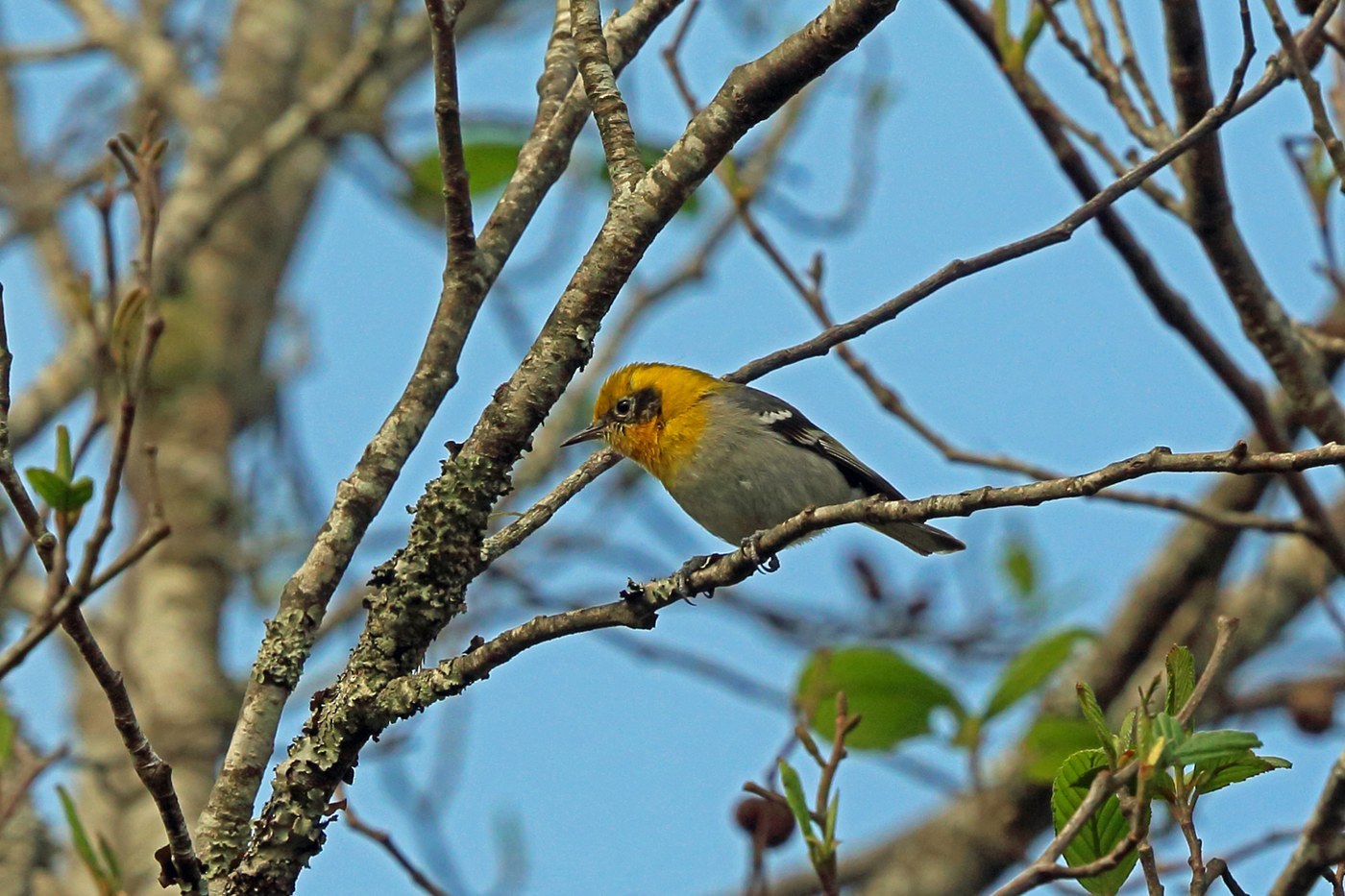
Key Field Marks
- Size & shape: A small, slender songbird (about 12–14 cm / 5 in) with a fine, slightly downcurved bill and a fairly long tail — superficially warbler-like but placed in its own family, distinct from true New World warblers.
- Plumage (male): Adult males have a bright burnt-orange to tawny head and throat, a black mask through the eye, and grey upperparts with white wing bars; the orange head glows conspicuously against high pine boughs.
- Plumage (female/immature): Duller, with a dull yellow-olive head and grey back replacing the male's orange, but retaining the dark eye-mask and white double wing bars.
- Bill & legs: Thin, pointed bill suited to gleaning insects; dark legs.
- Behavior: Forages high in the canopy of tall pines, often in mixed foraging flocks with chickadees, nuthatches, and kinglets, moving deliberately along outer branches and pine needle clusters rather than flitting rapidly like many warblers.
Separating It From Similar Species
- Male Hermit Warbler / Townsend's Warbler: Both show yellow (not orange) heads and lack the Olive Warbler's black mask combined with grey body and white wing bars; the Olive Warbler's orange tone is richer and more saturated.
- Female/immature birds can suggest a female Pine Warbler or Cape May Warbler, but the combination of a distinct dark eye-mask, grey (not greenish-yellow) back, and clean white wing bars helps separate it.
- Behaviorally, its preference for the very tops of mature pines, well above where most true warblers forage, is a useful supporting clue.
Habitat & Range
Resident in high-elevation pine and pine-oak forest of the "Sky Island" mountain ranges of southeastern Arizona and southwestern New Mexico, south through the Sierra Madre of Mexico to Nicaragua. It stays largely at elevation year-round, generally favoring open stands of mature pines, and northern populations may make modest local elevational movements in winter rather than long-distance migration.
Voice
Song is a clear, whistled, warbling series, often rendered as "peedle-peedle-peedle" or "tsee-tsee-tsee," with a quality more reminiscent of a titmouse than a typical warbler. The call is a soft, thin tsip.
Frequently asked questions
Is the Olive Warbler a true warbler?
No — despite its name and superficial resemblance to wood-warblers, the Olive Warbler is now classified in its own family (Peucedramidae), distinct from the New World warbler family Parulidae.
What is the most distinctive field mark of a male Olive Warbler?
A bright orange head and throat set off by a black mask through the eye, combined with a grey body and white wing bars.
Where should I look for an Olive Warbler in the U.S.?
High-elevation pine forests of the 'Sky Island' mountains of southeastern Arizona and southwestern New Mexico, typically foraging near the tops of mature pines.
How do female Olive Warblers differ from males?
Females and immatures show dull yellow-olive heads instead of orange, but retain the dark eye-mask and white double wing bars that help confirm the species.