
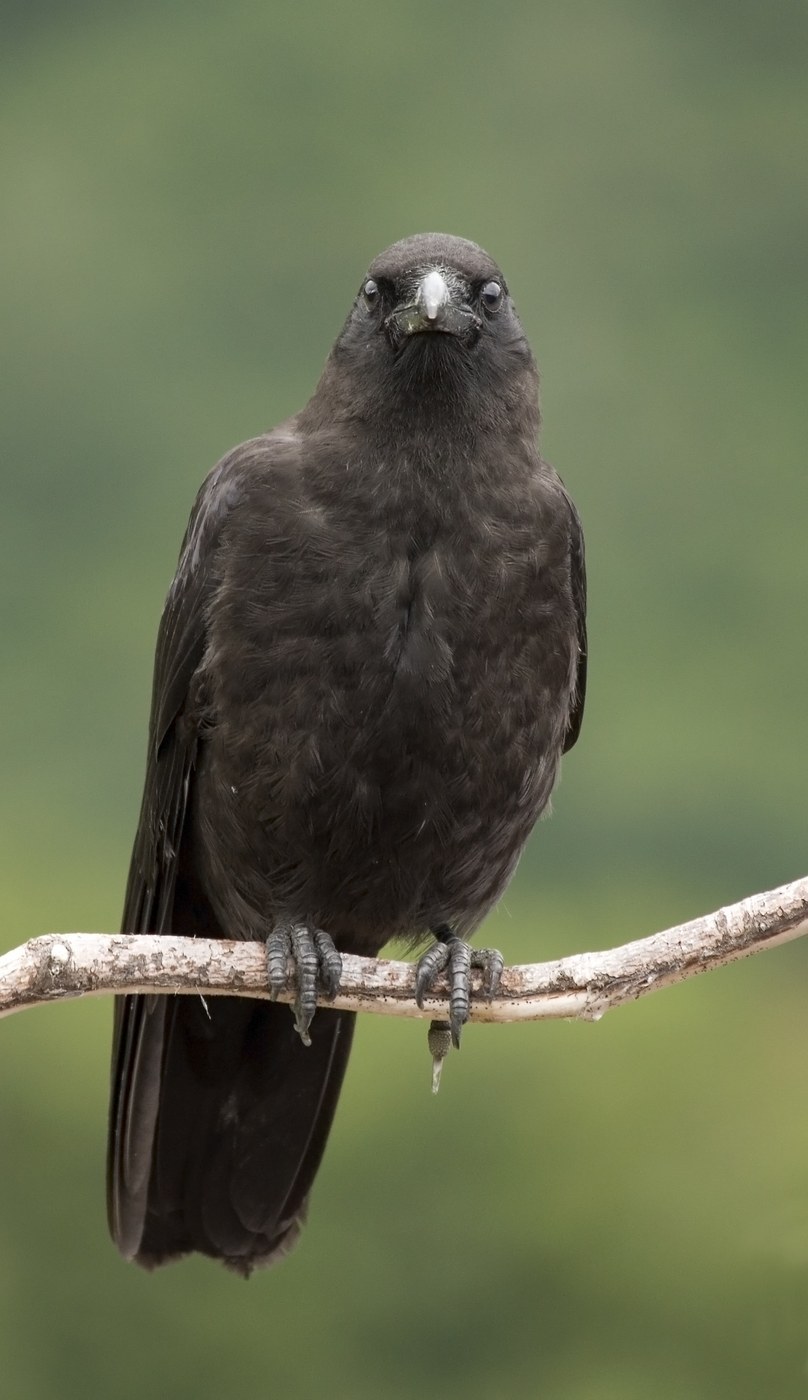
Northwestern Crow
Corvus caurinus
A small, coastal crow of the Pacific Northwest closely resembling the American Crow and often found foraging along tidelines.
- Size
- 33-41 cm (13-16 in) long, 85-90 cm wingspan
- Habitat
- rocky shorelines, beaches, and coastal forests of the Pacific Northwest
- Type
- songbird
Spotted a bird like this?
Identify any bird from a photo, free.
Overview
The Northwestern Crow is a small, entirely black corvid found along the coastal waters of the Pacific Northwest, from Washington's Puget Sound north through coastal British Columbia and southeastern Alaska. It is extremely similar in appearance to the American Crow, and the two forms are so alike genetically that some ornithological authorities have proposed merging them as a single species.
Wherever it occurs, this crow is closely tied to marine shorelines, where it forages extensively along the tideline for shellfish and other coastal food, often seen dropping mussels and clams onto rocks to break them open.
How to identify it
Key Field Marks
- Entirely glossy black plumage, essentially identical to American Crow
- Slightly smaller overall size on average
- Voice is somewhat lower and hoarser than American Crow, though calls overlap extensively
- Strong association with rocky shorelines and tidelines
Similar Species
- American Crow is virtually identical in appearance and the two are extremely difficult to distinguish reliably away from range and habitat clues; some taxonomic treatments consider them the same species.
- Common Raven is much larger with a wedge-shaped tail and heavier bill.
Habitat & range
Habitat
Northwestern Crows are closely tied to coastal habitats, including rocky shorelines, beaches, tidal flats, and adjacent coastal forest and towns.
Range
Found along the Pacific coast from the Puget Sound region of Washington north through coastal British Columbia to southeastern Alaska.
Migration
This species is largely non-migratory, remaining resident along the coast year-round.
Behavior & voice
Behavior
Northwestern Crows forage extensively along shorelines at low tide, taking shellfish, crabs, and other invertebrates, and are known to drop hard-shelled prey like mussels and clams from a height onto rocks to crack them open.
Voice
Calls are similar to the American Crow's caw but tend to be somewhat lower-pitched and hoarser, though there is considerable overlap between the two.
Feeding
Diet includes mussels, clams, crabs, and other marine invertebrates, along with carrion, bird eggs, and human food scraps around coastal towns.
Nesting
Pairs build a stick nest in a tree or shrub near the shoreline; the female incubates 3-7 blue-green, spotted eggs.
Frequently asked questions
How is the Northwestern Crow different from the American Crow?
The two are extremely similar and closely related, with the Northwestern Crow being slightly smaller on average and restricted to Pacific Northwest coastlines; some taxonomists consider them a single species.
Where does the Northwestern Crow live?
It lives along the Pacific coast from the Puget Sound region of Washington north through coastal British Columbia to southeastern Alaska.
What does the Northwestern Crow eat?
It eats shellfish and other marine invertebrates, carrion, eggs, and human food scraps found along shorelines.
Why does the Northwestern Crow drop shellfish on rocks?
It uses this behavior to crack open hard-shelled prey like mussels and clams that it cannot open with its bill alone.
Northwestern Crow guides
In-depth guides for identifying, finding, and understanding Northwestern Crow.
Other birds you may enjoy

Black Redstart
13-14.5 cm (5.1-5.7 in) long, 23-26 cm wingspan

Black-throated Sparrow
12-14 cm (4.7-5.5 in) long, about 19-20 cm (7.5-8 in) wingspan

Greater Bird-of-paradise
Body about 43 cm; males with additional flank plumes up to 50 cm and long tail wires

Blue Tit
11-12 cm (4.3-4.7 in) long, 17-20 cm wingspan

Red-billed Quelea
11.5–13 cm long, wingspan about 20–22 cm
White-plumed Antbird
13-14 cm (5-5.5 in) long

Pyrrhuloxia
19-22 cm (7.5-8.7 in) long, 30 cm wingspan

Blue-gray Tanager
16-18 cm (6-7 in) long

Blackburnian Warbler
11-13 cm (4.3-5.1 in) long, 20-22 cm wingspan

Bluethroat
13-14 cm (5.1-5.5 in) long, 20-22 cm wingspan

Eurasian Nuthatch
12-14.5 cm (4.7-5.7 in) long, 22.5-27 cm wingspan

Wood Thrush
19-21 cm (7.5-8.3 in) long, about 33 cm (13 in) wingspan