
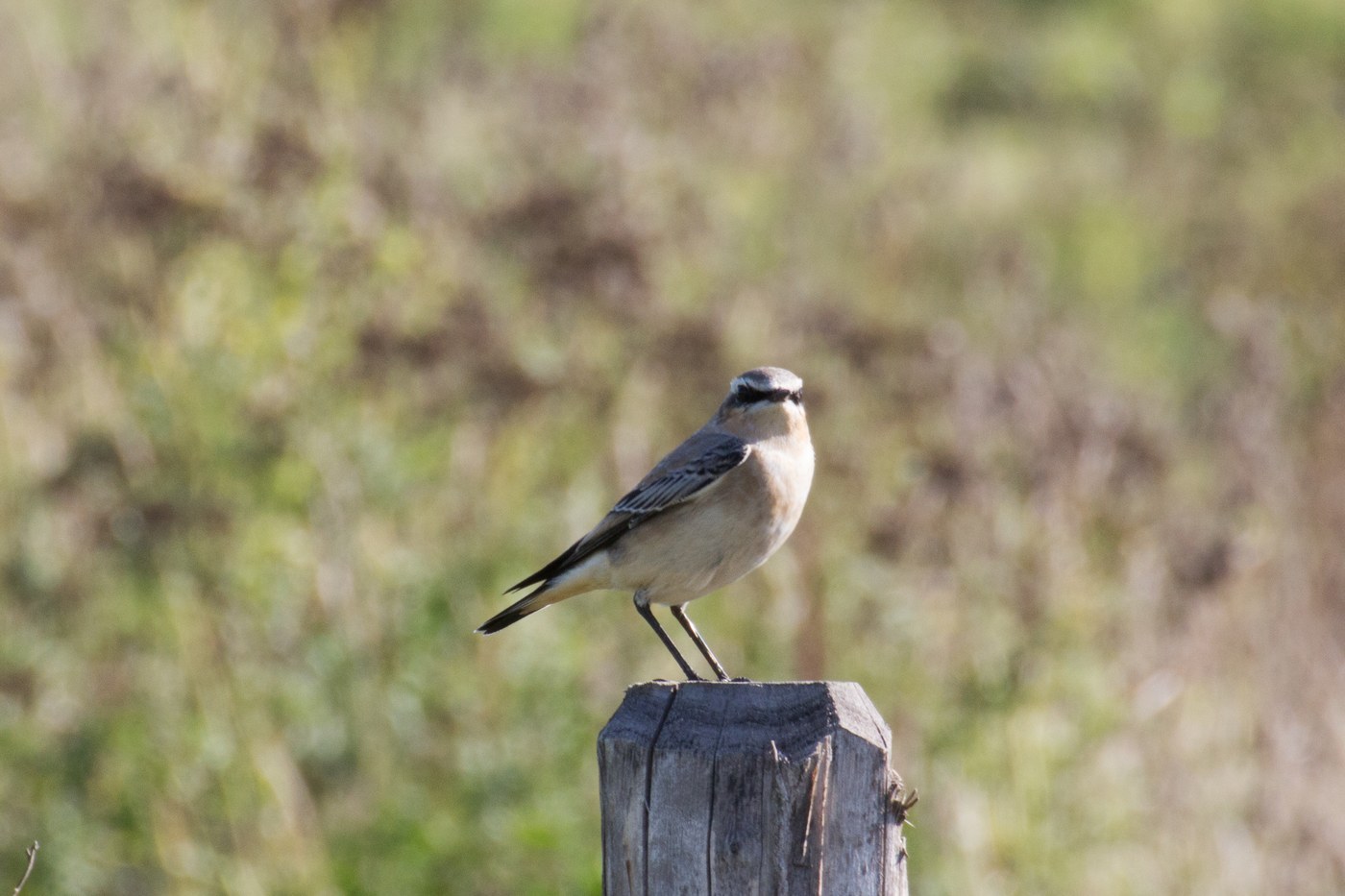
Northern Wheatear
Oenanthe oenanthe
An upright, ground-loving songbird of open country, instantly recognizable in flight by its bold white rump and one of the longest migrations of any small songbird.
- Size
- 14.5-15.5 cm (5.7-6.1 in) long, 26-32 cm wingspan
- Habitat
- open ground including moorland, heathland, coastal cliffs, tundra, and short grassland
- Type
- songbird
Spotted a bird like this?
Identify any bird from a photo, free.
Overview
The Northern Wheatear is a distinctive, upright songbird of bare and open ground, breeding across a vast range from western Europe to Alaska, and undertaking one of the longest migrations of any songbird its size to reach wintering grounds in sub-Saharan Africa.
Appearance
Breeding males have a blue-grey back, black face mask, and buffy-white underparts, with black wings contrasting against the paler body. Both sexes, in all plumages, share a distinctive white rump and black "T"-shaped tail pattern, conspicuous whenever the bird flies.
How to identify it
Key Field Marks
- Bold white rump, obvious in flight — the source of the bird's name ("white-arse" in Old English)
- Black "T"-shaped mark on the white tail
- Male: grey back, black face mask, buffy underparts
- Female/immature: browner, duller version of the same pattern, still showing the white rump
- Upright stance, frequent bobbing and bowing
Similar Species
Other, rarer wheatear species (such as Black-eared Wheatear or Isabelline Wheatear) can show broadly similar white-rump patterns but differ in overall structure, tail pattern extent, and face/throat coloring; the Northern Wheatear's combination of grey back, black mask, and buffy breast in breeding males is distinctive within its normal range.
Habitat & range
Habitat
Northern Wheatears favor open, often short-cropped or bare ground with good visibility — upland moorland, heathland, coastal grassland and cliffs, quarries, and arctic tundra — habitats that provide abundant surface-active insects and exposed perches such as rocks and fence posts.
Range and Migration
The species breeds across an enormous range spanning western Europe, through Scandinavia and Russia, and even into Greenland, Canada, and Alaska. All populations, including those breeding as far away as Alaska and eastern Canada, migrate to winter in sub-Saharan Africa — among the longest migrations undertaken by any songbird of its size.
Behavior & voice
Behavior
Northern Wheatears are active, ground-foraging birds, often seen perched upright on a rock, clod of earth, or fence post, then dropping to the ground to seize insect prey before flying to a new perch, frequently bobbing and bowing while calling.
Voice
The call is a hard, sharp "chack" or "tack," sometimes doubled. The song is a scratchy, varied warble, often incorporating mimicry of other bird sounds, delivered from a perch or in a brief fluttering song flight.
Nesting and Breeding
Wheatears nest in cavities — rabbit burrows, rock crevices, stone walls, or holes in the ground — lining the chamber with grass, moss, and hair. The female lays 5-6 pale blue eggs and incubates them for about 13-14 days.
Frequently asked questions
Why is it called a Wheatear?
The name is a folk corruption of an old English phrase referencing the bird's conspicuous white rump, visible whenever it flies or flicks its tail.
How far do Northern Wheatears migrate?
Remarkably far — even populations breeding in Alaska and eastern Canada cross to winter in sub-Saharan Africa, making journeys of many thousands of kilometers, among the longest migrations known for a songbird of its size.
Where do Northern Wheatears nest?
In cavities such as rabbit burrows, rock crevices, or holes in stone walls and banks, rather than in open cup nests in trees or bushes.
What is the easiest way to identify a Northern Wheatear in flight?
Look for the bold white rump and the black 'T'-shaped pattern on an otherwise white tail, visible on birds of both sexes and all ages.
Northern Wheatear guides
In-depth guides for identifying, finding, and understanding Northern Wheatear.
Other birds you may enjoy

Black Redstart
13-14.5 cm (5.1-5.7 in) long, 23-26 cm wingspan

Black-throated Sparrow
12-14 cm (4.7-5.5 in) long, about 19-20 cm (7.5-8 in) wingspan

Greater Bird-of-paradise
Body about 43 cm; males with additional flank plumes up to 50 cm and long tail wires

Blue Tit
11-12 cm (4.3-4.7 in) long, 17-20 cm wingspan

Red-billed Quelea
11.5–13 cm long, wingspan about 20–22 cm
White-plumed Antbird
13-14 cm (5-5.5 in) long

Pyrrhuloxia
19-22 cm (7.5-8.7 in) long, 30 cm wingspan

Blue-gray Tanager
16-18 cm (6-7 in) long

Blackburnian Warbler
11-13 cm (4.3-5.1 in) long, 20-22 cm wingspan

Bluethroat
13-14 cm (5.1-5.5 in) long, 20-22 cm wingspan

Eurasian Nuthatch
12-14.5 cm (4.7-5.7 in) long, 22.5-27 cm wingspan

Wood Thrush
19-21 cm (7.5-8.3 in) long, about 33 cm (13 in) wingspan