
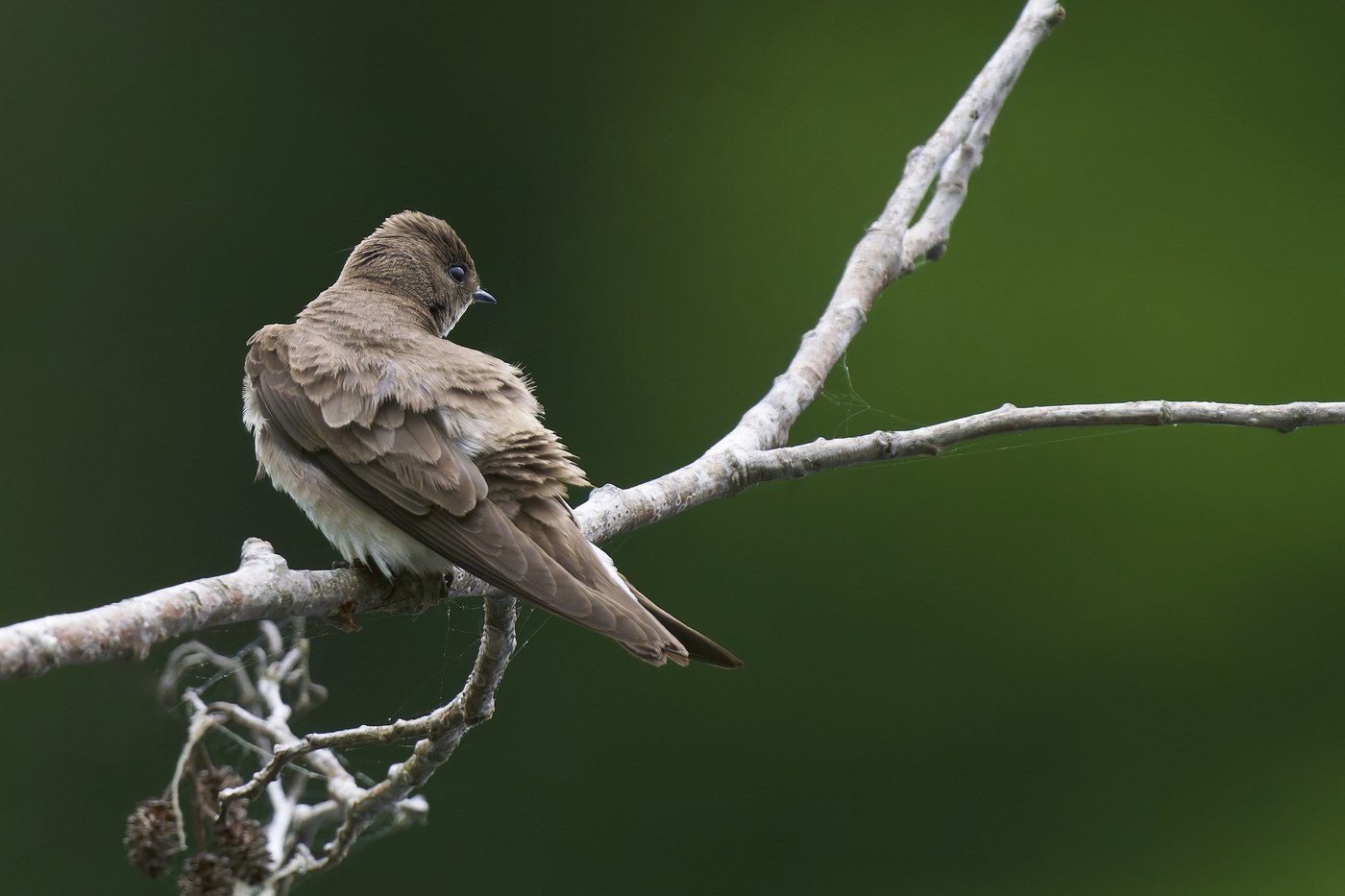
Northern Rough-winged Swallow
Stelgidopteryx serripennis
A plain brown swallow that nests in burrows in dirt banks, distinguished from other swallows by its uniform pale throat and lack of a breast band.
- Size
- 12-14 cm (4.7-5.5 in) long, 27-30 cm (10.6-11.8 in) wingspan
- Habitat
- riverbanks, road cuts, culverts, and open water edges with bare soil for burrowing
- Type
- songbird
Spotted a bird like this?
Identify any bird from a photo, free.
Overview
The Northern Rough-winged Swallow is a plain, uniformly brown swallow found across most of North America wherever open water and bare earthen banks occur together. Compared to other North American swallows, it is notably unadorned: brown above, with a pale grayish-brown throat and breast that fades gradually into a whitish belly, without a sharp breast band.
The species gets its name from tiny hooked barbs on the outer edge of the outermost primary feather, visible only in the hand, that give the wing a rough texture — the function of this feature is not fully understood.
How to identify it
Key field marks
- Plain brown upperparts, no iridescent sheen
- Dingy pale brownish-gray throat blending smoothly into a whitish belly (no sharp contrast)
- Squared or only slightly notched tail
- Broad-based wings and a somewhat heavier-headed look than other small swallows
Similar species
Bank Swallow has a crisp, well-defined brown breast band contrasting with a white throat and belly, unlike the smoothly graduated tones of Rough-winged Swallow. Tree Swallow shows a glossy blue-green back and sharply white underparts. Rough-winged Swallow's overall drab, unmarked plainness is its best clue.
Habitat & range
Habitat
Found near open water — rivers, streams, ponds, and lakes — wherever there are earthen banks, road cuts, gravel pits, or man-made structures such as culverts and drainpipes that provide burrow sites.
Range
Breeds across most of the United States, southern Canada, and Mexico. A migratory species, it winters from the southernmost U.S. through Mexico and Central America.
Behavior & voice
Behavior
Unlike the highly colonial Bank Swallow, Northern Rough-winged Swallows nest singly or in loose, small groups, often reusing burrows made by other animals such as kingfishers or rodents, or nesting in artificial cavities like drainpipes and culverts.
Voice
Calls are a series of low, buzzy, unmusical notes, less crisp than the calls of Bank or Tree Swallow; the species lacks a distinct song.
Feeding and nesting
Feeds on flying insects captured over water and open ground, typically foraging lower and more solitarily than other swallow species. Nests in a burrow (often self-dug into a soft dirt bank, or taken over from another species) lined with a simple mat of grass and, unlike Bank Swallow, generally does not nest in dense colonies.
Frequently asked questions
Why is it called "rough-winged"?
For tiny hooked barbs along the leading edge of the outermost wing feather that give it a rough texture to the touch, visible only up close.
How do you tell Northern Rough-winged Swallow from Bank Swallow?
Rough-winged Swallow has a plain, uniformly dingy throat and breast with no sharp band, while Bank Swallow shows a crisp brown breast band contrasting with a white throat and belly.
Where does the Northern Rough-winged Swallow nest?
In burrows in earthen banks, often reusing holes dug by other animals, or in artificial sites like drainpipes and culverts, usually singly rather than in large colonies.
What does a Northern Rough-winged Swallow eat?
Flying insects caught on the wing, typically foraged low over water or open ground.
Do Northern Rough-winged Swallows nest in colonies like Bank Swallows?
No, they typically nest alone or in small, loose groups rather than the large, dense colonies typical of Bank Swallow.
Northern Rough-winged Swallow guides
In-depth guides for identifying, finding, and understanding Northern Rough-winged Swallow.
Other birds you may enjoy

Black Redstart
13-14.5 cm (5.1-5.7 in) long, 23-26 cm wingspan

Black-throated Sparrow
12-14 cm (4.7-5.5 in) long, about 19-20 cm (7.5-8 in) wingspan

Greater Bird-of-paradise
Body about 43 cm; males with additional flank plumes up to 50 cm and long tail wires

Blue Tit
11-12 cm (4.3-4.7 in) long, 17-20 cm wingspan

Red-billed Quelea
11.5–13 cm long, wingspan about 20–22 cm
White-plumed Antbird
13-14 cm (5-5.5 in) long

Pyrrhuloxia
19-22 cm (7.5-8.7 in) long, 30 cm wingspan

Blue-gray Tanager
16-18 cm (6-7 in) long

Blackburnian Warbler
11-13 cm (4.3-5.1 in) long, 20-22 cm wingspan

Bluethroat
13-14 cm (5.1-5.5 in) long, 20-22 cm wingspan

Eurasian Nuthatch
12-14.5 cm (4.7-5.7 in) long, 22.5-27 cm wingspan

Wood Thrush
19-21 cm (7.5-8.3 in) long, about 33 cm (13 in) wingspan