
Northern Rough-winged Swallow Identification Guide
A plain brown swallow with a dingy, unmarked throat, easily overlooked among flashier swallows but told apart by its lack of a breast band and its harsh, buzzy call.
Read the full Northern Rough-winged Swallow encyclopedia entry →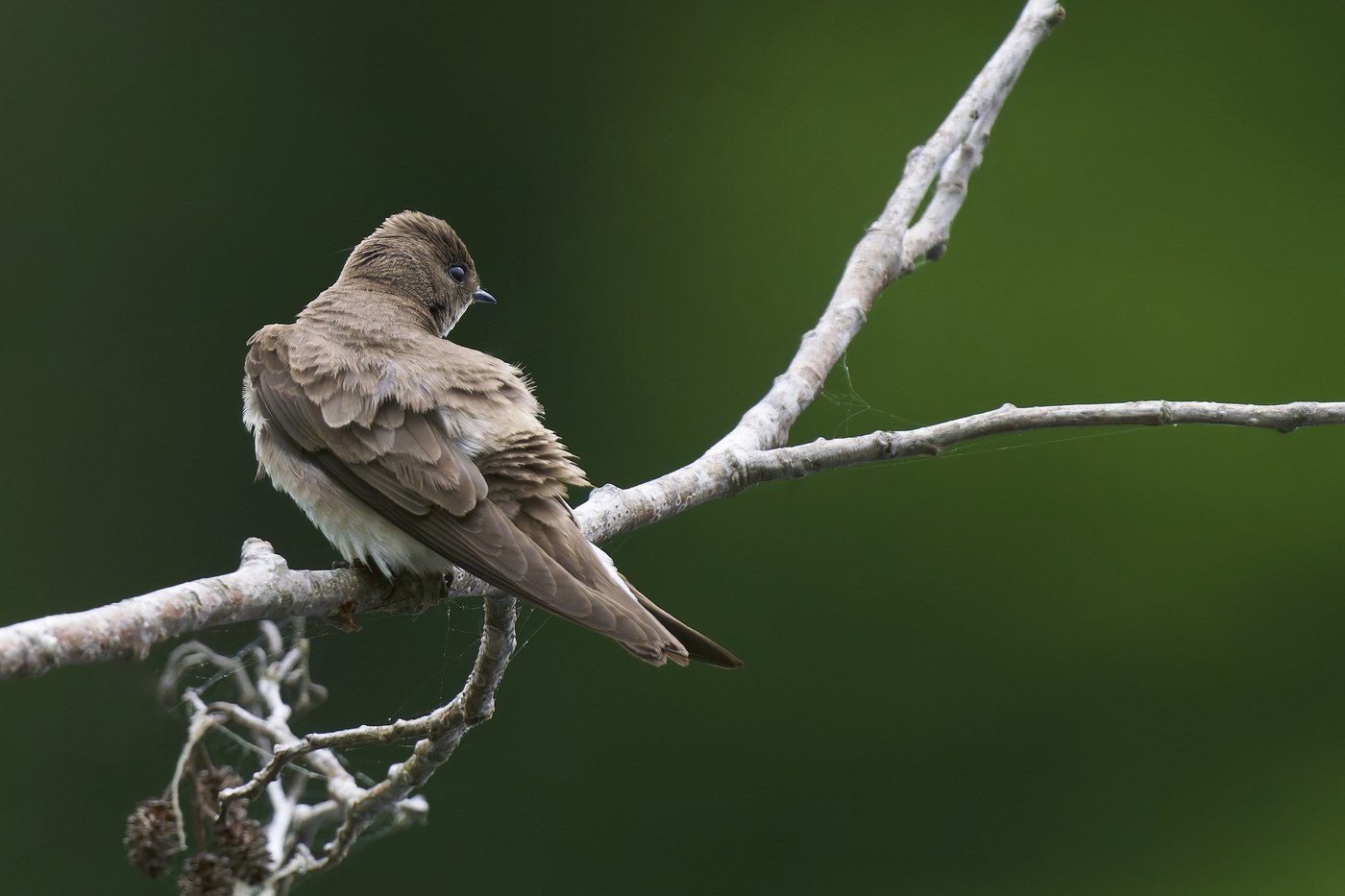
Key Field Marks
- Size & shape: Medium-small swallow (about 13 cm / 5 in) with broad-based wings and a squared to slightly notched tail.
- Upperparts: Plain grayish-brown, unglossed, with no white rump patch.
- Underparts: Dingy pale grayish-brown throat and breast fading gradually into a whitish belly — critically, there is no sharp breast band.
- Face: Plain, without a strong contrasting pattern; dark eye blends into the brownish face.
- Flight: Fairly slow, fluttery wingbeats compared to some other swallows, often gliding low over water.
Separating It From Similar Species
- Bank Swallow: Has a crisp, well-defined dark breast band across an otherwise white chest — the single most reliable difference from Rough-winged Swallow, which lacks any breast band.
- Juvenile Tree Swallow: Shows more contrast between a dark brownish-gray back/cap and clean white underparts, plus often a hint of a duskier breast band; adults have glossy blue-green backs and clean white bellies.
- Bank Swallow vs. Rough-winged in flight: Bank Swallows are smaller, quicker, and more likely in tight flocks; Rough-wingeds are usually seen singly or in loose groups.
Where & When to Look
- Habitat: Almost always near water — rivers, streams, lakes, ponds, and reservoirs — where it forages low over the surface for flying insects.
- Nesting: Nests in burrows in earthen banks, but readily uses artificial sites such as culverts, drainage pipes, bridge crevices, and quarry walls, unlike the colonial Bank Swallow which digs its own burrows in dense colonies.
- Range: Breeds across most of the U.S. and southern Canada; winters from the southern U.S. through Mexico and Central America.
- Season: Spring through summer breeder in northern range; one of the earlier spring swallow arrivals and among the latest to depart in fall.
Voice
- Calls are harsh, buzzy, and unmusical — a rough "brrt" or "jjzzt" — quite different from the more twittering, chattering calls of Tree or Barn Swallows, and fitting for a bird named for the serrated (rough) outer primary feather edge on adult males.
Frequently asked questions
How do I tell Northern Rough-winged Swallow from Bank Swallow?
Check the breast: Bank Swallow has a crisp dark breast band on white underparts, while Northern Rough-winged Swallow has a dingy, unmarked throat and breast that fades gradually to a whitish belly with no band.
Why is it called 'rough-winged'?
Adult males have tiny hooked barbs on the leading edge of the outermost primary feather that feel rough to the touch, a feature not visible in normal field viewing but the source of the name.
Where does Northern Rough-winged Swallow nest?
It nests in burrows or crevices in earthen banks, but very often uses human-made structures like drainage pipes, culverts, and bridge cavities rather than digging its own colony like Bank Swallow.
What does the call of a Northern Rough-winged Swallow sound like?
A harsh, buzzy, unmusical 'brrt' or 'jjzzt,' quite different from the more melodic twittering of Tree and Barn Swallows.