
Northern Raven
Corvus corax
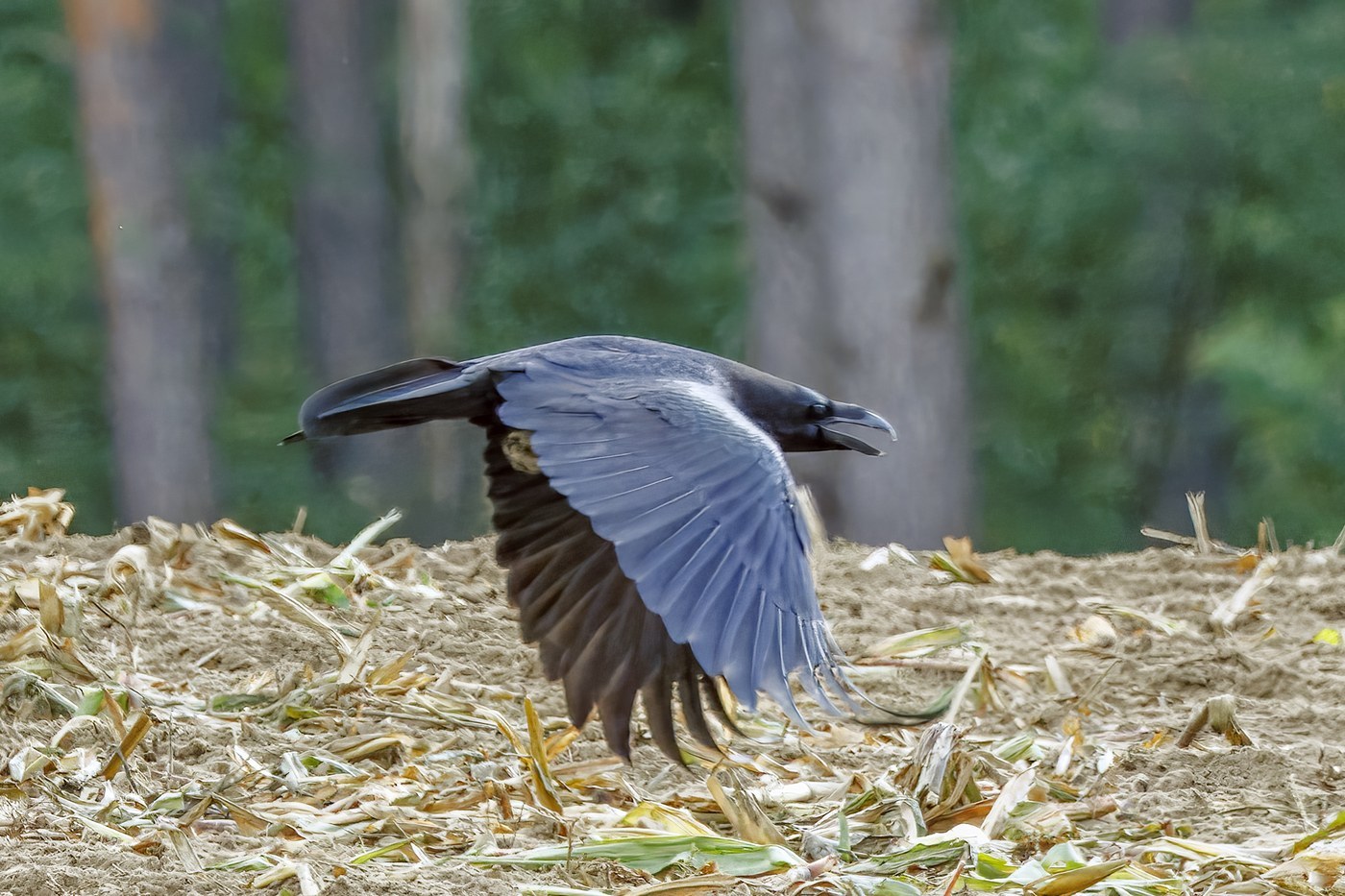
The largest of all songbirds, an immense, all-black corvid with a heavy bill, shaggy throat feathers and a wedge-shaped tail.
- Size
- 54–67 cm long, wingspan up to 150 cm
- Habitat
- Mountains, forests, coastlines, tundra, and deserts across the Northern Hemisphere
- Type
- songbird
Spotted a bird like this?
Identify any bird from a photo, free.
Overview
The Northern (Common) Raven is the largest member of the passerine order, a massive, all-black corvid with an imposing presence. It has a heavy, deep bill, shaggy "hackle" feathers on the throat that it can raise, and glossy black plumage with an iridescent purple-green sheen.
Ravens are powerful, agile fliers, often performing acrobatic rolls and dives, and are among the most cognitively sophisticated birds known, exhibiting complex problem-solving and social behavior.
They occupy an enormous geographic and elevational range, from Arctic tundra to desert canyons to high mountains, across most of the Northern Hemisphere.
How to identify it
Key field marks
- Very large size, clearly bigger than any crow
- Massive, deep-based bill
- Shaggy throat feathers (hackles), especially visible when calling
- Wedge-shaped or diamond-shaped tail in flight, versus the crow's fan-shaped tail
- Deep, resonant croaking call
Similar species
- Carrion Crow / Hooded Crow: much smaller, with a slimmer bill, smooth throat feathering, and a squared or rounded tail in flight
- Rook: smaller still, with a bare pale face patch and social flocking habits
Behavior cues
Ravens are usually seen alone or in pairs soaring on flat wings with frequent glides, unlike the more flapping flight of crows; the wedge-shaped tail is often the best flight-silhouette clue.
Habitat & range
Habitat
Extremely adaptable, found in mountains, coniferous and mixed forests, coastal cliffs, tundra, grasslands, and deserts.
Range
One of the most widely distributed birds in the world, occurring across North America, Europe, North Africa, and Asia — essentially circumpolar across the Northern Hemisphere.
Migration
Largely resident and territorial year-round, though young, non-breeding birds may wander widely or form nomadic flocks before establishing territories.
Behavior & voice
Behavior
Ravens are highly intelligent, forming long-term pair bonds and defending large territories. They are known for playful behavior, including aerial acrobatics, and for sophisticated problem-solving, tool use, and caching of food with apparent awareness of being watched by rivals.
Voice
A deep, resonant "gronk" or croaking call, along with a wide repertoire of other sounds including knocks, rattles, and even mimicked noises.
Feeding
An opportunistic omnivore and scavenger, eating carrion, small mammals, birds, eggs, insects, and grain, and often the first scavenger to find large carcasses.
Nesting and breeding
Builds a large stick nest on a cliff ledge, in a tall tree, or on a human structure, reused and added to over multiple years. Clutches typically contain 3–7 eggs, incubated by the female.
Frequently asked questions
How big is a raven compared to a crow?
Ravens are significantly larger than crows, with a heavier bill, shaggy throat feathers, and a wingspan that can reach 150 cm.
How can you tell a raven from a crow in flight?
Ravens have a wedge- or diamond-shaped tail and often soar on flat wings, while crows have a fan-shaped tail and flap more steadily.
What does a raven sound like?
Ravens give a deep, resonant croaking "gronk" call, distinct from the higher-pitched "caw" of crows.
Where do ravens live?
Ravens have one of the widest ranges of any bird, found across mountains, forests, tundra, coasts, and deserts throughout the Northern Hemisphere.
Are ravens intelligent?
Yes, ravens are considered among the most intelligent birds, with advanced problem-solving abilities and complex social behavior.
Northern Raven guides
In-depth guides for identifying, finding, and understanding Northern Raven.
Other birds you may enjoy

Black Redstart
13-14.5 cm (5.1-5.7 in) long, 23-26 cm wingspan

Black-throated Sparrow
12-14 cm (4.7-5.5 in) long, about 19-20 cm (7.5-8 in) wingspan

Greater Bird-of-paradise
Body about 43 cm; males with additional flank plumes up to 50 cm and long tail wires

Blue Tit
11-12 cm (4.3-4.7 in) long, 17-20 cm wingspan

Red-billed Quelea
11.5–13 cm long, wingspan about 20–22 cm
White-plumed Antbird
13-14 cm (5-5.5 in) long

Pyrrhuloxia
19-22 cm (7.5-8.7 in) long, 30 cm wingspan

Blue-gray Tanager
16-18 cm (6-7 in) long

Blackburnian Warbler
11-13 cm (4.3-5.1 in) long, 20-22 cm wingspan

Bluethroat
13-14 cm (5.1-5.5 in) long, 20-22 cm wingspan

Eurasian Nuthatch
12-14.5 cm (4.7-5.7 in) long, 22.5-27 cm wingspan

Wood Thrush
19-21 cm (7.5-8.3 in) long, about 33 cm (13 in) wingspan