
Northern Raven Identification Guide
The largest all-black songbird in the northern hemisphere, told from crows by its bigger size, wedge-shaped tail, shaggy throat, and deep croaking voice.
Read the full Northern Raven encyclopedia entry →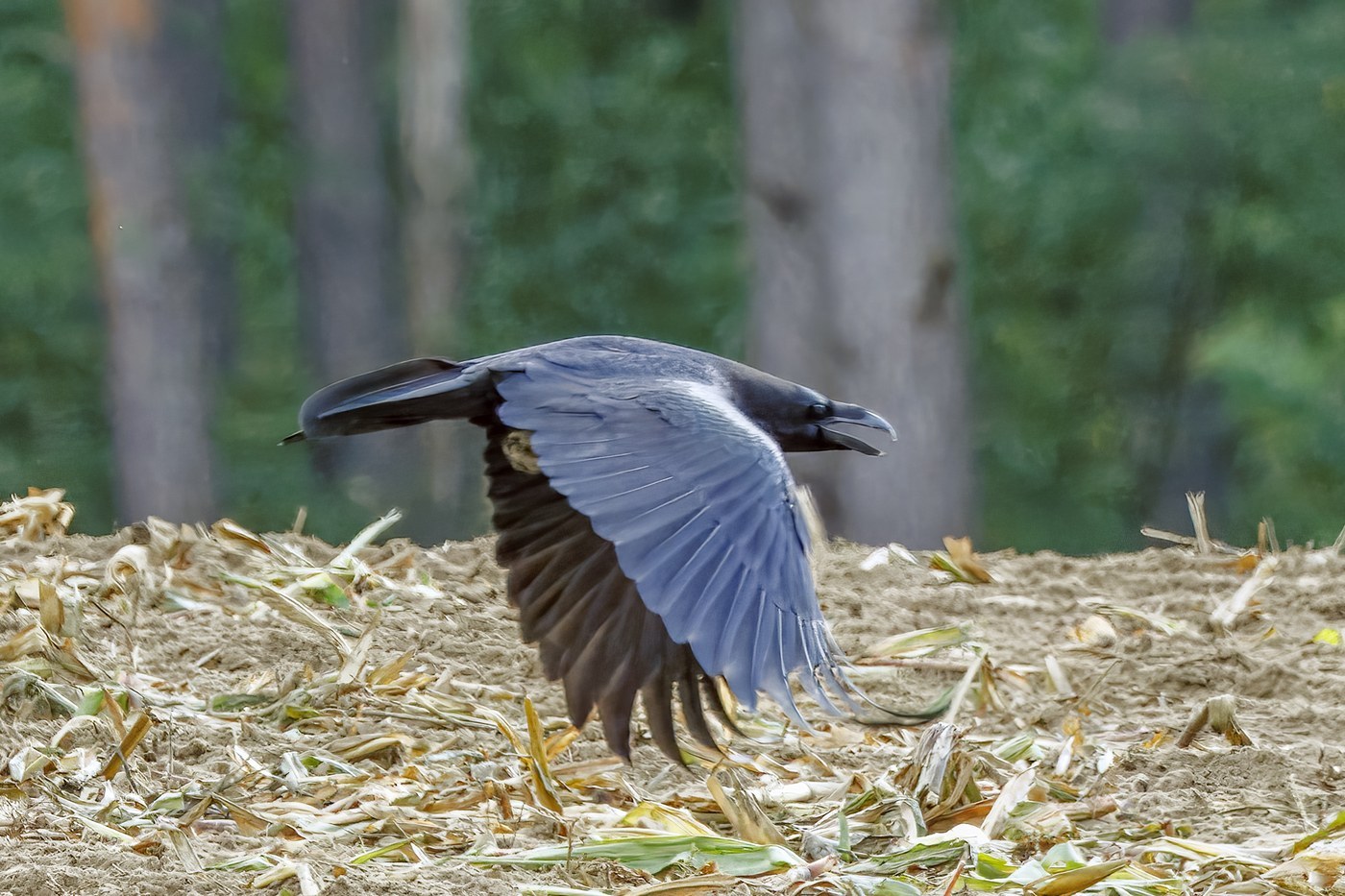
Key Field Marks
- Size & shape: A very large corvid (54–67 cm / 21–26 in), noticeably bigger and bulkier than any crow, with a heavy, raptor-like build in flight.
- Bill: Large, deep, and strongly curved at the tip, often looking oversized for the head.
- Throat: Shaggy, elongated throat feathers ("hackles") visible when the bird calls or the wind ruffles its plumage.
- Tail: Distinctly wedge-shaped (diamond-shaped) in flight — the single best silhouette clue, versus the fan- or square-tipped tail of crows.
- Plumage: Entirely glossy black with a purplish-blue sheen in good light; sexes look alike.
Separating It From Similar Species
- American Crow: Smaller, with a fan-shaped tail (straight or rounded trailing edge, never pointed), a smaller bill, no shaggy throat hackles, and a nasal "caw" instead of a deep croak. Crows flap almost continuously in flight, while ravens soar and glide on flat or slightly arched wings for long stretches, often riding thermals like a hawk.
- Chihuahuan Raven: Smaller-billed, with white (not gray) feather bases at the neck (usually not visible in the field), and a higher-pitched, less resonant croak; range overlaps mainly in the arid Southwest.
- Fish Crow: Even smaller than American Crow, with a distinctive nasal "uh-uh" call, found along the Atlantic/Gulf coasts and river systems, well outside typical raven silhouette size.
Where & When to Look
- Habitat: Extremely adaptable — found in coniferous and mixed forests, mountains, tundra, coastlines, deserts, and increasingly in cities and towns.
- Range: Resident across most of Canada, Alaska, the western and northeastern U.S., and much of the Northern Hemisphere; expanding into some Midwestern and eastern areas historically dominated by crows.
- Season: Present year-round wherever established; pairs are territorial and often mate for life.
Behavior & Voice
- Highly intelligent, often seen in playful aerial tumbles, rolls, and dives, sometimes carrying and dropping objects in flight.
- Usually seen singly or in pairs (unlike the large communal flocks crows can form), though non-breeding birds may gather at food sources.
- Voice is a deep, hollow, croaking "gronk-gronk" or "prruk," along with a wide repertoire of clicks, knocks, and other sounds — much lower and more guttural than a crow's caw.
Frequently asked questions
What is the easiest way to tell a raven from a crow?
Look at the tail shape in flight: ravens have a wedge-shaped tail while crows have a fan-shaped or squared tail. Ravens are also larger, soar more, and give a deep croak instead of a caw.
Do ravens and crows live in the same areas?
Yes, their ranges broadly overlap across much of North America, though ravens tend to favor more remote, forested, mountainous, or coastal areas while crows are more common around farmland, suburbs, and cities — this is a tendency, not a strict rule.
Why does a raven's throat look shaggy?
Ravens have elongated, pointed throat (hackle) feathers that they can raise, especially when calling or displaying, giving the throat a ragged, bearded appearance not present in crows.
Are ravens seen in large flocks like crows?
Typically no — ravens are usually seen alone, in pairs, or in small family groups, whereas American Crows regularly gather in large flocks, especially at winter roosts.