
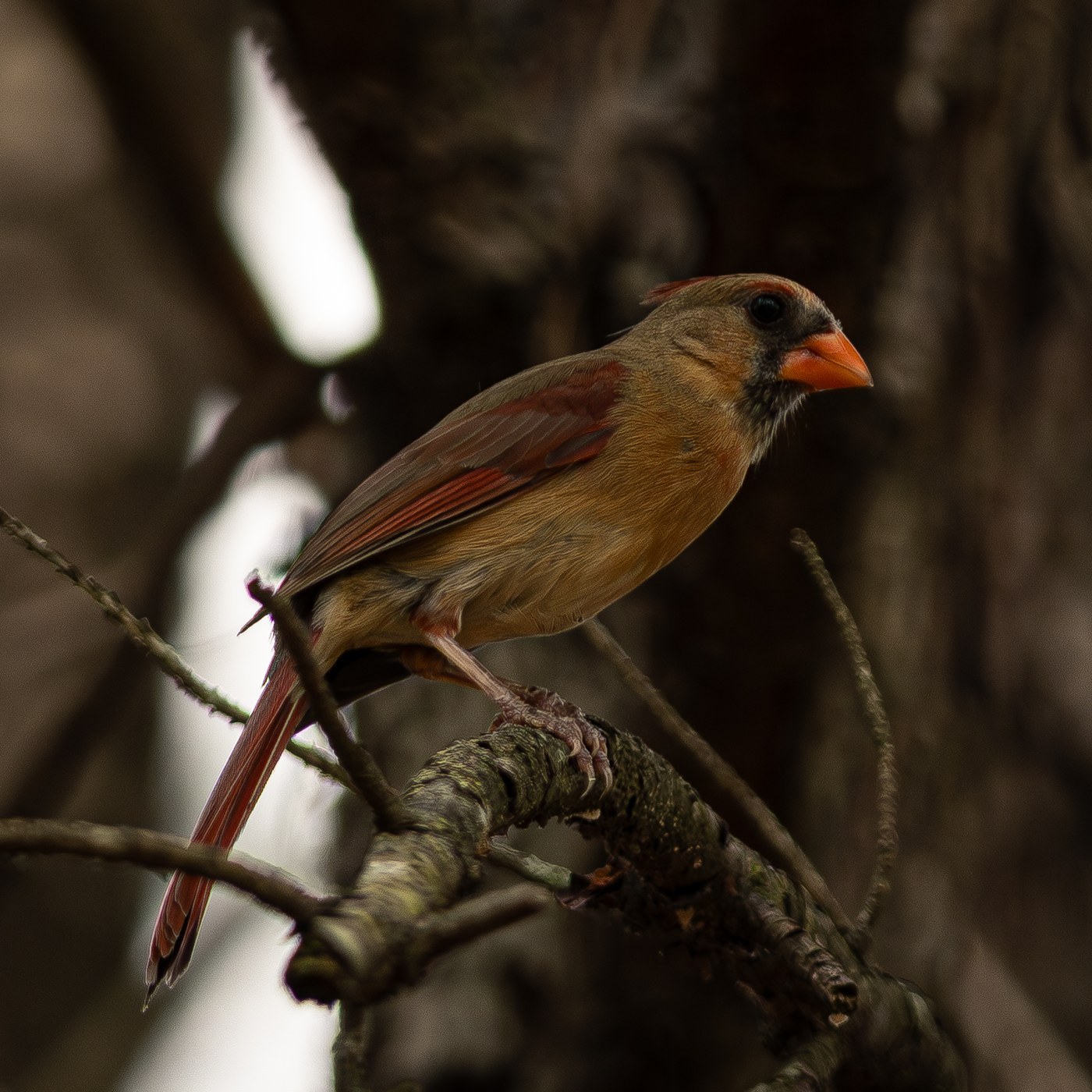
Northern Cardinal
Cardinalis cardinalis
A brilliant all-red songbird with a prominent crest and thick orange-red bill, common at backyard feeders across the eastern and central U.S.
- Size
- 21-23 cm (8-9 in) long, 25-31 cm (10-12 in) wingspan
- Habitat
- woodland edges, thickets, gardens, shrubby suburban yards
- Type
- songbird
Spotted a bird like this?
Identify any bird from a photo, free.
Overview
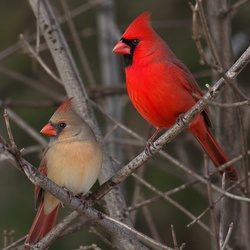
The Northern Cardinal is a striking, non-migratory songbird and a beloved backyard visitor across much of the eastern and central United States. Males are unmistakable: an overall vivid red plumage, a black mask around the face and throat, and a tall pointed crest. Females are more subdued, warm buffy-brown overall with reddish tinges on the crest, wings, and tail, and they share the same thick, cone-shaped orange-red bill.
Both sexes have the crest, which they can raise or lower depending on mood, and both sing, which is relatively unusual among North American songbirds. Cardinals are a favorite for their color, their willingness to visit feeders, and their frequent presence as a familiar backyard companion year-round.
How to identify it
Key Field Marks
- Prominent pointed crest on the head
- Thick, cone-shaped, bright orange-red bill
- Males: entirely vivid red with a black face mask
- Females: warm brown with red tinges on wings, tail, and crest
Similar Species
- Summer Tanager (male): also red, but lacks a crest and has a duller bill without the black facial mask.
- Scarlet Tanager (male): bright red with black wings, unlike the cardinal's uniformly red body and crest.
- Pyrrhuloxia (southwestern deserts): gray overall with red highlights and a stubby yellow bill, found in a different range than most cardinals.
Habitat & range
Habitat
Cardinals favor dense shrubby vegetation, woodland edges, thickets, hedgerows, and well-vegetated gardens and suburban yards where they can find cover and food close together.
Range
They are resident from the eastern and central United States (roughly from the Great Plains eastward) south through Mexico and parts of Central America; the species has also expanded its range northward over the past century into parts of the northeastern U.S. and southeastern Canada.
Migration
Northern Cardinals are non-migratory and defend territories year-round, though in winter they may form loose flocks and forage more widely, especially around feeders.
Behavior & voice
Behavior
Cardinals are often seen in pairs, with the male frequently feeding the female during courtship in a bill-to-bill exchange. They are somewhat shy but readily come to feeders, especially for sunflower seeds.
Voice
Both males and females sing loud, clear, whistled songs, often rendered as "cheer, cheer, cheer" or "birdy, birdy, birdy," with many song variations. The common call is a sharp, metallic "chip."
Feeding
Their stout bill is well suited to cracking seeds; they eat a variety of seeds, grains, and fruit, supplemented with insects, especially when feeding nestlings.
Nesting & Breeding
The female builds a cup nest of twigs, bark strips, and leaves in dense shrubs or low trees, typically laying 2-5 eggs. Pairs can raise two or three broods per year, and males continue feeding fledglings while females start a new nest.
Frequently asked questions
Why are only male cardinals red?
Males have evolved bright red plumage largely through sexual selection for mate attraction and signaling fitness, while females have cryptic brownish plumage that helps camouflage them while incubating eggs on the nest.
Do female cardinals sing?
Yes, female cardinals sing, which is relatively uncommon among North American songbirds; females often sing from the nest, possibly to communicate with their mate.
Do Northern Cardinals migrate?
No, cardinals are year-round residents throughout their range and do not undertake seasonal migration.
What do cardinals eat at bird feeders?
They are especially fond of sunflower seeds and safflower seeds, and will also eat cracked corn and other mixed seed.
Why do cardinals appear at dawn and dusk?
Cardinals are often among the first birds to sing and forage at dawn and the last to feed at dusk, a pattern related to their preference for low-light foraging in dense cover.
Northern Cardinal guides
In-depth guides for identifying, finding, and understanding Northern Cardinal.
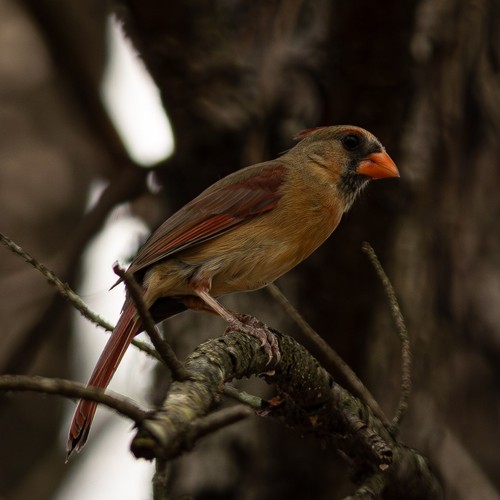
Northern Cardinal identified by the community
Real birds identified with Bird Identifier.

Other birds you may enjoy

Black Redstart
13-14.5 cm (5.1-5.7 in) long, 23-26 cm wingspan

Black-throated Sparrow
12-14 cm (4.7-5.5 in) long, about 19-20 cm (7.5-8 in) wingspan

Greater Bird-of-paradise
Body about 43 cm; males with additional flank plumes up to 50 cm and long tail wires

Blue Tit
11-12 cm (4.3-4.7 in) long, 17-20 cm wingspan

Red-billed Quelea
11.5–13 cm long, wingspan about 20–22 cm
White-plumed Antbird
13-14 cm (5-5.5 in) long

Pyrrhuloxia
19-22 cm (7.5-8.7 in) long, 30 cm wingspan

Blue-gray Tanager
16-18 cm (6-7 in) long

Blackburnian Warbler
11-13 cm (4.3-5.1 in) long, 20-22 cm wingspan

Bluethroat
13-14 cm (5.1-5.5 in) long, 20-22 cm wingspan

Eurasian Nuthatch
12-14.5 cm (4.7-5.7 in) long, 22.5-27 cm wingspan

Wood Thrush
19-21 cm (7.5-8.3 in) long, about 33 cm (13 in) wingspan