Northern Cardinal Identification Guide
A brilliant all-red songbird with a spiky crest and thick orange bill, one of the most familiar backyard birds across the eastern and central United States.
Read the full Northern Cardinal encyclopedia entry →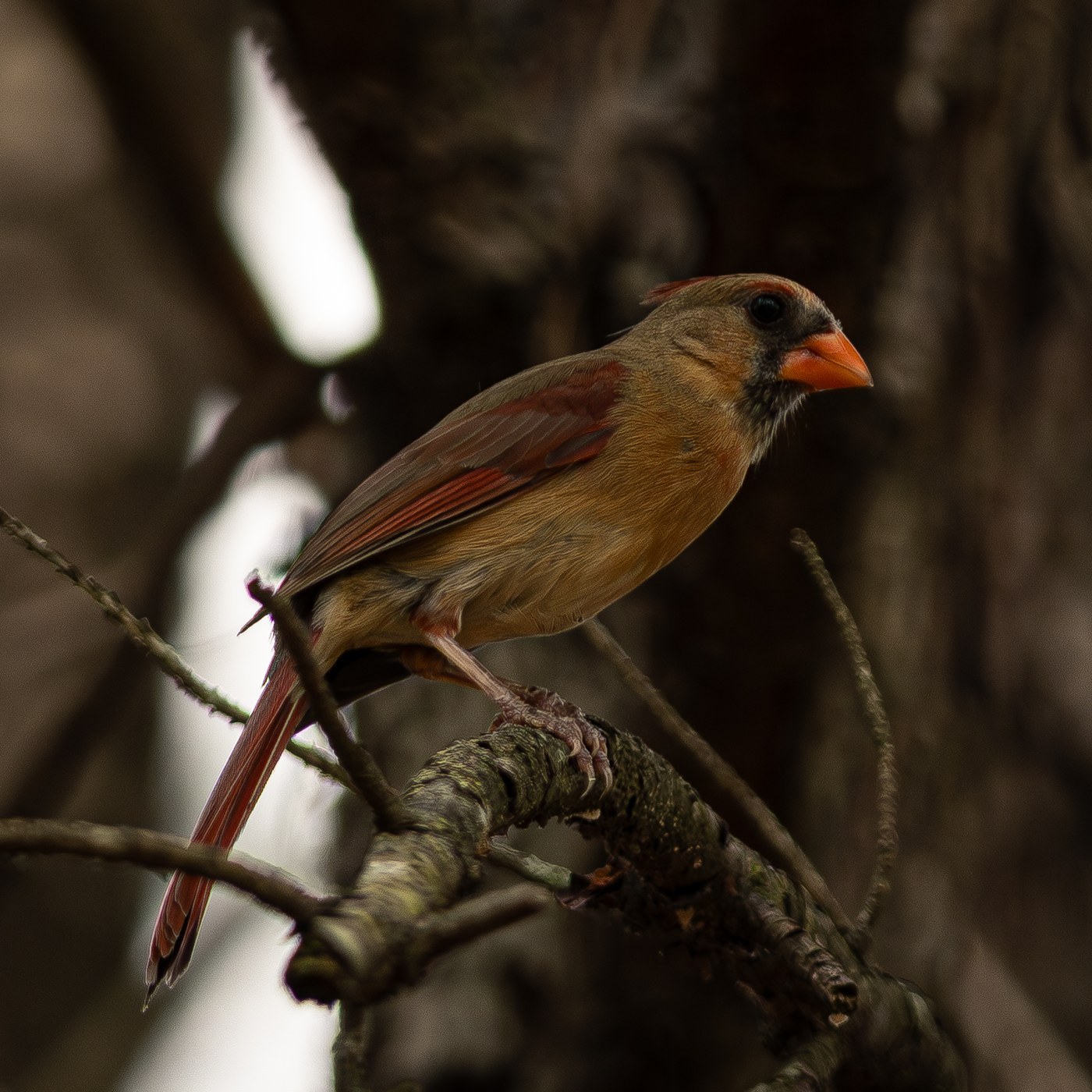
Overview
The Northern Cardinal (Cardinalis cardinalis) is a stocky, crested songbird found year-round in gardens, woodland edges, and thickets across the eastern and central U.S., the desert Southwest, and Mexico. Its brilliant color and cheerful whistled song make it a favorite backyard bird and a frequent visitor to seed feeders.
Key Field Marks
- Size & shape: A medium-sized songbird, about 8.5–9 inches long, with a long tail, a prominent pointed crest, and a massive, thick, cone-shaped bill built for cracking seeds.
- Male plumage: Brilliant overall red with a black mask extending from the face to the throat, and a bright coral-orange to red bill.
- Female plumage: Warm buffy-brown to olive overall, with reddish tinges on the crest, wings, and tail, and the same black face mask (though less extensive) and orange-red bill as the male.
- Bill color: In both sexes, the thick orange-red bill stands out strongly against the plumage and is a reliable mark even on female or juvenile birds.
- Behavior: Often seen in pairs year-round; feeds on the ground or at feeders, hopping rather than walking, and frequently perches conspicuously in the open to sing or scold.
Similar Species
- Summer Tanager males are also all red but lack a crest and have a shorter, less conical, pale (not orange) bill.
- Pyrrhuloxia (arid Southwest) is gray overall with red highlights and a stubby, curved yellow bill, distinctly different from the cardinal's straight orange bill and, in males, solid red body.
- Vermilion Flycatcher males are bright red but much smaller, slimmer-billed, and lack a crest.
- No other North American songbird combines an all-red body, black face mask, tall crest, and thick orange bill the way the male cardinal does, making adult males essentially unmistakable.
Where & When to Find One
Northern Cardinals are non-migratory and present year-round throughout their range, from southern Canada and the northeastern U.S. south through Texas, the Gulf Coast, and into Mexico, with an introduced/expanded range in the desert Southwest. They favor dense shrubby cover, woodland edges, hedgerows, and suburban gardens, and readily come to feeders offering sunflower seed. Look for them at dawn and dusk when they are most vocal and active, often low in thickets or perched on shrub tops.
Voice
Both sexes sing (unusual among North American songbirds), producing a series of clear, loud whistled phrases often rendered as "cheer-cheer-cheer" or "birdy-birdy-birdy," as well as a sharp, metallic "chip" note used as a contact and alarm call year-round.
Frequently asked questions
How do I tell a male from a female Northern Cardinal?
Males are brilliant all-red with a black face mask; females are warm brown to olive with reddish tinges on the crest, wings, and tail, but both share the same thick orange-red bill and crest.
What bird looks like a cardinal but isn't red?
The female Northern Cardinal is often mistaken for a different species because of her tan-brown coloring, but her crest, black face, and orange bill confirm she's a cardinal, not a separate bird.
How is a cardinal different from a Pyrrhuloxia?
Pyrrhuloxia is mostly gray with red accents and has a short, curved, pale yellow bill, while the cardinal has a straight, thick orange-red bill and, in males, an entirely red body.
Do Northern Cardinals migrate?
No, cardinals are year-round residents throughout their range and do not migrate, which is why pairs can often be seen at the same feeder in every season.
What does a Northern Cardinal's song sound like?
A loud series of clear whistled phrases, commonly described as 'cheer-cheer-cheer' or 'birdy-birdy-birdy,' sung by both males and females.
Northern Cardinal identified by the community
Recent Northern Cardinal sightings identified with Bird Identifier.